 On the 8th April 2016 I’ll present All the World’s a Stage! in Barking and Dagenham libraries. Barking and Dagenham have set up these Eventbrite links for people to register their interest in the event.
Category Archives: Children
Coming 1st June 2016..

Happy World Book Day!
Space and time travel stories
 Here is a set list for a space and time travel session I am preparing. Each of these stories has a some kind of link to space and time travel (albeit sometimes that link is tenuous!)
How the earth was made (Native American – a similar story exists in several tribes folklore)
The three wise astronomers (English – based upon the tradition of English devil tales in which the devil is outwitted)
Urashima Taro (Japanese folk tale about a time travelling fisherman)
The archer and the ten suns (Chinese legend explaining how the sun and stars took their place in the heavens)
The proud turtle (Filipino story about a Turtle who wants to fly)
The boy and the moon (Turkish story about a boy who finds the moon in a well!)
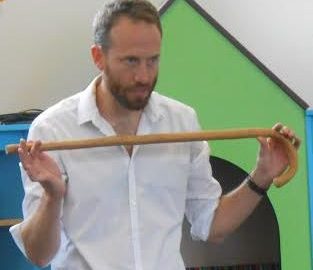
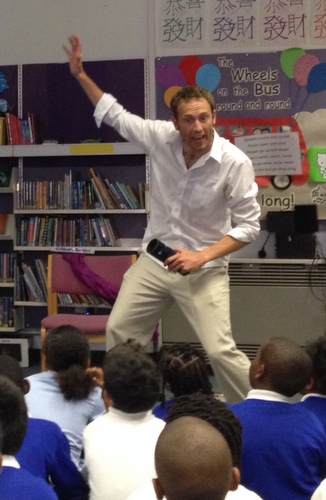
I’ve never found space and time travel to be that easy a theme to get into but I have really enjoyed this opportunity to research and interpret these stories. Having said that, the image above is taken from a piece I was presenting in 2009 about the irrepressible Professor Montague Rumpleseed Drake who lead audiences through British history on a time travelling adventure. Then I presented a piece about Dewey Fiction exploring literacy in space (see image below). Looking back on these stories now it seems like a lifetime ago!
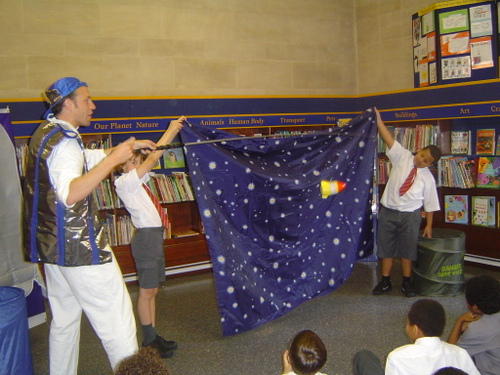 I digress. As I was researching these space and time travel stories I found that some of these tales have many variations and that choosing the best version could be tricky. In some instances I have mixed up different versions of the same story (ie where I liked the beginning of one and the ending of another). This might be considered by a purist or an anthropologist to be an affront to culture and of course I’m sensitive to that but on this occasion my choices have been thematic.
Whenever I prepare a story session there are lots of perfectly good stories which bear inclusion(there are no end to the European folk tales I could tell) but I think its important that a storyteller enjoys the story they are telling and that this is part of the reason I get good feedback. Hopefully I do this set of stories justice and that my audience is inspired to discover the different variations for themselves.
Happy half term!
 When I travel about the place I tend to forget stuff (I recently left a bag on a train back from Manchester). Here’s a short poem about the effect of leaving things at home.
When I spend a night away
I pack a bag for where I’ll stay
I’ll put in socks and pants and stuff
(pyjamas and a shirt’s enough).
As I’m leaving, in my rush
I always forget my toothbrush.
This regular lapse of memory
means that in my bathroom, I have three!
The toothbrush collection causes a stink
they take up room around the sink.
The soap is squeezed to find a space
there’s just enough for my toothpaste.
Three is company and very nice
but I don’t brush my teeth three times!
This trio make the bathroom hectic
and there’s a fourth (it’s electric!)
Next time that I’m on a trip
I really need to plan for it.
Somehow or other I have to stop
buying toothbrushes from the corner shop.
But if I’m away and I’ve forgotten
another one would not be rotten.
Owning five might seem obscene
but at least I’m committed to oral hygiene!
I really did go on a Bear Hunt!
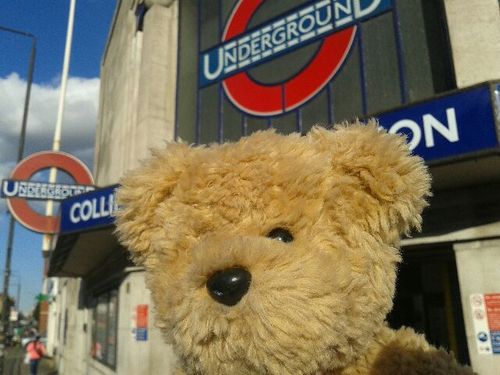 The following is the true story of what happens when you lose a prop which also happens to be your wife’s Teddy Bear told in the style of Michael Rosen’s “We’re Going on a Bear Hunt”.
….
We’re going on a Bear Hunt to entertain some children. What a beautiful day! But where is teddy?
Is he in the cupboard? My higgledy, piggledy cupboard?
I really need him and I can’t find him.
Oh no! I hope I haven’t lost him!
Crash, bash, crash, bash!
[An evening spent turning the house upside down later]
We’re going on a Bear Hunt to entertain some children. What a beautiful day! But where is teddy?
Is he at a school? A very, busy school?
I really need him and I can’t find him.
Oh no! I’ll have to try to contact them.
Tip, tap, tip, tap!
[An e-mail correspondence later]
 We’re going on a Bear Hunt to entertain some children. What a beautiful day!
But where is teddy?
Is he in Merton? In far away Merton?
I really need him and I can’t find him.
Oh no! I’ll have to go down there and get him.
Chug, chug, chug, chug!
[An hour and half on the tube later]
We’re going on a Bear Hunt to entertain some children. What a beautiful day! But where is teddy?
Is he in the staffroom? The warm and cosy staffroom?
I really need him and THEY can’t find him.
Oh no! Lauren’s going to kill me!
But who is this creature, with furry ears…
…. a red bow …
… whose been waiting 12 weeks to be collected.
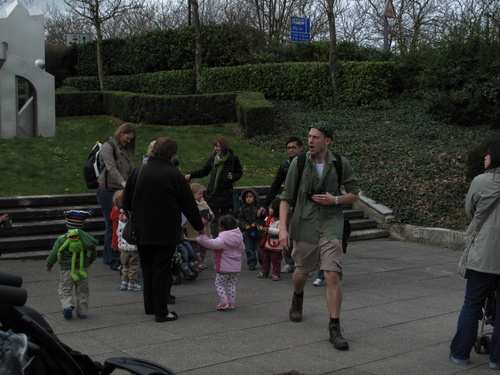 It’s teddy!
Quick, out of the school…
…. down the street …
…. into the Underground.
Announcement: “This train is being held here to regulate the service.”
Uhhh….
….. I’m not going on a Bear Hunt anymore!
NB: Teddy has now officially retired from show business and will spend his retirement on my wife’s bedside table.
Take good care of your props and ask before you borrow things.
Got any ID?
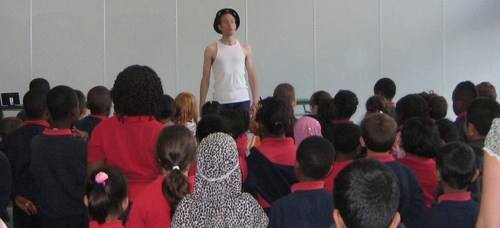 Recently I worked at a school which had a security door between its reception area and class rooms. The male staff toilet being in the reception area I found myself following a Dinner Lady into the main part of the school. The conversation went like this:
“The Dinner Lady: Are you supposed to be in here?
Me: I think so.
The Dinner Lady: Well, you have to ask.”
I have worked with young people for a long time and know that protecting children shouldn’t be a laughing matter but this time I did have a little chuckle. I confess that on this occasion my visitor’s badge wasn’t visible and it’s only fair for strangers to expect to be challenged when following people into restricted areas but I had only popped to the toilet…
… dressed as a Fairy Tale Prince.
Who’s in the audience?
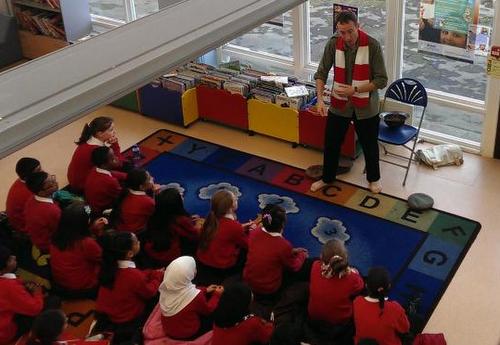 I have spoken about concentration and the fact that my work can be an audience training ground before, but I’d like to take a moment to consider some of the different characters you might find in an audience. I am neither a scientist or a psychologist but based on my experience the following six characters are amongst those that make up audiences of young people.
(A) participates boisterously. (A) will talk about the presentation during the presentation, calling out and is always a willing volunteer.
(B) participates enthusiastically. Like (A), (B) is a willing volunteer but will reserve their verbal participation for when it is encouraged.
(C) participates attentively. (C) listens hard but is more reserved than (A) or (B). (C) is more likely to share their thoughts and feelings privately.
(D) participates distractedly. (D) is a willing volunteer but is as likely to watch other audience members as the presentation. Dominant audience types are tricky for (D).
(E) participates dangerously. (E) is like (A) but their chat is off topic and can be destructive or aggressive. They are different to (F) because they are prepared to be convinced by the presentation.
(F) participates inappropriately. For one reason or another (F) cannot engage with the presentation. Where this is a choice rather than circumstances (F) is more challenging. (F) can manifest actively or passively and may leave the presentation (this ejection may be their choice or sadly somebody else’s).

We may not see these characters as clearly in older audiences because of social and economic factors but they might help to explain the behaviour of adults during presentations for young people.
We could analyse these character traits further but suffice to say audiences are unique and rightly or wrongly, my expectation of an audience will vary according to the environment, the occasion and the content of the story. In my experience (B) and (C) make up the largest parts of an average audience of children and thankfully I rarely see (E) or (F) but part of my role is to prepare and respond to different crowds. For some, sitting through the entire story will be an achievement where for others articulating why they liked, disliked or preferred another story will define appropriate participation.
Whilst the make up of the audience will influence the presentation it doesn’t change my job; to share a story. Now here’s my question to you, what type of audience member are you?
Wanted: Children’s Author for SRC 2015
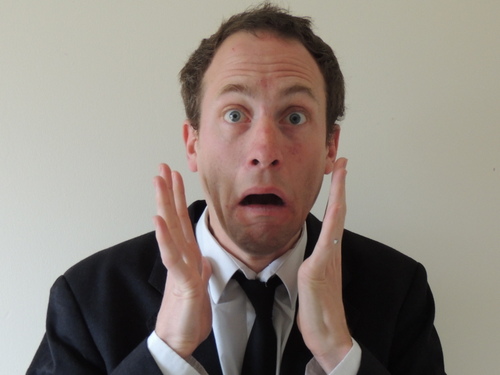 I am currently searching for an author to work with or a story to tell as part of the Summer Reading Challenge (SRC) 2015. As well as consulting librarians and scouring book shelves I am publishing this blog as part of my search. The reason I am publishing this post is to find the right story for the project but also to offer an opportunity to aspiring authors of children’s books. If you are reading this and are already thinking “I know a story” or “I have a story” or “I know somebody who might have a story” then please read on…
This is the criteria for stories I am considering:
– It must be suitable for children age between 4 and 11 years old.
– It must fit the Summer Reading Challenge theme “Record Breakers” (so stories about extraordinary achievements, world firsts or races would be perfect).
– The author/publisher must be prepared to sanction my storytellings between June and October 2015 (if you are just suggesting a possible title – you aren’t the author or publisher – then I will make the necessary approaches).
– It would be an advantage if the work is published and available for the audience to borrow/buy.
As I say, this post is part of a wider consultation that I am running until the end of February 2015. I cannot guarantee that your suggestion will be taken on as the final project but if you know a story or know somebody who might have a story then contact me.
Thanks for your support.
Wave your Flag
 “Did you see Dolly?” That is usually the first question I am asked when I admit that I went to the Glastonbury Festival 2014. My audience is then disappointed to learn that I went to watch Michael Rosen instead of the first lady of Country Music.
What I did see at Glastonbury were flags. Hundreds of flags. These flags came in all shapes and sizes, carrying the colours of foreign lands and regional territories, the emblems of sports teams and companies and the messages of the people (“Will you Play at our Wedding Dolly?”). The flag bearer and their tribe are usually fairly ordinary, muddy people. You won’t necessarily find a costume or a philosophy at the other end of a flagpole and therefore the flag is not necessarily a symbol of counter culture. A flag will help you find a tent or a friend. It might get you on television and will generally serve as a safe way to help you stand out in a crowd of 200,000 people.
 Another arena where people fall behind flags are sport’s events. This summer we have had a plethora of international competitions, opening and closing ceremonies, with all their pomp and circumstance. Integral to these pageants have been the anthems and flags and the manner in which these standards have set the tone. Who can forget the raw passion of Brazilian fans, bedecked in their bright yellow shirts as they sang their anthem a cappella. Compare this to in 2008, when Boris Johnson got the Union Flag caught in his belt during the Olympic Closing Ceremony. What did these moments say about two nations?
The ideas of what a flag might mean in relation to personal and national identity is very interesting particularly in the year that Scotland decides whether to remain part of the union with England. Of course there are many important considerations but if the Scots voted with heart rather than head then how a person feels might lead Scotland to the Saltire.

In my capacity as a storyteller and drama facilitator I encourage self expression and the discovery of identity. Through heritage projects (Hackney Museum and the Guilden Morden Fire) I help young people to discover their local history and to consider their legacy whilst promoting tolerance and diversity. In drama workshops I initiate games and activities in which participants explore ideas and issues and challenge the way in which groups articulate themselves and their opinions through vocal and physical technique. Many of my successes are defined as soft outcomes but often it won’t feel that way to the individual. The ability to speak confidently in a group and have your opinion listened to can be life changing for some people.
Like the anthem or the flag much of my work can be linked to pride, confidence and self esteem and expressing identity whilst understanding place within a wider community. My view is that unlike the Glastonbury crowd or the Commonwealth athletes, most people’s flags will be purely figurative. You don’t need to march behind a banner to be you but if you’re going to wave a flag at least wave it properly!
The Minstrel and the Firebird
In the Dark Days there lived a Minstrel. The Minstrel would play for the people of the town to earn enough money for his crust of bread. In times gone by the Minstrel had entertained the King but now his Flute was battered and he had no money to mend the strings of his Mandolin. Sometimes it seemed to him that he was completely alone in the world.
One afternoon the Minstrel was sat in the town square with his crust of bread when his attention was drawn to a group of boys. They had cornered something, some kind of animal, and were daring each other to kill it. The Minstrel chased the boys away and there cowering in the corner of the square in the filth and dirt was a soot black bird.
The Minstrel could see that the bird was hurt and too weak to fly. Rather than leave it to die, he gently lifted it up and placed it into the pocket of his tunic. Returning to his seat in the square he offered the bird his crust of bread. The bird began to glow; yellows and reds and oranges. The bird was no ordinary creature; it was a Firebird, that rarest and most beautiful of creatures, said to have been forged at the dawn of time in the very heart of the Sun. It glowed out of love for the Minstrel.
That evening the Minstrel took the Firebird back to his lodgings where he made it a nest from some old rags. The nest was very simple but as the Minstrel showed his compassion the Firebird seemed stronger and brighter.
The next day, once the Minstrel had fed the Firebird they went into the square. The Firebird proved to be very good for business and a crowd gathered to hear the Minstrel play. That night the Minstrel spent the copper coins he had earned on a great feast which he shared with the Firebird. The following day the crowd was bigger and that night the Minstrel felt it wise to use some of his copper coins to buy a metal cage, to protect the injured Firebird.
So this went on. Each day the Minstrel and the Firebird would go to the square where they were met by bigger and bigger crowds and each night they would feast. The Minstrel bought a new Flute and strings for his Mandolin and it wasn’t long before he was invited to entertain the King. The Firebird was now strong enough to fly but the Minstrel wasn’t ready to let her go. The Firebird, that rarest and most beautiful of creatures, sat in her metal cage. Still she glowed but not as brightly as before.
The night before the royal performance the Minstrel woke to a tapping noise. He went to where the Firebird’s cage stood by the window. There was another Firebird. The two rare and beautiful creatures were dancing silently in the moonlight. As the Minstrel approached he could see that the caged bird was flaming and glowing more magnificently than ever before. The dance continued until finally her friend flew away; a shooting star in the night sky. The Minstrel could see that the Firebird was crying. The Firebird, that rarest and most beautiful of creatures was sad at her imprisonment.
The Minstrel knew what he had to do. He threw open the window and lifted the Firebird from the cage. Although the Firebird was burning brightly she felt cool to the Minstrel’s touch. The Minstrel let her go. The Firebird flew out into the sky, chasing her friend, high above the trees and mountains, high up into the air until her brightness brought on the dawn. As the Firebird flew further and further away, the Minstrel despaired – how could he entertain the King without his friend?
The Minstrel needn’t have worried. The next morning the Minstrel walked out of the Royal Palace. The King had heard of the Minstrel’s popularity in the square and had very much enjoyed his music even asking him to return for another performance. The Minstrel smiled. He would miss the Firebird but he knew she was happy. Despite letting the Firebird go the Minstrel was no longer lonely and as he looked up at the warm, morning sun, he was certain that all of his day’s would be that little bit brighter.