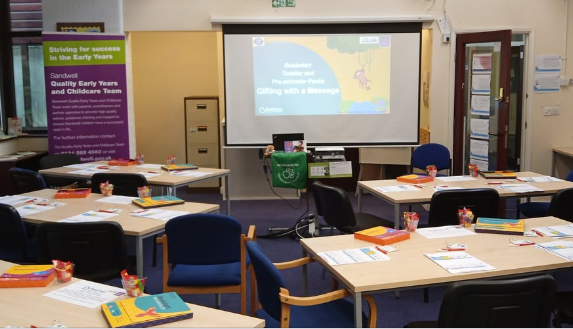
In October 2025 I was invited to West Bromwich to be part of Sandwell Children’s Services Booktrust gifting sessions. Over five sessions I spoke with groups of Early Years Practitioners from the authority about story, its importance to young children and how we can elicit it from play. First though, I talked about talk.

Storytelling is primarily a verbal expression of the imagination during which the storyteller creates mental pictures for their audience. Early storytellers would have told stories as much to educate as to entertain as stories would have been used to explain the world early people found. Effective storytelling relies upon the audience being able to create a mental picture from the storyteller’s descriptions. The quality of the image a storyteller creates will depend upon their command of language and their language will be rehearsed informally over time through conversation. Talk is therefore important to storytelling.
Some of the research around early talk is quite shocking. Studies suggest that some parents talk to their children for between 7 and 44 minutes per day. Perhaps this is understandable when you consider the amount of time some children spend at school or at home, away from their parents. Talking to a school age child for less than three quarters of an hour might be explainable but what about a pre-school child? Further research which shows almost 25% of pre-school children own a tablet or electronic device for the purpose of entertainment. As a parent myself, I appreciate that a screen can be respite but anecdotal evidence suggests that some children speak with American accents as the videos they watch online are the most prevalent voices in their lives. Then there is the quality of the conversation which children are engaged with; the children who shout in their early years setting may do so because that is how they are heard at home.

Engaging in talk provides children with many of the necessary skills for story; hearing and using different sentence structures teaches a child about form, listening to others and taking turns to speak teaches about positive participation, builds concentration, develops empathy and curiosity whilst also teaching about speaking for a purpose. Only once a child has begun to master talk can they begin to use story to explain their world in much the same way as their ancient ancestors.
To encourage talk in a learning setting we must consider the resources that we make available to children. How will they stimulate talk? What will be the quality of the talk? Resources that stimulate talk are manifold but more familiar resources are likely to be more effective stimuli (a child may talk about a soft toy but struggle to talk about an aeroplane if they have never travelled). Giving children new experiences will not only create opportunities for talk but will also become reference points for imaginative play and possible future storytelling.
Using open questions practitioners can lead talk and elicit story:
What is teddy’s name? Where are teddy’s friends? Why is teddy sad?
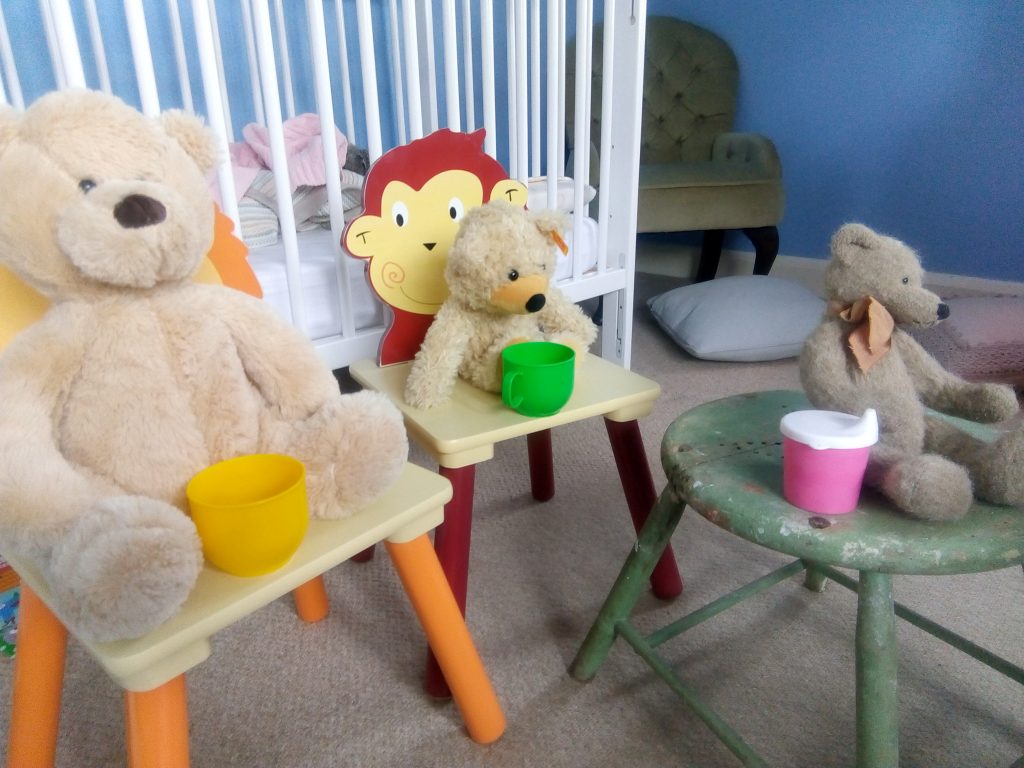
Adults can go further, intervening in play to build imaginative games with talk; if a child is playing in a mud kitchen, how might talk about the Three Bears porridge affect the play and the talk within the interaction? Such impromptu interventions can be planned into the way a setting is prepared for a session and also challenged; instead of a soft toy bear could a child be encouraged to share a story about a bear?
The beauty of talk is that it can occur throughout a practitioner’s setting and interactions with children but it will not come unless the practitioner uses their skills and sensitivity. Unlike story, where a practitioner may feel embarrassed or overwhelmed, talk is natural. Talk will come within trusting caring relationships, where children are co-creators because their contributions are listened to and valued. Families also need to be handled skilfully and sensitively. It is never too late for families to change habits and talk more at home because once there is talk, there will be stories.
John Kirk is a storyteller, Primary School teacher and poet based in East Sussex