 The following appeared on the Federation of Children’s Book Groups blog during their Share a Story month – thanks to Christine Routh, super librarian at Leighton Park School, Reading for thinking of me – its all about Dragons…
In March 2015 I was contacted by a school in Norwich about telling stories relating to Dragons to link to the school’s involvement in the Go Go Dragons Project. We decided I would tell my version of The Golden Legend “St George and the Dragon” and a version of “Beowulf”.
The choice of story was important. Although its quite short and simple, I think the story of St George and the Dragon has a deeper message about facing fears and overcoming difficulties. On the other hand Beowulf represents a huge challenge to me as a storyteller. The narrative is action packed but I want to allow the words to tell the story. What links these stories is english-ness and Dragons.
Dragons are wonderful creatures. They have existed in stories around the world for hundreds of years and everybody has their own ideas about them. I suppose that my idea of a Dragon is formed somewhere between “The Hobbit”, “Puff the Magic Dragon” and a painting my parents had of The Golden Legend (George slaying a classic green Dragon) but I am also a fan of the film “How to Train your Dragon” in which the animators reimagine these creatures as anything from elegant to ugly.
The problem with Dragons is that they are a generally unfriendly bunch. To St George and Beowulf they represent an evil that threatens a way of life. For young children, anxiety about the Dragon may need to be managed (telling them that George will be victorious) but with older audiences building the description of a terrifying beast with an element of peril can be gripping.
To help young audiences understand the story I try to keep the same simple description throughout the narrative. This is a technique used by Homer in “The Odyssey”. Repeating simple descriptions of characters and locations also helps me remember the story!
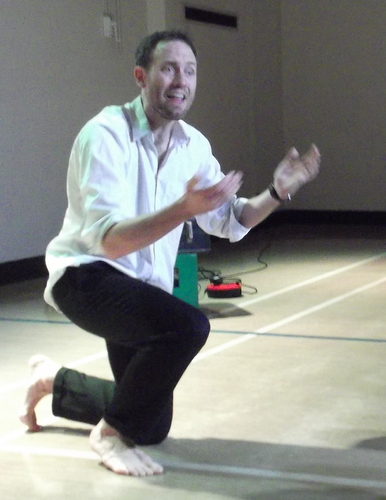 Through choice and repetition of language I assist understanding but concentration can be a challenge for young audiences. In many of my stories I use different devices which allow the audience to refocus after a period of time. In a story like Private Peaceful this may be a song or some music. In St George I am mixing imaginative play and drama activities into the story as audience members become knights. Another technique I enjoy is to slide into characters (in A Christmas Carol I use elements of costume, my voice and small physical gestures to play 13 roles!). Done badly this could be confusing particularly where differentiation is subtle (in a story like “The War Game” I take the roles of four different soldiers). In the case of Beowulf I have devised a short story in which the dying hero remembers the deeds of his life. This is complimented by a role play storytelling session in which the audience have the opportunity to explore the story through drama. Involving a whole group in such an activity can be a very memorable storytelling experience.
If I do strike the right balance that means my stories appeal then it is difficult to qualify the impact of a storyteller. By invigorating stories with expression, props, costume and activities I hope I play a part in honing my audience’s appreciation of live performance and that I enthuse and excite them with language and stories. The legacy of such a simple exchange as sharing a story could be almost as fantastic as a Dragon itself!