Early March is always a busy time at Kirk Towers so this year I have taken on extra staff to help out with the administration …
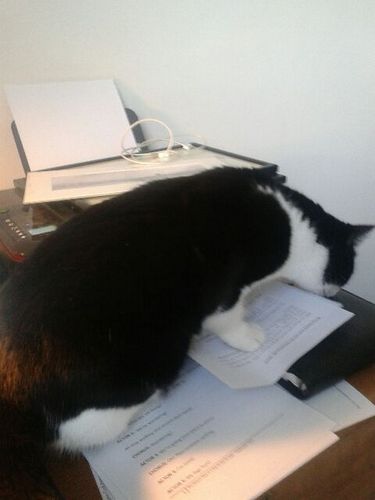
… so far she has mastered printing but typing is proving trickier.
Have a wonderful World Book Day!
Early March is always a busy time at Kirk Towers so this year I have taken on extra staff to help out with the administration …
… so far she has mastered printing but typing is proving trickier.
Have a wonderful World Book Day!
 National Storytelling Week starts on the 31st January 2015 and ends with National Library Day on the 7th February 2015.
On Tuesday I got ahead of the game, joining children at Fulwell Cross and Woodford Green libraries to tell “The Very Hungry Caterpillar”. I had a great time working with the children and their families telling this classic tale in my own way.
“A brilliant way for our libraries to celebrate National Storytelling Week and bring something special to our regular Stories and Rhymes sessions.” (Redbridge Libraries, January 2015)
Next week I will be sharing stories in Blackburn, Kingston and Dartford but I would encourage you to find out what’s happening at your local library (nine times out of ten events are free) and get along to participate in a community activity.
 I have had a very special year. “Private Peaceful“, “The War Game” and devising and presenting workshops in Hackney and Waltham Forest have been wonderful opportunities whilst I have visited the four corners of England, meeting thousands of young people in schools and libraries. Highlights have included working at The City of London Docklands Museum as part of CityRead 2014, The Shrewsbury Children’s Bookfest, working in Guilden Morden and taking my work to Newcastle Upon Tyne, Cheshire and Liverpool. I have done so much that had you said to me twelve months ago how 2014 might pan out I wouldn’t have believed you!
I feel that I have been very fortunate this year and that I owe a lot to other people so on the 11th November as we commemorate the sacrifice of those who fell in The Great War I will be donating £888.25 to The Royal British Legion (£1 for every 100,000 people who died fighting for Britain and the Empire). Thank you to Terry Deary and Bloomsbury Books for allowing me to make this gesture and to everybody who supported my work in 2014.
As for the future, I have dates in my diary for World Book Week, World Book Night and visits to Cheshire and Stevenage but who knows what I’ll be sitting here typing in another year’s time.
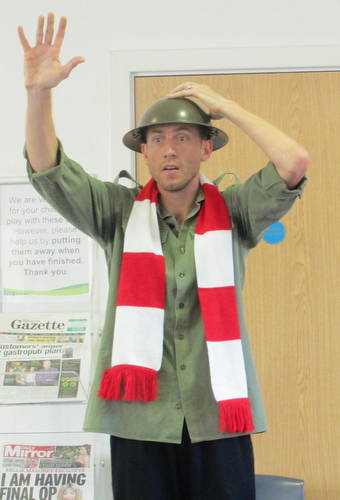 I have done 25 presentations of “The War Game” so far to just over 1500 young people from across Britain of different social and cultural backgrounds.
As Remembrance Day approaches my next stop is the Barbican Children’s Library.
We live in the 21st Century. It’s great to be surrounded by technology that supports and sustains us but sometimes that technology can be a hindrance. I, like most people have a mobile phone. Its great that I can be connected to a wider world but I find the mobile phone camera a real annoyance particularly when I am working in public settings. I tried to work out whether my problem with phone cameras was irrational so I decided to make a list of the reasons I’d rather people didn’t take photos during my stories.
1. I would like you concentrate on my story. I have used this blog to talk about concentration before. Taking a photo, to my mind, means that you aren’t concentrating on the story. You are distracted and will potentially distract others (including me – I’ll come onto that).
2. I would like you to show others how to watch a story. Young people with very little experience of live presentations will watch how other people engage with material. If you are old enough to bring a phone to a presentation then you are old enough to realise that you are a role model for how to behave. If you watch then the chances are that they will too. If you chat or play with your phone the chances are that they will see this as a signal not to pay attention.
3. I didn’t write the story for a small screen. My work is often high energy and has maximum impact live. Recordings of any sort (particularly by a cameraman with no previous knowledge of my work) does not do it justice and will potential spoil the future experience for somebody else.
4. I would never come into your work place and take photos of you sitting at your desk. At the beginning of public presentations I make it quite clear as to whether you can or can’t take photos. There is usually a good reason for restricting photography (performance rights and child protection being two very reasonable concerns in public settings). I am well aware that you might want to take pictures of your children and if you ask I’ll pose for photos once the story has finished. It is disappointing and frankly ignorant when people continue to record my work.
5. It’s disruptive. My style of storytelling relies on flow and momentum. Stopping is frustrating and can ruin the entire session. I do a lot of work in public environments and I think that some people therefore assume that my work is somehow worth less or that they can snap away to their heart’s content. I will stop if I feel that somebody is taking an excessive number of photos or has filmed enough of my story to present it themselves. Remember: my stories are my living and whilst I try not to be overly precious I am protective of them.
I suppose these five points can be summed up in one word: control. It is very frustrating to any kind of artist to think a sub standard version of their work might be distributed without consent and of the potential financial implications of losing control of that work.
There’s a simple way around my ire though; play by the rules and keep your camera in your bag unless you have my permission. Thanks!
NB: I understand that in early years centres, schools and colleges staff may want to take a few pictures – I’m not an ogre, I won’t have a problem if you check and we can discuss it at the beginning.