Think back to your experience of school. What are your fondest memories? Perhaps you remember doing something with a friend, a teacher or an assembly but are your memories directly linked to learning? I can use long multiplication but I don’t remember learning it. This is probably because of the way human beings learn things.
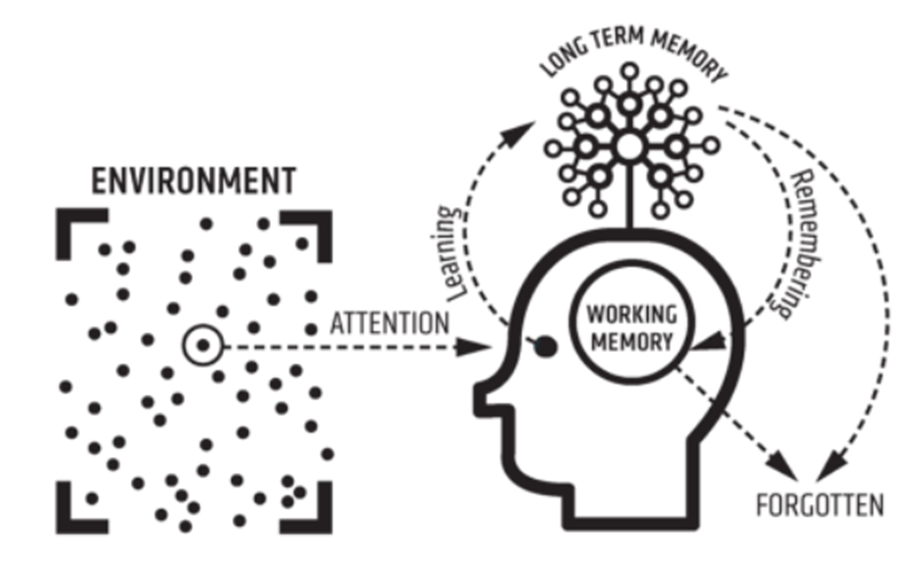
This model shows how human beings learn (Tom Sherrington, 2020); information from the environment transitions to the working memory and then it passes to the long term memory to be later retrieved or is forgotten. The most likely reason why I can’t remember learning long multiplication is that I gradually built this schema through repetition and practice. The other things I suggested (a friend, a teacher or assembly) might in fact be homogenised memories or stand out because they were completely extraordinary. Cognitive psychologist Daniel Willingham suggests that whilst human beings can reason we don’t enjoy it and prefer to rely on memory (2009). Willingham calls learning the “residue of thought” saying that thinking occurs when information is presented in new ways.
Before there were books and other media, storytellers helped our ancient ancestors to explain their world. A well told story will be remembered and popular tales would be retold for the purpose of entertainment and education. Over time, as our understanding has developed, story has taken on a different significance in classrooms with many teachers understanding the power of story as a vehicle for curriculum learning.
One of my favourite quotes about authorship is credited to JK Rowling; “You can’t be a good writer without being a devoted reader.” How can we expect learners to have enriched vocabulary, recognise grapheme-phoneme correspondences or different forms of writing if they have never experienced these things themselves? Guided reading and writing inspired by a carefully selected story or reading a story for pleasure as a class can deepen a learner’s understanding of language and its use.
Pie Corbett’s popular Talk for Writing programme goes even further, encouraging learners to imitate model texts using text maps (pictorial diagrams of the writing) before the teacher leads an innovation and independent writing phase. The memorisation of text maps can promote oracy skills as learners will often rehearse a story aloud with accompanying actions to strengthen their memory of it.
Presenting information through story to emphasis the causality of events (Willingham’s 4cs of story, 2009) can enhance a learner’s understanding of History and Geography even if the main characters aren’t always people; a chronological story can help to explain why the Romans left Britain or the factors that lead to the destruction of Pompeii by Mount Vesuvius. In the story of the Pitcher and the Crow, stones displace the water for the Crow to then drink, a Science experiment that might be repeated with a class as they explore states of matter. Religious parables, fables and folklore, myths and legends can all be incorporated by a teacher into RSHE, PSHE, MFL and History in an impactful way.
Most teachers I know, even those who do not explicitly use stories in their teaching, understand how to communicate a narrative when reading from a book. So what is the role of the professional storyteller? Storyteller Andy Copps and I have been working on a joint project exploring the folklore of southern Africa. In a 45 minute storytelling, we offer ancient answers to questions such as why the Giraffe has a long neck, why Lions don’t eat fruit and why Rhinos have short tails. As well as exposing children to rich vocabulary through oral storytelling, the stories show how the ancestors of southern African tribespeople explained their world and can be a stimulus of discussion in PSHE and Science (how animals and plants adapt to their habitats) as well as a starting point for story writing. We have identified these possible learning outcomes from our presentation but they are not concrete and a teacher might find other curriculum outcomes relating to a storytelling session.
Educationalists like Tom Sherrington and Daniel Willingham might frown at the idea of different learning styles but storytelling can be a highly interactive, fun way for children to engage with new information. Think back to Sherrington’s model at the beginning of this blog. When the information you want a learner to take on board is competing with lots of other stimuli, making a topic easier to process by addressing it through a story is an approach that may work for some learners. Certainly, including a professional storyteller in curriculum planning could be an extraordinary moment in a child’s school life which makes subject learning more memorable.
Interesting links:
Stories for teaching Science in Primary Schools (STEM.org.uk)