Coming in March 2016…
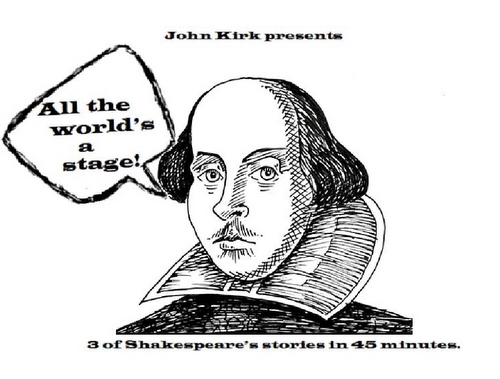
Coming in March 2016…
“Inside every sane person there’s a madman struggling to get out”. – The Light Fantastic by Terry Pratchett
Anybody whose ever been to one of my events know my dirty secret: I am ashamed of my reading ability. As a teenager I rarely read anything at all and it is only in recent years that I am discovering books that my peers read when they were prepubescent. You see, I struggled with reading and never thought it would be “my thing” until I discovered Terry Pratchett. I, like so may other people, loved Discworld and as a slow reader I felt rewarded for my effort as Pratchett skilfully illuminated his alternative reality full of wit and wonder. Even now, years later, I am very grateful to my Mum for introducing her reluctant (and sullen) teenage son to these books. I’d go as far as to say that up to the age of eighteen, Terry Pratchett’s works were near enough the only books that I’d read for fun.
Other people will be far more eloquent in his passing but I felt compelled to write something down so here goes…
Thanks Terry Pratchett. Your stories are laugh out loud funny. You opened my mind and helped me to see things in much more abstract ways. Whether your work would be considered classic literature is for others to debate but I’m sure you helped shape the man I am today. To tell a great story is a gift and your legacy is that you told a black fedora hatful of them. They are certainly a highlight of my literary life and it is sad to think that you won’t write any more.
 I am currently searching for an author to work with or a story to tell as part of the Summer Reading Challenge (SRC) 2015. As well as consulting librarians and scouring book shelves I am publishing this blog as part of my search. The reason I am publishing this post is to find the right story for the project but also to offer an opportunity to aspiring authors of children’s books. If you are reading this and are already thinking “I know a story” or “I have a story” or “I know somebody who might have a story” then please read on…
This is the criteria for stories I am considering:
– It must be suitable for children age between 4 and 11 years old.
– It must fit the Summer Reading Challenge theme “Record Breakers” (so stories about extraordinary achievements, world firsts or races would be perfect).
– The author/publisher must be prepared to sanction my storytellings between June and October 2015 (if you are just suggesting a possible title – you aren’t the author or publisher – then I will make the necessary approaches).
– It would be an advantage if the work is published and available for the audience to borrow/buy.
As I say, this post is part of a wider consultation that I am running until the end of February 2015. I cannot guarantee that your suggestion will be taken on as the final project but if you know a story or know somebody who might have a story then contact me.
Thanks for your support.
 “Where have all the good men gone?” asks Bonnie Tyler in her song, “I Need a Hero”. Good question Bonnie. See, the title of her track isn’t just catchy it’s true. We all need heroes and stories would be poorer without them. I have written before about fairy tale villains and the modern anti hero’s role in stories but where would they be without a good old fashioned hero to foil them? The tug of war between good and evil and right and wrong has manifested itself in countless ways through time. Be it a Knight in shining armour sent to battle a dragon or a humble servant/beggar who’ll save the Kingdom and marry a Princess (the premise of many a pantomime) we need a hero. What are their qualities and their relationships with their followers and loved ones and what can we learn from their adventures?
The hero. The warrior, the conqueror, the vanquisher, the heartthrob. Archetypally the hero is male although not always. For every Aladdin there is a Scheherazade who demonstrates the qualities of heroism. The hero is generally young or youthful. The hero is bold; strong both in body and mind and is respected widely for their strength. Many heroes represent change and vibrant progressiveness which will shake up a stagnating world.
I have recently been exploring epic poetry and for the purpose of this blog we’ll consider Odysseus, King of Ithaca and the warrior Beowulf. Both men are legendary figures, first appearing many thousands of years ago with their exploits translated and reinterpreted over time since. Odysseus the Greek and Beowulf the Scandinavian come from very different traditions but they are both heroes. Both are bold warriors and leaders of men who have not just defeated mortal armies but monsters too (Odysseus blinding Polyphemus the Cyclops and Beowulf slaying the beast Grendel and his Mother). They have demonstrated great intelligence and cunning through their various adventures but they are not without falls. It is Odysseus’ arrogance which leads Poseidon to seek vengeance against his entire crew. It might be argued that Beowulf dies because he is too proud to ask his younger warriors to fight with him.
 What of their followers? Despite gifts and praise, when Beowulf’s followers are faced with a Dragon fear gets the better of them. At many stages of The Odyssey, Odysseus’ crew verge on mutiny and in finally disobeying his will, they doom themselves. That I suppose is the point. The fallibility of their followers is in sharp contrast to the quick wits and mental toughness displayed by the hero. Our heroes inspire ordinary men to be better than themselves and rise above their weaknesses (in 1001 Nights, the heroine, Scheherazade inspires King Shahryar with her skill as storyteller).
As we remember The Great War I am struck by the relationship between Hero and follower, their relationship with conflict and sacrifice and the parallels with modern conflict and soldiering. Odysseus is reluctant to go to Troy but his contribution once there is invaluable whilst Beowulf offers his men to aid another Kingdom. How many brave and loyal men died at Troy, following their leader’s orders, so that King Menelaus could retrieve Helen? How many brave and loyal men were prepared to lay down their lives because their leader said so, to fight somebody else’s dragon. Stories and their meanings can be disputed but I think that this is an interesting perspective that shouldn’t be overlooked.
Without meaning to continue the Great War analogy too far, for the hero there is a Home Front. It is from here that a hero will often find purpose for it is here that they know love. Odysseus spends time with Circe and Calypso but has a deep and faithful bond with Penelope who steadfastly waits for his return. After his success, Beowulf is received by Hygelac, King of the Geats and his people with warmth, love and adoration. It is in the reconciliation of love that we see the hero’s actions have been for a selfless cause. The hero is rewarded but really everybody’s a winner (Odysseus reclaims his Kingdom and family, Beowulf strengthens the bond with another country and consolidates his position and again, our heroine Scheherazade spares the people of her city any further misery by changing the heart of King Shahryar). Our hero must understand love and it’s influence on their actions. A strong moral compass is important to a hero because if they are seen to act out of greed or for individual gain they would be viewed quite differently (Robin Hood is a hero for redistributing his loot not for keeping it!).
It isn’t just love and new found riches that our hero will enjoy. It isn’t uncommon for them to live long and prosperous lives and sometimes to even achieve further greatness. Now what do they call that? Oh yes… “They all lived happily ever after!”

This year I have seen the amount of work I do swell. More than ever before I am being asked to travel across the country to work with young people and adults on all manner of projects. As the school year ends I thought I would share a few of the comments from the past three months.
In March Private Peaceful was perhaps the largest single project I have ever undertaken and the feedback from it was phenomenal but rather than share what you can see on a dedicated page I have picked out testimonials from other workshops that I offer.
“Children from all ages and classes were engaged and buzzing from their work with you.”
Literacy Coordinator, Watling Lower School, Dunstable (Jack and the Beanstalk Workshop and Storytelling Day, May 2014)
 “The staff said you were the best story teller they had ever experienced.”
Inclusive Coordinator, Sauncey Wood Primary School, Harpenden (The Unlucky Mummy Myths and Legends Day, May 2014)
and perhaps my favourite…
“‘I really get it now. Shakespeare was my worst thing before but now I understand that it’s meant to be fun and dramatic.'”
Year Eight, Shenfield High School, Shenfield (Shakespeare’s The Tempest Workshop Sessions, May 2014)

I’d be lying if I said that everybody adored my style of working and that there haven’t been difficult days along the way but the comments I choose to share here are my mandate for carrying on working into 2014-15. They demonstrate my value and the difference my storytelling and workshop sessions make to young people and educational professionals.
I am incredibly lucky to have worked with some fantastic people during the current academic year (City Read London, Shrewsbury Children’s Bookfest, Guilden Morden Primary School and Hackney Museum) and much of my success is because of the wonderful, supportive people who give me such wonderful opportunities.
The Summer Reading Challenge 2014 has already kicked off what’s looking like a very exciting six months. Who knows? Maybe I’ll be visiting you.
 A year ago I devised Dracula to coincide with The Summer Reading Challenge (SRC) 2013. The piece was hugely successful and it has been my pleasure to present it across the rest of the country at schools and events since. Time waits for no man and a year later I am about to embark upon an even bigger tour with an even bigger challenge: Homer’s Odyssey.
I had originally thought to give SRC 2014 a miss – Private Peaceful was a very demanding and very consuming project and I thought that perhaps I needed some time to reflect. In February I was booked by Hammersmith and Fulham Libraries for four days of storytelling. I knew that the obvious choice considering the theme this year is Mythical Mazes, would be Theseus and the Minotaur but I tell this already as part of my traditional storytelling offer to schools. I briefly considered “The Secret Garden” as an alternative slant on the theme before settling on Homer.
There are many good reasons for children to hear The Odyssey. It may be 3000 years old but its a really famous and influential story packed with Gods and Monsters. Be it the Coen Brothers’ Oh Brother! Where Art Thou? or the test of the Glass Slipper to find true love in Cinderella, shades of The Odyssey are everywhere. The original is very skilfully written and as the plotlines merge it is clearly much more than an adventure story. There is a strong message through the narrative about the foolishness of men and the wisdom and fortitude of women. I have used this blog to talk about the role of strong women in fairy tales before and whilst Odysseus truly is a man of exploits and trials (many of which are brought about by ill judged decisions) loyal Penelope is admirably steadfast and dignified as she waits for his return.
 In recent months I have been doing more and more work around narrative poems. I have explored Alfred Noyes’ Highwayman, Tennyson and even used narrative poetry as a device for telling the story of The Great Fire of Guilden Morden. I have been keen to retain the sense of a narrative poem, its language and imagery, in my reinterpretation. I say reinterpretation because mine will be an adaptation of Homer. There is no way I could remember twelve and a half thousand lines of poetry but I hope that I offer a flavour of the journey as we follow Odysseus home in just 40 minutes. My story must also have a sense of progression and therefore cannot afford to linger. My other big challenge is making the piece accessible to very young audiences. I want the experience to be fun but its important that the tone is right and any jokes mustn’t cloud the narrative.
 The result is a series of short stories which in the future I will be able to tell independently or present as a show following Odysseus from Troy back to Penelope. I’ll be doing my usual array of voices, physical attitudes and helping the audience to identify Gods from the Monsters with suggestions of costume and some more visual setpieces. (I have already redecorated my Kitchen with tomato juice in a failed attempt to produce a suitably gory effect for the blinding of Polyphemus).
If the preparation is an indicator of the summer to come then it’s going to be epic!
Dates from 9th July 2014 in London Libraries. Follow link and check local listings for details of presentations.
Here is the story of my CityRead2014 in pictures. The saluting came about when the group piled into the photograph at New X Learning. It became a trend that would be repeated across London.
I started in Lewisham…

and was next in Wandsworth.

April rolled in with presentations in Barking and Dagenham…

and Islington.

As the Easter Holidays began the dates came thick and fast with presentations in The City of London…

Waltham Forest…

and Ealing.

I did nine presentations in Croydon…

eight in Haringey…

with days in Merton…

and Camden too – Phew!

When the schools went back we pressed on with huge crowds in Lambeth…

Redbridge…

and Brent.

Not forgetting Hackney…

Westminster…

Kensington and Chelsea …

and Hammersmith and Fulham.

As April ended I went to Bexley …

and Bromley to work with secondary school groups.

My CityRead 2014 finished with May visits to Richmond Upon Thames…

… and Kingston Upon Thames.
65 presentations in 27 days across 23 different London authorities to 2300 people.
My CityRead 2014 was incredible.
 When I was younger I didn’t think that I liked poetry. Outside Shakespeare I rarely read verse for pleasure. Last year though, I was introduced to Alfred Noyes’ “The Highwayman” and it changed my view of poetry completely. Since then I have been reading other narrative poems including the “The Ballad of the Fleet” (Tennyson) and “The Walrus and the Carpenter” (Carroll) and incorporating them into my work.
A narrative poem tells us a story but it is set out in stanzas with the rhythms and rhyming patterns familiar in other types of poem. It will contain a skilfully woven story packed with wonderful imagery and metaphors which compels its audience.
In my opinion the narrative poem offers so much that I have even used them in pieces for Birthday Parties! Here are what I see as the merits of working with narrative poetry.
The narrative poem is perhaps one of the most ancient form of storytelling (The Iliad and Beowulf are both story poems). As a Drama Facilitator I believe they are a fantastic way of introducing complex text to young audiences which demonstrates the breadth and depth of our literary heritage beyond Shakespeare.
It offers a whole story. A chapter of a book or a scene from a play wouldn’t offer the beginning middle and end in this way. If I want to guarantee that a group have heard the material a narrative poem is a concise way of quickly offering an entire story.
The narrative poem will capture the imaginations of boys and girls as it often recalls and romanticises some kind of adventure.
Investigating narrative poetry through drama is a lot of fun and once a group has a story they are better positioned to explore the author’s imagery and language choices. The poems I am talking about were mostly written in the 19th and 20th Century and whilst the language is certainly complex it is not impenetrable. Accessing it allows young participants to make their own judgements about themes, events and characters (perhaps physically characterising or hot seating characters about their decisions in the story or making up scenes based upon their deductions).
I have also found that exploring a narrative poem can become a catalyst for exploring rhythm, rhyme and meter and getting groups to write in poetry.
_ _ _ _
“The wind was a rushing train, dodging every tree
The moon was a shiny banana ripe and ready for me.
The road was a lonely wanderer, under an ongoing spell
and Mr Highwayman came riding, riding, riding
Josh Highwayman came riding, up to the Grand Hotel.”
_ _ _ _
“The snow was a breeze of coldness coating the leafy bush,
The sun was a ball of fire, gleaming upon rushing waves
The field was a soft green carpet, over the earthy road
And the Highwayman came skating, skating, skating
The Highwayman came skating up to the big mansion’s door.”
_ _ _ _
As well as getting excited about narrative poetry I have discovered narrative songs. My taste in story song is eclectic ranging from Benny Hill (The Fastest Milkman in the West) to Charles Daniels (The Devil Went Down to Georgia) and Chris Wood (Hollow Point). You could easily laugh some narrative songs off as being novelties but constructing an effective narrative within a poem or a song is a great skill. Tennyson and Noyes might not be matched for their poetry’s beautiful imagery but Hollow Point particularly is (in my view) a powerful piece of modern verse based storytelling.
Up to now narrative poems have formed the basis of workshops or featured within other work that I have presented but this summer to coincide with The Summer Reading Challenge 2014 I am taking my new found love of the narrative poem to a whole new level as I reinterpret Homer’s “Odyssey” for a young audience.
My final reinterpretation is unlikely to be a narrative poem but one thing is certain – it’s going to be epic!
Special thanks to the children of South Malling Primary School for sharing their “modern” takes on “The Highwayman”.
 This week I am using my blog to qualify my impact on learning by sharing some of the testimony I have received in the past 3 months.
“The day was absolutely fantastic and the feedback from children and parents was brilliant. It was lovely to see the children echoing the language you used when writing stories the next day. They all thoroughly enjoyed the day so thank you!!” Teacher, Wychwood Primary School, Shipton Under Wychwood (Traditional Storytelling and Presentation Day, January 2014)
“I can honestly say that this was one of our most successful days!
John totally engaged the children and especially a group of boys who usually show very little interest in drama, storytelling or writing! The next day the children were still talking about John’s visit and the tips he had given them for story writing. I call that money well spent!” Headteacher, Gillibrand Primary School, Chorley (Classic Storytelling and Workshop Day, February 2014)
“Again, a fabulous day much enjoyed and talked about by the children all week… They have also been inspired to write their own poems and stories – ” Teacher, South Malling Primary School, Lewes (Alfred Noyes’ “The Highwayman“, February 2014)
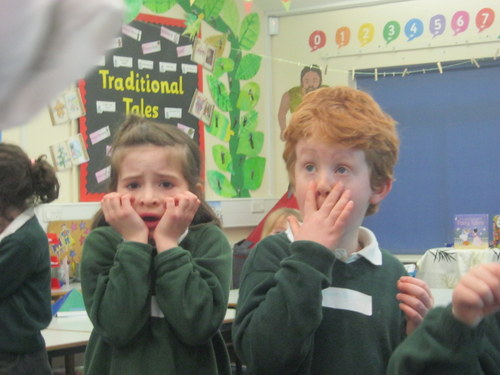 Each of these teachers work in very different social, economic and geographic settings and yet their feedback demonstrates that my stories and workshops manage to transcend such obstacles, appealing to young people nationwide. They also point to a lasting impact and legacy.
Positive and constructive feedback is always appreciated but I’d like to finish this piece by sharing a lovely comment I received from a school in Liverpool. Leaving London at 5.30am I made it to Anfield for a 10.45am start. I led a story and workshop session and was back in the big smoke by 7.45pm. The children were wonderful to work with but getting this comment from their teacher made an epic trip to Merseyside more than worthwhile.
“The children got a lot out of the workshop! Thank you.” Teacher, Whitefield Primary School, Liverpool
Related blogs
Fairy Tale Stepmothers do ave’em! – my thoughts on female Fairy tale villains
See also A Tale of Two Newspapers – a piece about performing in Chorley (my home town)
See also “The Highwayman” from an Ostler’s point of view – my thoughts on rewriting Alfred Noyes’ “The Highwayman”
See also Why Mickey Flanagan isn’t joking – my thoughts on quality
I also offer a “Highwayman” workshop!!
Highwaymen are often referred to as “Gentlemen of the Road” but they were in fact nothing more than common thieves. “Stand and Deliver!” (the command rather than the song), was last uttered by a Highwayman in Britain in 1831 but their exploits were (and are) popularly romanticised. Alfred Noyes’ epic poem chronicles the night time adventures of one such rogue and the Landlord’s daughter, who tragically meet their ends in the cobbled inn yard. Alfred Noyes’ “The Highwayman” is a brilliant story of love that has been reinterpreted by artists, film makers and musicians around the world.
As part of a workshop exploring Alfred Noyes’ “The Highwayman”, I was challenged to reinterpret the poem for a group of Primary School children. This video is a part of the result and this blog came about as more and more people watched it online.
PLEASE VISIT 1000 UP! TO VIEW THE VIDEO
Rather than tell the Highwayman’s story I wanted to explore the world of the other characters mentioned in the poem. I wanted the tone to be quite serious so taking Bess’ perspective was out. The Landlord and the King’s Guards presented possibilities but the most interesting character seemed to be Tim the Ostler. In the original poem Tim is mentioned by name but appears in just one stanza:
“And dark in the dark old inn-yard a stable-wicket creaked
Where Tim the ostler listened; his face was white and peaked;
His eyes were hollows of madness, his hair like mouldy hay,
But he loved the landlord’s daughter,
The landlord’s red-lipped daughter,
Dumb as a dog he listened, and he heard the robber say—”
Who was this man? Why was he there? What was his role in events and what was his story beyond the inn yard?
What follows is the transcript of the above video. My version is actually longer than this as I introduce the Captain of the Guard and explain what happens to Tim (I reserve those verses for live presentations).
What was most striking for me in Noyes’ poem was his rhythm and rhyming structure. When I listen to the poem I always think about a horses hooves and I wanted my poem also to respect a regular meter (which it loosely does). I also love his imagery and try to include some bold similes and metaphors. Like Noyes I was drawn to his original themes of love, jealousy and violence but I have chosen for Tim the Ostler to recount his bitter betrayal rather than a third party.
Tim the Ostler
Now the landlord he has a daughter, whose lips are as red as a fire
Her hair is a perfumed cascade you couldn’t fail to admire
Oh how I longed for this young girl, who goes by the name of Bess
My master’s black eyed daughter
She smiled at me, his daughter
I dreamt that this sweetest lady would someday be my Princess….