Tag Archives: legacy

April to June: What they said..

John Kirk is a storyteller and drama facilitator specialising in drama workshops and theatre for young people.

This year I have seen the amount of work I do swell.  More than ever before I am being asked to travel across the country to work with young people and adults on all manner of projects.  As the school year ends I thought I would share a few of the comments from the past three months.

In March Private Peaceful was perhaps the largest single project I have ever undertaken and the feedback from it was phenomenal but rather than share what you can see on a dedicated page I have picked out testimonials from other workshops that I offer.

“Children from all ages and classes were engaged and buzzing from their work with you.”

Literacy Coordinator, Watling Lower School, Dunstable (Jack and the Beanstalk Workshop and Storytelling Day, May 2014)

John Kirk is a storyteller and drama facilitator specialising in drama workshops and theatre for young people.“The staff said you were the best story teller they had ever experienced.”

Inclusive Coordinator, Sauncey Wood Primary School, Harpenden (The Unlucky Mummy Myths and Legends Day, May 2014)

and perhaps my favourite…

“‘I really get it now. Shakespeare was my worst thing before but now I understand that it’s meant to be fun and dramatic.'”

Year Eight, Shenfield High School, Shenfield (Shakespeare’s The Tempest Workshop Sessions, May 2014)

John Kirk is a storyteller and drama facilitator specialising in drama workshops and theatre for young people.

I’d be lying if I said that everybody adored my style of working and that there haven’t been difficult days along the way but the comments I choose to share here are my mandate for carrying on working into 2014-15.  They demonstrate my value and the difference my storytelling and workshop sessions make to young people and educational professionals.

I am incredibly lucky to have worked with some fantastic people during the current academic year (City Read London, Shrewsbury Children’s Bookfest, Guilden Morden Primary School and Hackney Museum) and much of my success is because of the wonderful, supportive people who give me such wonderful opportunities.

The Summer Reading Challenge 2014 has already kicked off what’s looking like a very exciting six months.  Who knows?  Maybe I’ll be visiting you.

See also feedback from Jan-March

Mammoths to Medals (Revisited)

John Kirk specialises in drama workshops and theatre for young people.In 2013 I moved from the London borough of Hackney to the London Borough of Waltham Forest.  I may have only moved seven short miles but after six happy years in one of the most vibrant boroughs in Britain it was a massive wrench.  Whilst living in Hackney I had some of the most creatively fulfilling years of my life as I built strong working relationships with organisations including The Hackney Museum.  Hackney Museum, based in Hackney Central Library is an amazing community resource staffed by knowledgeable and creative people with a passion for sharing local history.  I may be biased but I think its one of the best museums in the country.

Working in heritage environments is something I really enjoy.  My earliest solo storytelling pieces were based around British history (including a Victorian Classroom session for The Bruce Castle Museum) and this summer I will be helping to lead a creative exploration of the Guilden Morden fire.

Anyway, as I sat watching Lizzy Yarnold, Jade Etherington and Team GB at the Sochi Winter and Paralympic Games I couldn’t help but think back to my time working with Hackney Museum.  It was in the build up to Summer Olympic and Paralympics (London 2012) that I collaborated with Hackney Museum on Mammoths to Medals,a presentation which sought to tell the incredible story of Hackney’s history as part of the Museum’s Mapping the Change project.  In just 30 minutes we explored 200,000 years of Hackney’s history highlighting the contributions of those people who have called Hackney their home; Anglo Saxon Farmers, Tudor Society, Victorian Industrialists and migrants from across the globe.

In the life of the project I have presented the piece on many occasions at Hackney Museum and in Hackney Primary Schools.  Incorporating games and learning activities into a chronological narrative the piece offer facts about Hackney and but also it questions how we will be remembered.

John Kirk is a storyteller and drama facilitator specialising in drama workshops and theatre for young people.A lot has changed in the two years since we made the piece was documented at Kingsmead Primary School.  Hackney’s demographic and landscape have been slowly morphing for 200,000 years but concerns about how communities will withstand the gentrification of East London mean our legacy is once again scrutinised.

When we look at Hackney’s story it shows us that change doesn’t have to be a bad thing.  It points to how different traditions, cultures and values have shaped an area into a place people want to live and work.   I am incredibly proud of being a part of Hackney’s history and of this piece.  I hope that through watching Mammoths to Medals young people recognise how they can shape their community.

Thankfully I haven’t lost touch with Hackney Museum and hope to be back to run sessions as the country prepares to commemorate The Great War.  For the moment though I am very settled in Waltham Forest and I’m looking forward to the future.

Qualifying my contribution to children’s learning

John Kirk is a storyteller and drama facilitator specialising in drama workshops and theatre for young people.This week I am using my blog to qualify my impact on learning by sharing some of the testimony I have received in the past 3 months.

“The day was absolutely fantastic and the feedback from children and parents was brilliant. It was lovely to see the children echoing the language you used when writing stories the next day. They all thoroughly enjoyed the day so thank you!!”  Teacher, Wychwood Primary School, Shipton Under Wychwood (Traditional Storytelling and Presentation Day, January 2014)

“I can honestly say that this was one of our most successful days!
John totally engaged the children and especially a group of boys who usually show very little interest in drama, storytelling or writing! The next day the children were still talking about John’s visit and the tips he had given them for story writing. I call that money well spent!” Headteacher, Gillibrand Primary School, Chorley (Classic Storytelling and Workshop Day, February 2014)

“Again, a fabulous day much enjoyed and talked about by the children all week… They have also been inspired to write their own poems and stories – ” Teacher, South Malling Primary School, Lewes (Alfred Noyes’ “The Highwayman“, February 2014)

John Kirk is a storyteller and drama facilitator specialising in drama workshops and theatre for young people.Each of these teachers work in very different social, economic and geographic settings and yet their feedback demonstrates that my stories and workshops manage to transcend such obstacles, appealing to young people nationwide.  They also point to a lasting impact and legacy.

Positive and constructive feedback is always appreciated but I’d like to finish this piece by sharing a lovely comment I received from a school in Liverpool.  Leaving London at 5.30am I made it to Anfield for a 10.45am start.  I led a story and workshop session and was back in the big smoke by 7.45pm.  The children were wonderful to work with but getting this comment from their teacher made an epic trip to Merseyside more than worthwhile.

“The children got a lot out of the workshop! Thank you.”  Teacher, Whitefield Primary School, Liverpool

Related blogs

Fairy Tale Stepmothers do ave’em! – my thoughts on female Fairy tale villains

See also A Tale of Two Newspapers – a piece about performing in Chorley (my home town)

See also “The Highwayman” from an Ostler’s point of view – my thoughts on rewriting Alfred Noyes’ “The Highwayman”

See also Why Mickey Flanagan isn’t joking – my thoughts on quality

The Victorian Classroom Experience

John Kirk specialises in drama workshops and theatre for young people.I had just marched out of the hall, my cane tucked under my arm, the children quivering with fear.  In the quiet of the staffroom I reviewed my morning as a Victorian School Master.

The session had come about after I was contacted to provide an authentic Victorian Classroom experience.

About three years ago I was commissioned to write a School Room session for The Bruce Castle in Haringey.  This would be a fabulous opportunity to revisit the piece.

The Bruce Castle School in Tottenham was run by the Hill family during the 19th Century (Rowland Hill gave us the Penny Black).  The school was renowned for its progressive approach to discipline.  Rather than using corporal punishment, The Bruce Castle School introduced a system of points and rewards which was administered by the pupils themselves.  It had many supporters including Charles Dickens who is known to have visited the school.

Unfortunately The Bruce Castle is something of an exception to the rule in the period.  It was only late in the reign of Queen Victoria that education became compulsory and then only for the very young.  Many children found school either voluntarily or via the workhouses.  With sometimes eye watering class sizes order was maintained through fear.

Having reworked the piece to incorporate references to potential punishments I have tried to communicate the importance of the credibility of the session to the school.  If the children don’t buy into the experience then the experience is liable to collapse (he’s not really a teacher/he isn’t really going to cane us etc) 150 years ago it was acceptable to hurl board rubbers at pupil’s heads – 150 years is clearly a very long time!  When I arrive, the school has excelled.  They have a free standing white board and arranged rows of benches in their hall.  There is even a lectern for the register.  With my bell and my cane we have created a pop up Victorian Classroom!

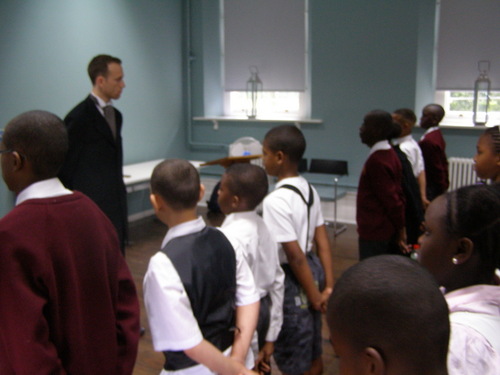
OLYMPUS DIGITAL CAMERAJust before 9.05 I go to get the class.  They are ready.  We head to the hall where the boys and the girls stand in front of separate benches.  The atmosphere is nervous.

“No speaking, Eyes front”.

I register the class, addressing them by surname.  As I stumble through the register I am reminded of how far removed the Victorian world is from the present day.

“Sit down”.

The lesson today is divided into reading, writing and mental arithmetic.  It begins however with physical drill.

Whilst researching for the original piece I discovered that quite often PE would take place in the classroom because the school didn’t have outdoor facilities.  The children would take part in physical drills at their desks!  We often take public parks for granted but at this time open spaces in urban areas must have been truly oases.

Drill over its into learning by repetition.

“Sit up straight!  Eyes front!  No slouching!”

Victims are selected.

“What is 4×5?”

Pressure can make the most intelligent child look very silly.

“What is the superlative in the passage?”

The point of this isn’t simply to intimidate or make a child feel silly.  The point is to demonstrate a method of learning.  This isn’t the learning of compromise this is the learning of fear – my way or the highway.  if a girl hesitates on an answer its also an opportunity to reinforce attitudes towards educating young ladies with a jibe about needlework.
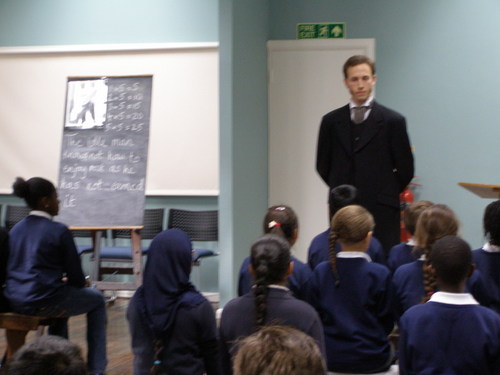
OLYMPUS DIGITAL CAMERAThe lesson moves onto a writing exercise.  Today as substitutes for slates we have portable whiteboards.

“Why are you writing with your left hand?  You will write with your right hand”.

As School Master I maintain an unsympathetic air to the teachers and pupils and the lesson continues in silence.  What rapport there is between class and instructor is cold and dangerously sharp.

“Sit up straight!  Eyes front!  No slouching!”

The lesson concludes with three cheers for Queen Victoria.

Afterwards there is time to discuss the experience with the class.  The feedback on the session is interesting.  Words like “unfair”, “shocking”, “mean” and even “rude” are used.  Comparisons are made (everybody prefers their class teacher to my incarnation!).  There is general relief that I am not the monster of the Victorian classroom.

Sitting in the staffroom I can’t help but smile.  As the children return to their classroom and life gets back to normal there is legacy in their participation.  Undoubtedly this morning’s interaction will provide context to their learning, stimulus for their writing and renewed enthusiasm for their study but you only need to listen to hear them recalling moments from the session to know that this has affected them.

It has been an unforgettable experience.