Tag Archives: added value

Read this and I’ll buy you some chocolate…

Recently a mother brought her child to one of my storytelling sessions.  When her boy got up and volunteered she jeered at him.  When he was embarrassed and didn’t want to do it anymore she said “I’ll buy you some sweets if you do it”.  I stopped her saying that volunteering should always be the individual’s choice but what she had done (other than mortifying him and putting everybody else off helping me) was to say to her child and the rest of the audience “sweets are better than this”.  Thanks.

This particular lady thought she was doing the right thing; she had attended the library to listen to a story – big tick.  Unfortunately though, it doesn’t follow that a love of books, reading and stories will rub off by simply turning up in a library.  When I deliver stories it’s very common for children to look around at how other people are receiving the story and judge their own response accordingly; are Mum and Dad watching? are Mum and Dad enjoying this?  You can’t hand a book to a child and say “read this and I’ll buy you some chocolate” because a carrot and stick approach is simply not appropriate when trying to nurture a child’s interest.  Libraries are undoubtedly the right place to encourage a love of reading and books but more often than not a child’s library experiences need to be positively reinforced by an adult.

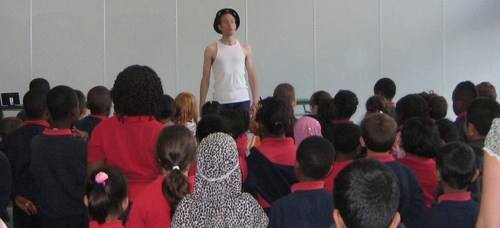
It’s the same in schools.  We live in an age when many children see reading, writing and arithmetic as purely for tests and exams so, thankfully for me, schools are always looking for ways of inspiring their children.  A good author visit or storytelling day should have quite obvious and immediate short term benefits but authors and storytellers may not have the long term solutions a school is searching for.  The long term legacy of such experiences depend upon them being properly valued at the time and adequately followed up by teachers in the classroom.

I am keen for schools and the public to get the most out of what I do.  I try to encourage discussion of my visits and I try to build opportunities for further writing exercises into my session structures.  In public sessions I try to work with libraries to ensure stories are available to be borrowed and also encourage adults to engage with me on social media so that they are aware of my events in the future.  More often than not my work is about enjoyment and entertainment but by trying to inspire the adult as well as the child I hope that for some children a story becomes more than 30 minutes of fun.  A well-executed storytelling can become a doorway to a whole world of stories or a topic or who knows, a career.

We all have bad habits we can easily shake off.  It can be as simple as singing the songs at toddler rhyme time rather than using the time to check text messages or being seen to borrow and read books or just putting the book marking off and engaging with the class’s storytelling visit.  If we don’t do these things what messages are being shared?  Your learning is somebody else’s problem.  Reading is something you have to do.  I’m too busy for stories.  If we want to encourage and inspire our children we all have to raise our game.
1000 up for Time the Ostler (and counting)!

I also offer a “Highwayman” workshop!!

A year ago I made a video inspired by “The Highwayman” in which Tim the Ostler confesses what he did to betray Bess and The Highwayman.  Twelve months on its just had its thousandth viewing.  Yah!

I’m thrilled that so many people have watched it (admittedly it’s not millions of bods but I’m not a pop star or a puppy/baby doing anything cute).  As with most things though the devil is in the detail – How many people watched the video because they were looking for it?  How is this short clip being used?  Do people like it?  I wish I could tell you but the truth is I have no idea.  For all the views, my video has received very little feedback.

It’d be lovely to know that this little film is being used as a study tool rather than just accidentally clicked on.  So do me a favour, if you’ve watch and enjoy any of my Youtube videos don’t forget to leave a comment or click “like”.

I also offer a “Highwayman” workshop!!

Mammoths to Medals (Revisited)

John Kirk specialises in drama workshops and theatre for young people.In 2013 I moved from the London borough of Hackney to the London Borough of Waltham Forest.  I may have only moved seven short miles but after six happy years in one of the most vibrant boroughs in Britain it was a massive wrench.  Whilst living in Hackney I had some of the most creatively fulfilling years of my life as I built strong working relationships with organisations including The Hackney Museum.  Hackney Museum, based in Hackney Central Library is an amazing community resource staffed by knowledgeable and creative people with a passion for sharing local history.  I may be biased but I think its one of the best museums in the country.

Working in heritage environments is something I really enjoy.  My earliest solo storytelling pieces were based around British history (including a Victorian Classroom session for The Bruce Castle Museum) and this summer I will be helping to lead a creative exploration of the Guilden Morden fire.

Anyway, as I sat watching Lizzy Yarnold, Jade Etherington and Team GB at the Sochi Winter and Paralympic Games I couldn’t help but think back to my time working with Hackney Museum.  It was in the build up to Summer Olympic and Paralympics (London 2012) that I collaborated with Hackney Museum on Mammoths to Medals,a presentation which sought to tell the incredible story of Hackney’s history as part of the Museum’s Mapping the Change project.  In just 30 minutes we explored 200,000 years of Hackney’s history highlighting the contributions of those people who have called Hackney their home; Anglo Saxon Farmers, Tudor Society, Victorian Industrialists and migrants from across the globe.

In the life of the project I have presented the piece on many occasions at Hackney Museum and in Hackney Primary Schools.  Incorporating games and learning activities into a chronological narrative the piece offer facts about Hackney and but also it questions how we will be remembered.

John Kirk is a storyteller and drama facilitator specialising in drama workshops and theatre for young people.A lot has changed in the two years since we made the piece was documented at Kingsmead Primary School.  Hackney’s demographic and landscape have been slowly morphing for 200,000 years but concerns about how communities will withstand the gentrification of East London mean our legacy is once again scrutinised.

When we look at Hackney’s story it shows us that change doesn’t have to be a bad thing.  It points to how different traditions, cultures and values have shaped an area into a place people want to live and work.   I am incredibly proud of being a part of Hackney’s history and of this piece.  I hope that through watching Mammoths to Medals young people recognise how they can shape their community.

Thankfully I haven’t lost touch with Hackney Museum and hope to be back to run sessions as the country prepares to commemorate The Great War.  For the moment though I am very settled in Waltham Forest and I’m looking forward to the future.

A Story? Really? A blog about managing innocence in storytelling

John Kirk is a storyteller and drama facilitator specialising in drama workshops and theatre for young people.As a storyteller I rely upon two presentation models: narrating events and being the character.  My relationship with the audience will change depending how I present the story.  If I am narrating events I inform the audience of our relationship.  I allow them to understand that the story and its events are a fiction and that they are watching a presentation.  I do this by introducing myself, talking about the story and clearly demonstrating different characters.  When I become a character my audience must do much more of the work themselves.

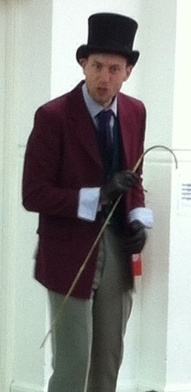
“So what?”, I hear you cry.  Well, when I present a session as a Victorian School Teacher the participants are briefly starring in a drama devised to expose them to the way education might have been in the 19th Century.  If the participants don’t respect the threat of caning then the session is less effective.  Equally, when I present a Detective investigating a crime the participants must be convinced that the scenario is credible.  A lack of investment in the world of the story can be a session’s undoing.

John Kirk specialises in drama workshops and theatre for young people.Cynicism can bedevil creativity as we grow up and the examples above relate to characters and sessions devised for pre-teens but what about when we are very young?  What are the dangers of investing too heavily in stories?  Can there be any harm in believing that you just met the Gruffalo?  I suppose that very much depends on the experience.  For a young child, meeting a creature with terrible tusks, terrible claws and terrible teeth in terrible jaws etc. will either be the best or worst day of their life.

Clearly telling a very young participant that what is happening (or about to happen) isn’t real can impact their experience.  You could go as far as to say that intentionally breaking the illusion robs them of an innocent experience.  There is unquestionable security in the truth and I think it is the storyteller’s responsibility to offer that security through the narrative by ensuring audiences see that the wicked get there just desserts.  If the participant absolutely believes is this more memorable or just confusing?  Is Miss Trunchbull scary if you know its an act or is the Mad Hatter as wonderful if you know its in some way false?  How a situation is managed will hinge on lots of factors including the sensitivity of the participant and the circumstances and legacy of the meeting.

From my point of view it isn’t easy to maintain the reality of being a character rather than a person for an extended period of time.  It can involve a lot of planning with a school or organisation ahead of the day.  Trying to think like a character at all times and allowing everybody to believe you are a character can be exhausting (once I spent an entire day in a Headteacher’s study in role pretending to work at her desk!).  I have however found that the legacy of this approach is huge and the feedback on such sessions is generally very positive.

John Kirk specialises in drama workshops and theatre for young people.“When you came in to work with the children during world book week, they were completely gripped!  The story narrative you came up with to engage the children was phenomenal, the children completely believed the 3 Little Pigs had been eaten!  You stayed in role all day and as a result the children played along too, the quality of writing and language we got from them was fantastic.   I have no doubt in my mind that we would use you again… as we are still talking about it a year later!!” (Teacher, St Wulstans and St Edmunds Primary School, Fleetwood)

I suppose that to some extent the purpose of the story will determine whether the participants are allowed to believe in the character.  After presenting the Victorian Classroom I will appear to participants as myself and discuss their experiences.  This is partly to assure groups that the monstrous school master is imaginary but also so that the group can articulate how my lesson and their lessons compare.

John Kirk is a storyteller and drama facilitator specialising in drama workshops and theatre for young people.The real world can be a hard place and sometimes we grow up too fast.  Its a sad day when a child becomes inhibited by doubt.  I was recently at a school and a little girl took me to one side and asked whether I really was Willy Wonka.  I told her that in life we can choose to believe or we can choose not to believe but that decision was ultimately hers.  She skipped away satisfied with my answer, having just chatted with the world’s greatest chocolate maker!

There are times when I wish I was a little more innocent.  As an adult and a storyteller I have an important role to play in maintaining the innocence of my youngest audiences for as long as possible.

“The Highwayman” from an Ostler’s Point of View

I also offer a “Highwayman” workshop!!

Highwaymen are often referred to as “Gentlemen of the Road” but they were in fact nothing more than common thieves.  “Stand and Deliver!” (the command rather than the song), was last uttered by a Highwayman in Britain in 1831 but their exploits were (and are) popularly romanticised.  Alfred Noyes’ epic poem chronicles the night time adventures of one such rogue and the Landlord’s daughter, who tragically meet their ends in the cobbled inn yard.  Alfred Noyes’ “The Highwayman” is a brilliant story of love that has been reinterpreted by artists, film makers and musicians around the world.

As part of a workshop exploring Alfred Noyes’ “The Highwayman”, I was challenged to reinterpret the poem for a group of Primary School children.  This video is a part of the result and this blog came about as more and more people watched it online.

PLEASE VISIT 1000 UP! TO VIEW THE VIDEO

Rather than tell the Highwayman’s story I wanted to explore the world of the other characters mentioned in the poem.  I wanted the tone to be quite serious so taking Bess’ perspective was out.  The Landlord and the King’s Guards presented possibilities but the most interesting character seemed to be Tim the Ostler.  In the original poem Tim is mentioned by name but appears in just one stanza:

“And dark in the dark old inn-yard a stable-wicket creaked
Where Tim the ostler listened; his face was white and peaked;
    His eyes were hollows of madness, his hair like mouldy hay,
    But he loved the landlord’s daughter,
The landlord’s red-lipped daughter,
Dumb as a dog he listened, and he heard the robber say—”

Who was this man?  Why was he there?  What was his role in events and what was his story beyond the inn yard?

What follows is the transcript of the above video.  My version is actually longer than this as I introduce the Captain of the Guard and explain what happens to Tim (I reserve those verses for live presentations).

What was most striking for me in Noyes’ poem was his rhythm and rhyming structure.  When I listen to the poem I always think about a horses hooves and I wanted my poem also to respect a regular meter (which it loosely does).  I also love his imagery and try to include some bold similes and metaphors.  Like Noyes I was drawn to his original themes of love, jealousy and violence but I have chosen for Tim the Ostler to recount his bitter betrayal rather than a third party.


Tim the Ostler

Now the landlord he has a daughter, whose lips are as red as a fire

Her hair is a perfumed cascade you couldn’t fail to admire

Oh how I longed for this young girl, who goes by the name of Bess

My master’s black eyed daughter

She smiled at me, his daughter

I dreamt that this sweetest lady would someday be my Princess….

I also offer a “Highwayman” workshop!!

An Unbirthday Party

A Birthday Party is a very special thing.  When a child reaches the age when there is innocent pleasure in parlour games and jelly and ice cream its up to you to take advantage before this briefest of windows closes and they become too cynical for pinning tails on donkeys.

In the planning and execution of a Birthday Party its worth remembering that you are creating an indelible memory which will effect the child’s relationship with birthdays forever.  Some of my clearest childhood memories are from such parties: the joy of presents, the disappointment at losing party games, the sickness caused by too many sweets and too much excitement.

DSC03063Organisation shouldn’t be taken lightly.  There’s the cake, the birthday tea and of course the party bag and prizes.  The song says “it’s my party and I’ll cry if I want to”; whilst it wasn’t necessarily referring to the party organiser, in an age of competition between parents the pressure to find an edge will drive you to distraction.

A storyteller offers a party just that edge.

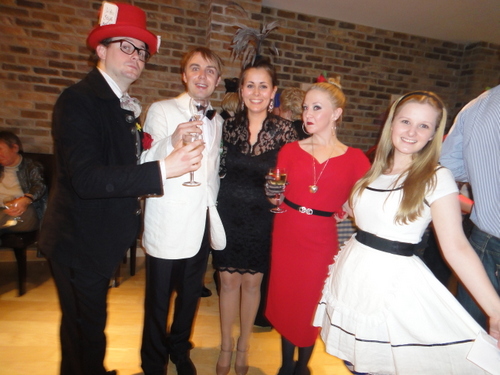
It has been my pleasure to offer my experience to both children’s and adult birthday parties where “Alice’s Adventures in Wonderland” was an overarching theme.  For a children’s party I appear as The Mad Hatter, weaving Lewis Carroll’s poetry into an afternoon of games and activities ranging from group storytelling to decorating paper hats.  In the case of adults I work as coordinator and consultant, bringing a team of performers to mingle at the party.

John Kirk specialises in drama workshops and theatre for young people.For any age group a storyteller adds value to the celebrations.  Storytellers will delight and entertain guests whilst a strong sense of the narrative can define and guide a party purposefully with energy, colour and imagination.  The ability to collaborate with a storyteller means that the party organiser is able to request personal touches as your wildest dreams are brought to life.

The legacy of great storytelling at a Birthday Party isn’t difficult to quantify and will make all the hard work seem worth it.

“That was the best birthday party ever!”

“That was brilliant!”

… or sometimes – “thank you”.