Category Archives: English History

The Great Fire of Guilden Morden (Part One)

John Kirk specialises in drama workshops and theatre for young people.Three years ago it was my pleasure to be involved in two projects which were funded by the Creative Partnerships initiative.  The programme saw artists working with schools and exposing pupils and staff to new ideas of working.  In Stoke we worked to explore how we identify with urban spaces through stories and in Lincolnshire we created a story trail for the school and wider community.

Rather than doing a day in a school I was able to present a series of workshops as I took up residency in my partner schools.  The projects were very rewarding and I feel that I learned a lot about my practice from being involved.  I was supported by my partner schools to try out ideas (to take risks) and organise really memorable learning experiences for the children (we did a Q&A in Stoke with some local VIPs as well as a creative walk, whilst in Lincolnshire I organised storytelling experiences around the school to help the children’s imaginations).  Sadly (as is the way with these things) the programme came to an end just as I was discovering it.

Last year I was contacted by Guilden Morden Primary School who were looking for a creative partner for a Heritage Lottery funded project.  Working over 12 weeks between May 2014 and July 2014 the school would devise and develop a creative response to The Guilden Morden Fire (22/5/1881).  This creative response would be documented using web based, digital technology.  Remembering my previous Creative Partnership experiences I jumped at the chance.

At the time of writing we are approaching the midway point of the project.  I have tried to summarise what we’ve done below…
John Kirk is a storyteller and drama facilitator specialising in drama workshops and theatre for young people.Week One

Celebration.  Our first session fell on May Day.  In Cambridgeshire at the time of our story May Day would have been an opportunity for the community to celebrate the coming of Spring.  I want celebration to be central to our final presentation so I introduced a simple group dance to the children.  The dance will be incorporated into the final presentation and offer our work a communal spectacle.

Who are you?  Through simple storytelling games I found out more about the groups and we used objects to stimulate more personal stories.

Week Two

Who am I to you?  The pupils brought objects from home to tell their personal stories.  We then used the objects to build a map of their school community.  By spending two weeks focussed on identity we are better positioned to introduce the heritage aspect of the project (I have a better understanding of who I am but where do I come from?)

Week Three

The Great Fire of Guilden Morden Walkabout.  I lead walks around the village, introducing the children to the story of the fire in role.  Each walk took us on a 40 minute stroll about Guilden Morden stopping at the (assumed) site of the fire, The Independent Chapel, Old School, War Memorial, Church and Vicarage.  At each stop I role played a different character who had a part in the story of the fire.

Week Four

Commemoration.  This session fell on the anniversary of the fire.  To mark the date the school organised a fire drill and I read the newspaper report of the fire to the children in assembly.  Our commemoration was in sharp contrast to the celebration of Week One.

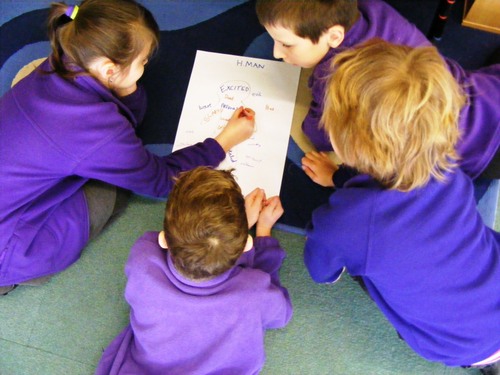
In their own words “The Guiden Morden Fire”.  The groups retold the story of the fire using drama games.  The groups used drama to structure their own version of the story.  These structures will be used as a starting point for building a narrative poem and dramatic scenes.
John Kirk is a storyteller and drama facilitator specialising in drama workshops and theatre for young people.Week Five

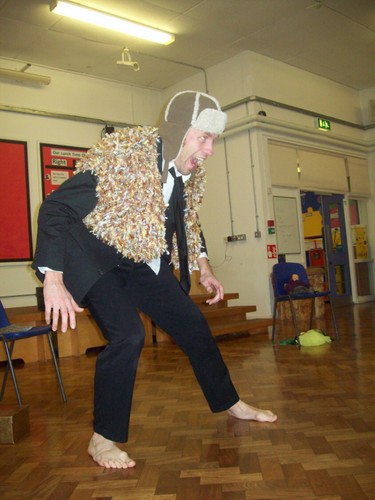
Acting Out the Events of 1881.  With the younger classes I appeared as a Victorian Schoolmaster and with the older classes we turned our version of the story into a series of scenes.  In the next week the classes will transcribe these scenes to form the basis of scripts and stories.

Over the next six weeks we have a lot of work still to do but I hope to be able to share news of our success, images and video here over the next few months.  Stayed tuned!
Mammoths to Medals (Revisited)

John Kirk specialises in drama workshops and theatre for young people.In 2013 I moved from the London borough of Hackney to the London Borough of Waltham Forest.  I may have only moved seven short miles but after six happy years in one of the most vibrant boroughs in Britain it was a massive wrench.  Whilst living in Hackney I had some of the most creatively fulfilling years of my life as I built strong working relationships with organisations including The Hackney Museum.  Hackney Museum, based in Hackney Central Library is an amazing community resource staffed by knowledgeable and creative people with a passion for sharing local history.  I may be biased but I think its one of the best museums in the country.

Working in heritage environments is something I really enjoy.  My earliest solo storytelling pieces were based around British history (including a Victorian Classroom session for The Bruce Castle Museum) and this summer I will be helping to lead a creative exploration of the Guilden Morden fire.

Anyway, as I sat watching Lizzy Yarnold, Jade Etherington and Team GB at the Sochi Winter and Paralympic Games I couldn’t help but think back to my time working with Hackney Museum.  It was in the build up to Summer Olympic and Paralympics (London 2012) that I collaborated with Hackney Museum on Mammoths to Medals,a presentation which sought to tell the incredible story of Hackney’s history as part of the Museum’s Mapping the Change project.  In just 30 minutes we explored 200,000 years of Hackney’s history highlighting the contributions of those people who have called Hackney their home; Anglo Saxon Farmers, Tudor Society, Victorian Industrialists and migrants from across the globe.

In the life of the project I have presented the piece on many occasions at Hackney Museum and in Hackney Primary Schools.  Incorporating games and learning activities into a chronological narrative the piece offer facts about Hackney and but also it questions how we will be remembered.

John Kirk is a storyteller and drama facilitator specialising in drama workshops and theatre for young people.A lot has changed in the two years since we made the piece was documented at Kingsmead Primary School.  Hackney’s demographic and landscape have been slowly morphing for 200,000 years but concerns about how communities will withstand the gentrification of East London mean our legacy is once again scrutinised.

When we look at Hackney’s story it shows us that change doesn’t have to be a bad thing.  It points to how different traditions, cultures and values have shaped an area into a place people want to live and work.   I am incredibly proud of being a part of Hackney’s history and of this piece.  I hope that through watching Mammoths to Medals young people recognise how they can shape their community.

Thankfully I haven’t lost touch with Hackney Museum and hope to be back to run sessions as the country prepares to commemorate The Great War.  For the moment though I am very settled in Waltham Forest and I’m looking forward to the future.

St George and the Dragon: The Golden Legend

John Kirk is a storyteller and drama facilitator specialising in drama workshops and theatre for young people.I was recently asked to recall the stories that I told.  As I compiled my list it occurred to me that my repertoire includes stories about our world from all around the world. A striking example of this is The Legend of St George and the Dragon.

The Legend of St George and the Dragon is well known in England because he is the nation’s patron saint and although it seems, on the surface, a straight forward battle between man and beast (albeit mythical monster) this is a story which is appreciated around the world.

It is said that the story was first brought to England from the Holy Land  by Knights returning from the Crusades.  The story goes that St George comes to the town of Silene in Libya.  Learning that the town is troubled by a terrible Dragon, George seeks the beast out and kills it.  He is hailed as hero by the people.  It’s easy to see how the central idea of bravery, honour and valour conquering a terrible enemy would have resonated with the returning soldiers and fascinated the population at the time.

The idea of George as a Knight fighting with a Dragon, sometimes referred to as “The Golden Legend”, is a romantic view of the Saint’s life.   Saint George was a Roman Soldier, who was born in Turkey 2000 years ago and died for refusing to renounce his Christian faith.  In death St George is respected by Christians and Muslims alike.  As well as England, St George is patron of the World Scouting Movement and other countries including Georgia, Greece, India, Russia and Egypt.  The list of countries and cities who have chosen George as their patron saint is much longer than this but I feel this selection demonstrates his truly global appeal.

John Kirk is a storyteller and drama facilitator specialising in drama workshops and theatre for young people.George and the Dragon is a legend: a traditional story sometimes popularly regarded as historical but not authenticated (www.oxforddictionaries.com).  Both Knight and Dragon can be viewed as metaphors (the saint’s battle with religious persecution).  In some versions of the story George captures the Dragon and only agrees to killing it if the people of the town convert to Christianity.

At the beginning of this blog I said that St George and the Dragon demonstrates how the stories I tell are about our world from all around the world.  Now, I’m not suggesting that everyone who chooses George as their patron did so because of “The Golden Legend” but I would say that you don’t have to be religious to buy into the metaphor.  Everyday all around the world people face hardships and difficulties.  They aren’t knights and don’t have swords or shields but they do share the resolve and courage that George had in facing his Dragon.

Doing the right thing isn’t always easy – it’s a simple yet enduring message.

The Great Fire of London

John Kirk is a storyteller and drama facilitator specialising in drama workshops and theatre for young people.Recently I have being doing a lot of history projects in the name of education; The Gun Powder Plot, The Princes in the Tower and The Great Fire of London.

In 2013 it wouldn’t be uncommon to hear that a lesson was being in some way led or influenced by an artist but theatre’s relationship with education is historic.

As a visual and aural medium theatre has always been an effective method of communicating information quickly to an illiterate society.  The Greeks used comedy and drama to make social and political points, Mystery plays were a popular way of sharing the stories of the Bible with Medieval audiences and even William Shakespeare got in on the act with a series of plays we now recognise as his histories.

John Kirk is a storyteller and drama facilitator specialising in drama workshops and theatre for young people.Why though, are there so few plays concerning The Gun Powder Plot and The Great Fire of London?

I don’t really have an answer to this but I do have a couple of theories.

In the case of The Gun Powder Plot (the failed attempt to blow up the opening of Parliament and King James I in 1605 – “Remember, remember the 5th of November”) and to some extent The Great Fire of London (a fire in Pudding Lane leads to 4 days of devastation in 1666) my initial thought is that perhaps there were plays and they weren’t good enough to survive the test of time or that I just don’t know them if they are out there.John Kirk is a storyteller and drama facilitator specialising in drama workshops and theatre for young people.

My second thought is that 17th Century England is a politically volatile place where the censor still dictates what is appropriate for the public.  The Gun Powder Plot is an attempt on the life of a reigning monarch at the beginning of the century.  In 1643 Charles I was executed after a Civil War and England became a republic for almost ten years before the restoration of the monarchy and finally James II being run out of England for being Catholic.

Socio-political statement might also have jarred with the increasing public appetite for Restoration Comedy as the likes of Wycherley (The Country Wife) and Moliere (Tartuffe) titillate audiences with plays about gossip and the naughtiness of society.

My final theory and the one I’m sticking to as to why there are no really great plays about two of England’s most famous historical events is health and safety.  Plays about fire and combustion tend not to mix well with wooden theatres!  Perhaps sense prevailed and they left these two topics for another generation.