Tag Archives: Victorians

The Great Fire of Guilden Morden (Part One)

John Kirk specialises in drama workshops and theatre for young people.Three years ago it was my pleasure to be involved in two projects which were funded by the Creative Partnerships initiative.  The programme saw artists working with schools and exposing pupils and staff to new ideas of working.  In Stoke we worked to explore how we identify with urban spaces through stories and in Lincolnshire we created a story trail for the school and wider community.

Rather than doing a day in a school I was able to present a series of workshops as I took up residency in my partner schools.  The projects were very rewarding and I feel that I learned a lot about my practice from being involved.  I was supported by my partner schools to try out ideas (to take risks) and organise really memorable learning experiences for the children (we did a Q&A in Stoke with some local VIPs as well as a creative walk, whilst in Lincolnshire I organised storytelling experiences around the school to help the children’s imaginations).  Sadly (as is the way with these things) the programme came to an end just as I was discovering it.

Last year I was contacted by Guilden Morden Primary School who were looking for a creative partner for a Heritage Lottery funded project.  Working over 12 weeks between May 2014 and July 2014 the school would devise and develop a creative response to The Guilden Morden Fire (22/5/1881).  This creative response would be documented using web based, digital technology.  Remembering my previous Creative Partnership experiences I jumped at the chance.

At the time of writing we are approaching the midway point of the project.  I have tried to summarise what we’ve done below…
John Kirk is a storyteller and drama facilitator specialising in drama workshops and theatre for young people.Week One

Celebration.  Our first session fell on May Day.  In Cambridgeshire at the time of our story May Day would have been an opportunity for the community to celebrate the coming of Spring.  I want celebration to be central to our final presentation so I introduced a simple group dance to the children.  The dance will be incorporated into the final presentation and offer our work a communal spectacle.

Who are you?  Through simple storytelling games I found out more about the groups and we used objects to stimulate more personal stories.

Week Two

Who am I to you?  The pupils brought objects from home to tell their personal stories.  We then used the objects to build a map of their school community.  By spending two weeks focussed on identity we are better positioned to introduce the heritage aspect of the project (I have a better understanding of who I am but where do I come from?)

Week Three

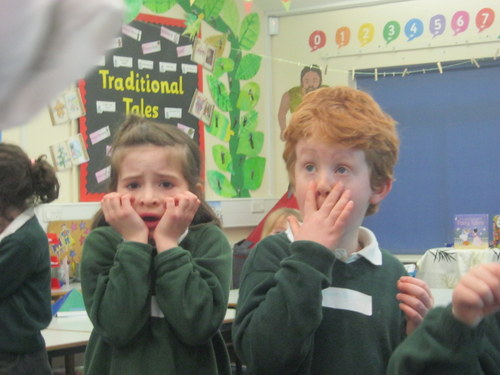
The Great Fire of Guilden Morden Walkabout.  I lead walks around the village, introducing the children to the story of the fire in role.  Each walk took us on a 40 minute stroll about Guilden Morden stopping at the (assumed) site of the fire, The Independent Chapel, Old School, War Memorial, Church and Vicarage.  At each stop I role played a different character who had a part in the story of the fire.

Week Four

Commemoration.  This session fell on the anniversary of the fire.  To mark the date the school organised a fire drill and I read the newspaper report of the fire to the children in assembly.  Our commemoration was in sharp contrast to the celebration of Week One.

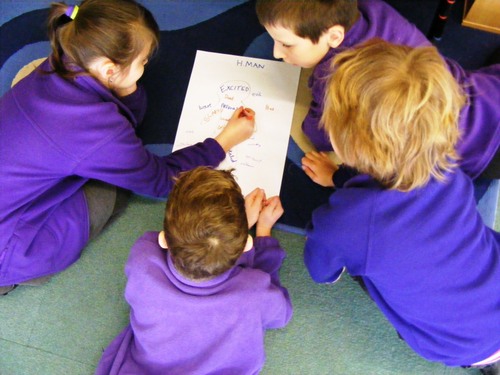
In their own words “The Guiden Morden Fire”.  The groups retold the story of the fire using drama games.  The groups used drama to structure their own version of the story.  These structures will be used as a starting point for building a narrative poem and dramatic scenes.
John Kirk is a storyteller and drama facilitator specialising in drama workshops and theatre for young people.Week Five

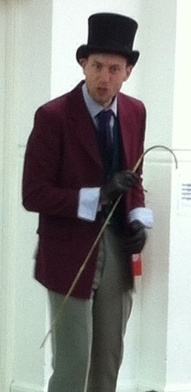
Acting Out the Events of 1881.  With the younger classes I appeared as a Victorian Schoolmaster and with the older classes we turned our version of the story into a series of scenes.  In the next week the classes will transcribe these scenes to form the basis of scripts and stories.

Over the next six weeks we have a lot of work still to do but I hope to be able to share news of our success, images and video here over the next few months.  Stayed tuned!
Mammoths to Medals (Revisited)

John Kirk specialises in drama workshops and theatre for young people.In 2013 I moved from the London borough of Hackney to the London Borough of Waltham Forest.  I may have only moved seven short miles but after six happy years in one of the most vibrant boroughs in Britain it was a massive wrench.  Whilst living in Hackney I had some of the most creatively fulfilling years of my life as I built strong working relationships with organisations including The Hackney Museum.  Hackney Museum, based in Hackney Central Library is an amazing community resource staffed by knowledgeable and creative people with a passion for sharing local history.  I may be biased but I think its one of the best museums in the country.

Working in heritage environments is something I really enjoy.  My earliest solo storytelling pieces were based around British history (including a Victorian Classroom session for The Bruce Castle Museum) and this summer I will be helping to lead a creative exploration of the Guilden Morden fire.

Anyway, as I sat watching Lizzy Yarnold, Jade Etherington and Team GB at the Sochi Winter and Paralympic Games I couldn’t help but think back to my time working with Hackney Museum.  It was in the build up to Summer Olympic and Paralympics (London 2012) that I collaborated with Hackney Museum on Mammoths to Medals,a presentation which sought to tell the incredible story of Hackney’s history as part of the Museum’s Mapping the Change project.  In just 30 minutes we explored 200,000 years of Hackney’s history highlighting the contributions of those people who have called Hackney their home; Anglo Saxon Farmers, Tudor Society, Victorian Industrialists and migrants from across the globe.

In the life of the project I have presented the piece on many occasions at Hackney Museum and in Hackney Primary Schools.  Incorporating games and learning activities into a chronological narrative the piece offer facts about Hackney and but also it questions how we will be remembered.

John Kirk is a storyteller and drama facilitator specialising in drama workshops and theatre for young people.A lot has changed in the two years since we made the piece was documented at Kingsmead Primary School.  Hackney’s demographic and landscape have been slowly morphing for 200,000 years but concerns about how communities will withstand the gentrification of East London mean our legacy is once again scrutinised.

When we look at Hackney’s story it shows us that change doesn’t have to be a bad thing.  It points to how different traditions, cultures and values have shaped an area into a place people want to live and work.   I am incredibly proud of being a part of Hackney’s history and of this piece.  I hope that through watching Mammoths to Medals young people recognise how they can shape their community.

Thankfully I haven’t lost touch with Hackney Museum and hope to be back to run sessions as the country prepares to commemorate The Great War.  For the moment though I am very settled in Waltham Forest and I’m looking forward to the future.

A Story? Really? A blog about managing innocence in storytelling

John Kirk is a storyteller and drama facilitator specialising in drama workshops and theatre for young people.As a storyteller I rely upon two presentation models: narrating events and being the character.  My relationship with the audience will change depending how I present the story.  If I am narrating events I inform the audience of our relationship.  I allow them to understand that the story and its events are a fiction and that they are watching a presentation.  I do this by introducing myself, talking about the story and clearly demonstrating different characters.  When I become a character my audience must do much more of the work themselves.

“So what?”, I hear you cry.  Well, when I present a session as a Victorian School Teacher the participants are briefly starring in a drama devised to expose them to the way education might have been in the 19th Century.  If the participants don’t respect the threat of caning then the session is less effective.  Equally, when I present a Detective investigating a crime the participants must be convinced that the scenario is credible.  A lack of investment in the world of the story can be a session’s undoing.

John Kirk specialises in drama workshops and theatre for young people.Cynicism can bedevil creativity as we grow up and the examples above relate to characters and sessions devised for pre-teens but what about when we are very young?  What are the dangers of investing too heavily in stories?  Can there be any harm in believing that you just met the Gruffalo?  I suppose that very much depends on the experience.  For a young child, meeting a creature with terrible tusks, terrible claws and terrible teeth in terrible jaws etc. will either be the best or worst day of their life.

Clearly telling a very young participant that what is happening (or about to happen) isn’t real can impact their experience.  You could go as far as to say that intentionally breaking the illusion robs them of an innocent experience.  There is unquestionable security in the truth and I think it is the storyteller’s responsibility to offer that security through the narrative by ensuring audiences see that the wicked get there just desserts.  If the participant absolutely believes is this more memorable or just confusing?  Is Miss Trunchbull scary if you know its an act or is the Mad Hatter as wonderful if you know its in some way false?  How a situation is managed will hinge on lots of factors including the sensitivity of the participant and the circumstances and legacy of the meeting.

From my point of view it isn’t easy to maintain the reality of being a character rather than a person for an extended period of time.  It can involve a lot of planning with a school or organisation ahead of the day.  Trying to think like a character at all times and allowing everybody to believe you are a character can be exhausting (once I spent an entire day in a Headteacher’s study in role pretending to work at her desk!).  I have however found that the legacy of this approach is huge and the feedback on such sessions is generally very positive.

John Kirk specialises in drama workshops and theatre for young people.“When you came in to work with the children during world book week, they were completely gripped!  The story narrative you came up with to engage the children was phenomenal, the children completely believed the 3 Little Pigs had been eaten!  You stayed in role all day and as a result the children played along too, the quality of writing and language we got from them was fantastic.   I have no doubt in my mind that we would use you again… as we are still talking about it a year later!!” (Teacher, St Wulstans and St Edmunds Primary School, Fleetwood)

I suppose that to some extent the purpose of the story will determine whether the participants are allowed to believe in the character.  After presenting the Victorian Classroom I will appear to participants as myself and discuss their experiences.  This is partly to assure groups that the monstrous school master is imaginary but also so that the group can articulate how my lesson and their lessons compare.

John Kirk is a storyteller and drama facilitator specialising in drama workshops and theatre for young people.The real world can be a hard place and sometimes we grow up too fast.  Its a sad day when a child becomes inhibited by doubt.  I was recently at a school and a little girl took me to one side and asked whether I really was Willy Wonka.  I told her that in life we can choose to believe or we can choose not to believe but that decision was ultimately hers.  She skipped away satisfied with my answer, having just chatted with the world’s greatest chocolate maker!

There are times when I wish I was a little more innocent.  As an adult and a storyteller I have an important role to play in maintaining the innocence of my youngest audiences for as long as possible.

The Victorian Classroom Experience

John Kirk specialises in drama workshops and theatre for young people.I had just marched out of the hall, my cane tucked under my arm, the children quivering with fear.  In the quiet of the staffroom I reviewed my morning as a Victorian School Master.

The session had come about after I was contacted to provide an authentic Victorian Classroom experience.

About three years ago I was commissioned to write a School Room session for The Bruce Castle in Haringey.  This would be a fabulous opportunity to revisit the piece.

The Bruce Castle School in Tottenham was run by the Hill family during the 19th Century (Rowland Hill gave us the Penny Black).  The school was renowned for its progressive approach to discipline.  Rather than using corporal punishment, The Bruce Castle School introduced a system of points and rewards which was administered by the pupils themselves.  It had many supporters including Charles Dickens who is known to have visited the school.

Unfortunately The Bruce Castle is something of an exception to the rule in the period.  It was only late in the reign of Queen Victoria that education became compulsory and then only for the very young.  Many children found school either voluntarily or via the workhouses.  With sometimes eye watering class sizes order was maintained through fear.

Having reworked the piece to incorporate references to potential punishments I have tried to communicate the importance of the credibility of the session to the school.  If the children don’t buy into the experience then the experience is liable to collapse (he’s not really a teacher/he isn’t really going to cane us etc) 150 years ago it was acceptable to hurl board rubbers at pupil’s heads – 150 years is clearly a very long time!  When I arrive, the school has excelled.  They have a free standing white board and arranged rows of benches in their hall.  There is even a lectern for the register.  With my bell and my cane we have created a pop up Victorian Classroom!

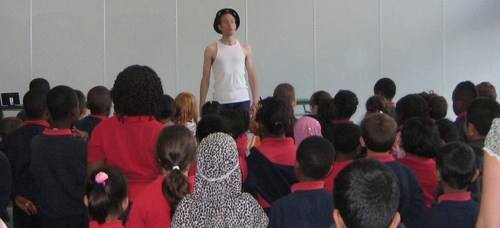
OLYMPUS DIGITAL CAMERAJust before 9.05 I go to get the class.  They are ready.  We head to the hall where the boys and the girls stand in front of separate benches.  The atmosphere is nervous.

“No speaking, Eyes front”.

I register the class, addressing them by surname.  As I stumble through the register I am reminded of how far removed the Victorian world is from the present day.

“Sit down”.

The lesson today is divided into reading, writing and mental arithmetic.  It begins however with physical drill.

Whilst researching for the original piece I discovered that quite often PE would take place in the classroom because the school didn’t have outdoor facilities.  The children would take part in physical drills at their desks!  We often take public parks for granted but at this time open spaces in urban areas must have been truly oases.

Drill over its into learning by repetition.

“Sit up straight!  Eyes front!  No slouching!”

Victims are selected.

“What is 4×5?”

Pressure can make the most intelligent child look very silly.

“What is the superlative in the passage?”

The point of this isn’t simply to intimidate or make a child feel silly.  The point is to demonstrate a method of learning.  This isn’t the learning of compromise this is the learning of fear – my way or the highway.  if a girl hesitates on an answer its also an opportunity to reinforce attitudes towards educating young ladies with a jibe about needlework.

OLYMPUS DIGITAL CAMERAThe lesson moves onto a writing exercise.  Today as substitutes for slates we have portable whiteboards.

“Why are you writing with your left hand?  You will write with your right hand”.

As School Master I maintain an unsympathetic air to the teachers and pupils and the lesson continues in silence.  What rapport there is between class and instructor is cold and dangerously sharp.

“Sit up straight!  Eyes front!  No slouching!”

The lesson concludes with three cheers for Queen Victoria.

Afterwards there is time to discuss the experience with the class.  The feedback on the session is interesting.  Words like “unfair”, “shocking”, “mean” and even “rude” are used.  Comparisons are made (everybody prefers their class teacher to my incarnation!).  There is general relief that I am not the monster of the Victorian classroom.

Sitting in the staffroom I can’t help but smile.  As the children return to their classroom and life gets back to normal there is legacy in their participation.  Undoubtedly this morning’s interaction will provide context to their learning, stimulus for their writing and renewed enthusiasm for their study but you only need to listen to hear them recalling moments from the session to know that this has affected them.

It has been an unforgettable experience.