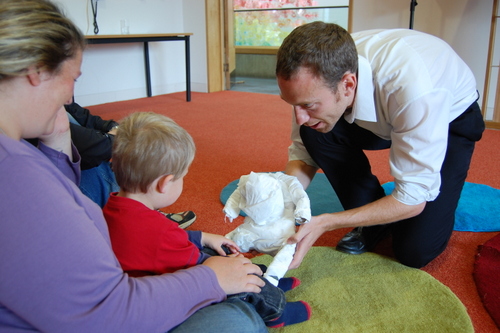
As a student I was introduced to the ideas and work of Bertholt Brecht.
Bertholt Brecht was a German playwright and drama theorist who lived in the early part of the 20th Century. The theatre of the time was shallower and more melodramatic than the theatre that would be familiar to us today.
Brecht was an advocate of Epic Theatre and sought to readdress the performer-audience relationship, believing that theatre should instruct as well as entertain its audience.
Rather than allowing the spectator to relax, Brecht wanted them to think about what was being presented. He developed techniques to alienate audiences into objectivity and in his essays he talks about how an actor might encourage this alienation.
Over a decade has gone by since I first read Brecht’s ideas but today many of them are recognisable in my storytelling.
Directly addressing the audience
Brecht believed that to readdress the relationship between performer and audience meant tearing down the conceit that the audience is somehow invisible to the performers. In removing the “fourth wall” from the stage Brecht acknowledges the Elizabethan theatre in which delivering a soliloquy to the crowds would be commonplace.
As a storyteller I would find it almost impossible to share stories without looking at the audience. My narratives often depend upon a more active rapport as the audience become characters or participate in activity and discussion.
 Simplicity
Brecht talks about stripping back the paraphernalia of theatre (the lights, set, costume etc) to expose the audience to a story rather than allowing them to hide behind the experience.
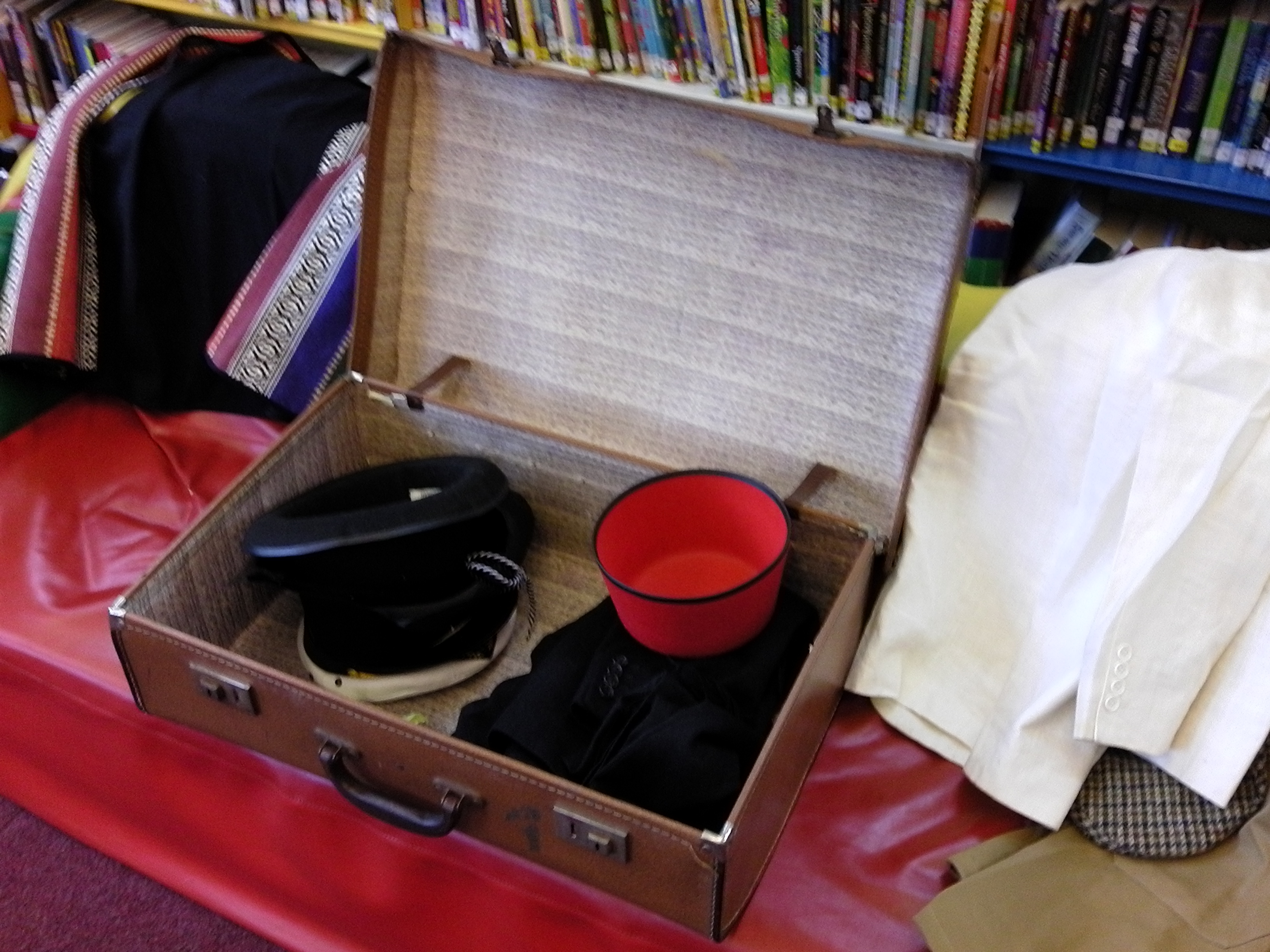
A stripped back style isn’t really a choice when you carry your set, costume and props in a suitcase! I do believe that in stripping away some of the frills of performance my audiences are more focussed.
My further thoughts on technology, concentration and storytelling
Characterisation
Bertholt Brecht admired the Chinese style of acting in which the performer demonstrated their character. They do not become the role but play the gestus (a suggestion) of the role.
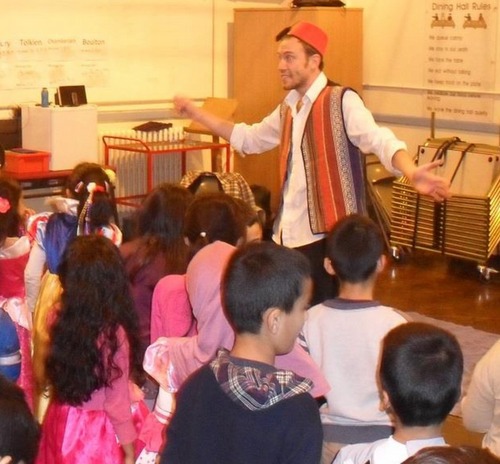
In my version of A Christmas Carol I play as many as 14 of Dickens’ characters, sometimes for no more than a few seconds. The character is a vehicle for my narrative. I must portray the gist of the character quickly with no time to consider my emotional connections to a part. With small parts I achieve these lightning transformations by making distinct physical and vocal choices (Scrooge is spiky and nasal where Bob is small and timid). Of course I work with young audiences so I incorporate bits of costume or props to suggest different characters. The result is very entertaining (particularly when I get confused!) because its visually dynamic but it also forces audiences to concentrate.
My thoughts on the use of subtext in Naturalistic performance
Empathy vs Choice
Brecht believed that empathy shouldn’t be theatre’s primary currency. Brecht was acutely aware of the theatre’s power to enlighten people to broader social issues. Through his work he attempted to detach audiences from the sentimental and move them to take action by encouraging his actors to clearly present their character’s choices.
Brecht the playwright would probably have approved of the way I structure my presentations as I will happily mix narrative with drama activities. In Brecht’s plays he regularly juxtaposes presentation ideas as narrative is interrupted by dramatic songs. This means, like in a Music Hall presentation, his scenes can often stand alone and that the audience are again reminded that they are watching a play.
As I generally interpret other writer’s works I am rarely positioned to state personal opinions for the duration of a narrative but I will try to convey my thoughts and feelings on a story to the audience. This could be in the choices I make in the wording of the adaptation or a pause or a look to the audience highlighting what I see as a crossroads for a protagonist in the narrative.
 It is difficult to say whether my audiences empathise with my presentations. My style of presentation means that they probably remain quite objective toward characters (it can’t be easy to empathise with characters when I’m continually changing roles!) but empathy is still important to my stories (if we don’t care what happens to Hansel and Gretel in the enchanted forest then there is no real peril or adventure).
Truth in Non Naturalistic Storytelling
When we talk about alienating an audience from a presentation we must be careful about removing the truth entirely. Non naturalistic storytelling is still storytelling. At times it may be heavily stylised and may jar with an audience’s expectations but it’s success will depend upon a world being credibly sustained. In my own work it is vital that the audience quickly accept that I will be demonstrating lots of different characters who will exist to serve the story. If style takes precedence over substance then the story has been failed.
I believe that it was studying Brecht and non naturalistic storytelling techniques that lead me to be the storyteller I am today. We are fortunate to have the benefit of past wisdom at our disposal when we make art today. I could probably analyse my style in the light of other practitioner’s ideas, drawing comparisons and justifying their influence on my work but I feel that learning about Brecht has allowed me the freedom and confidence to tackle complicated and amazing stories that I couldn’t otherwise have done.
My further thoughts on the value of training and experience to the storytelling experience
It’s only by better understanding rules about form and content that we can begin to bend them to our advantage.
Brecht on Everyday Theatre
You artists who perform plays
In great houses under electric suns
Before the hushed crowd, pay a visit some time
To that theatre whose setting is the street.
………………………………………
Here the woman from next door imitates the landlord:
Demonstrating his flood of talk she makes it clear
How he tried to turn the conversation away from the burst water pipe.
A drunk gives us the preacher at his sermon, referring the poor
To the rich pastures of paradise. How useful
Such theatre is though………………
These actors do not, like parrot or ape
Imitate just for the sake of imitation, just to show that
They can imitate; no, they
Have a point to put across. You
Great artists, masterly imitators, in this regard
Do not fall short of them! Do not become too remote
However much you perfect your art
From that theatre of daily life
Whose setting is the street.
Take that man on the corner: he is showing how
An accident happened. This very moment
He delivers the driver to the verdict of the crowd: the way he
Sat behind the wheel, and now
He imitates the man who was run over, apparently
An old man. Of both he gives
Only so much as to make the accident intelligible, and yet
Enough to make you see them. But he shows neither
As if the accident was unavoidable. The accident
Becomes in this way intelligible, yet not intelligible, for both of them
Could have moved quite differently; now he is showing what
They might have done so that no accident
Would have occurred. There is no superstition
About this eyewitness, he
Shows mortals as victims not of the stars, but
Only of their errors.