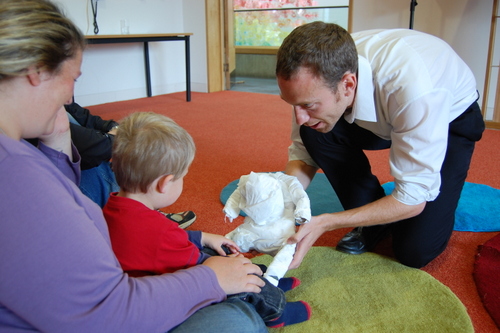
I graduated from Rose Bruford College in 2002 and that Christmas I took a job with a small scale touring pantomime company. I was young and fresh and keen to begin building my career. Well some would say that at 6ft 4ins I wasn’t the most obvious choice for Rumpelstiltskin but I was still very excited to be involved particularly when I learned that we would be doing a public performance in a supermarket.
Well when we arrived at the venue we realised the story wasn’t to be performed in the store but in the staff canteen to the children of the workers. The other problem (as it turned out) was that store was open and the canteen in operation. During a 90 minute show we battled deafening tanoy announcements, staff and parents talking over the story and even workers crossing the performance area. It was at about this point I realised how hard a life in the arts was potentially going to be.
Nearly 12 years on from this experience I am now more than accustomed to inviting family and friends to watch me present stories in strange places. I have told stories in pub beer gardens, public squares, parks and even a beach hut. In my view, the same golden rule for success applies whatever the venue: if you aren’t the most interesting thing in the room then you are doomed.
If the environment isn’t right then it won’t matter about the content or delivery, the presentation will not be as effective as it might otherwise have been. This isn’t always as straightforward as it may seem. My work is something between pure storytelling and theatricality. You might think that in suggesting characters using props, hats and wigs even my most wordy stories would be the most interesting thing in any room. However, I was once telling Private Peaceful in a library when my young audience were completely distracted as a cat crossed the window ledge behind me!
I accept that there are certain things which are beyond the control of the event organiser (unless its your cat) but there are invariably steps that can be taken to ensure that everybody has the best possible opportunity to enjoy the story.
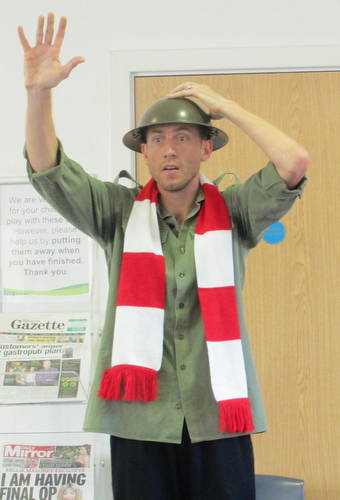 Is the story suitable and do the group know enough about the subject matter? Preparing for an event (determining a story’s suitability, talking to a group about the content/background) will maximise engagement and minimise disruptive behaviour. In telling “The War Game” I have noticed that audience members with some knowledge of The Great War take more from the experience.
Can the group engage comfortably and safely with the presentation? It’s easy to say “they won’t mind” but in setting up a space the patience of an audience should be considered. This could mean laying out mats in a public library or ensuring that all the equipment in the school hall is away before we start our session so that there is extra space and no distractions but it can also relate to numbers. As a performer I don’t mind a large audience but when size compromises or dilutes the quality of the presentation there is a problem. Sadly, in austere times and as many schools grow to three or even four form entry, I am in regular correspondence with organisations who want to offer experiences to children but are having to make tough decisions based on numbers.
How is the experience going to be valued by those taking part? Young people with little experience of live presentations will watch adults and how they interact with a presentation. This means that very young children can sometimes be engrossed by stories because they are taking cues from their parents and elder siblings. Unfortunately things can also go the other way. I was once telling Hansel and Gretel to a group. At the beginning of the session I enlisted a teacher to assist me in handing out sweets and pebbles to the children so that they could help tell the story. Rather than placing the two items in front of each child the teacher chose to throw them to (or sometimes at) the children. A higher than usual proportion of that group spent the first few minutes of the story throwing their props because, in my opinion, they hadn’t been shown how to respect that element of the story. In my experience there is a definite difference in behaviour and attitude when a teacher or parent respects my work and gives a story their full attention (that means not marking books or checking a mobile phone). Its even better when my stories feeds directly into a project/topic and has a lasting legacy.
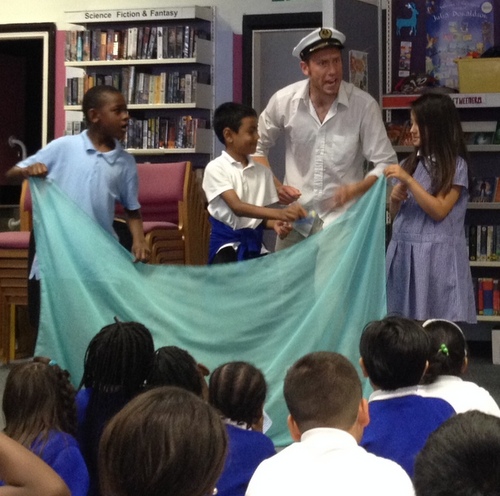
How is the experience going to be valued by the rest of the community? In some environments everybody must take responsibility for the experience. In school halls, museums and public libraries my stories have been interrupted by all manner of people who failed to recognise that their activity meant they had become the most interesting thing in the room. In my view (and this is only my view) we all have a responsibility to children and their literacy and whilst disruptions in a public setting are often unavoidable in some settings they are inexcusable.
I’m sure that I’ll have other supermarket experiences over the course of my storytelling life but my first is indelibly etched on my mind. For now my work is about collaboration. It is about effectively communicating with organisers what I do and how I do it ahead of the event and then it is about working in partnership to ensure that every session is memorable for the right reasons.