Tag Archives: school

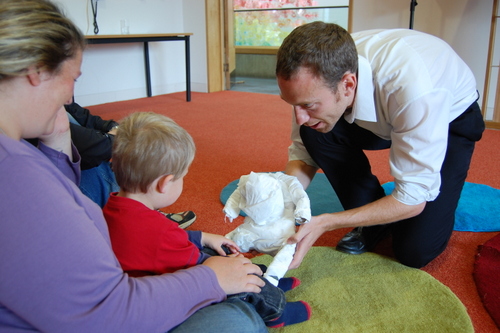
Telling a story in Aisle Four and creating the environment for storytelling.

The Victorian School MasterI graduated from Rose Bruford College in 2002 and that Christmas I took a job with a small scale touring pantomime company.  I was young and fresh and keen to begin building my career.  Well some would say that at 6ft 4ins I wasn’t the most obvious choice for Rumpelstiltskin but I was still very excited to be involved particularly when I learned that we would be doing a public performance in a supermarket.

Well when we arrived at the venue we realised the story wasn’t to be performed in the store but in the staff canteen to the children of the workers.  The other problem (as it turned out) was that store was open and the canteen in operation.  During a 90 minute show we battled deafening tanoy announcements, staff and parents talking over the story and even workers crossing the performance area.  It was at about this point I realised how hard a life in the arts was potentially going to be.

Nearly 12 years on from this experience I am now more than accustomed to inviting family and friends to watch me present stories in strange places.  I have told stories in pub beer gardens, public squares, parks and even a beach hut.  In my view, the same golden rule for success applies whatever the venue: if you aren’t the most interesting thing in the room then you are doomed.

If the environment isn’t right then it won’t matter about the content or delivery, the presentation will not be as effective as it might otherwise have been.  This isn’t always as straightforward as it may seem.  My work is something between pure storytelling and theatricality.  You might think that in suggesting characters using props, hats and wigs even my most wordy stories would be the most interesting thing in any room.  However, I was once telling Private Peaceful in a library when my young audience were completely distracted as a cat crossed the window ledge behind me!

I accept that there are certain things which are beyond the control of the event organiser (unless its your cat) but there are invariably steps that can be taken to ensure that everybody has the best possible opportunity to enjoy the story.
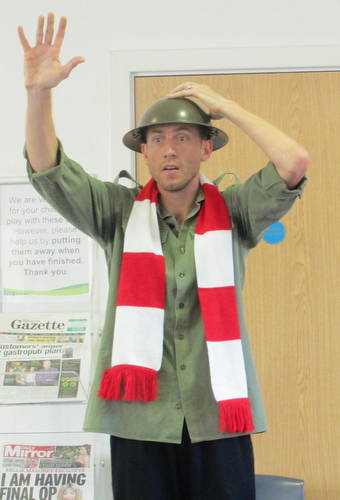
The War GameIs the story suitable and do the group know enough about the subject matter?  Preparing for an event (determining a story’s suitability, talking to a group about the content/background) will maximise engagement and minimise disruptive behaviour.  In telling “The War Game” I have noticed that audience members with some knowledge of The Great War take more from the experience.

Can the group engage comfortably and safely with the presentation?  It’s easy to say “they won’t mind” but in setting up a space the patience of an audience should be considered.  This could mean laying out mats in a public library or ensuring that all the equipment in the school hall is away before we start our session so that there is extra space and no distractions but it can also relate to numbers.  As a performer I don’t mind a large audience but when size compromises or dilutes the quality of the presentation there is a problem.  Sadly, in austere times and as many schools grow to three or even four form entry, I am in regular correspondence with organisations who want to offer experiences to children but are having to make tough decisions based on numbers.

How is the experience going to be valued by those taking part?  Young people with little experience of live presentations will watch adults and how they interact with a presentation.  This means that very young children can sometimes be engrossed by stories because they are taking cues from their parents and elder siblings.  Unfortunately things can also go the other way.  I was once telling Hansel and Gretel to a group.  At the beginning of the session I enlisted a teacher to assist me in handing out sweets and pebbles to the children so that they could help tell the story.  Rather than placing the two items in front of each child the teacher chose to throw them to (or sometimes at) the children.  A higher than usual proportion of that group spent the first few minutes of the story throwing their props because, in my opinion, they hadn’t been shown how to respect that element of the story.    In my experience there is a definite difference in behaviour and attitude when a teacher or parent respects my work and gives a story their full attention (that means not marking books or checking a mobile phone).  Its even better when my stories feeds directly into a project/topic and has a lasting legacy.
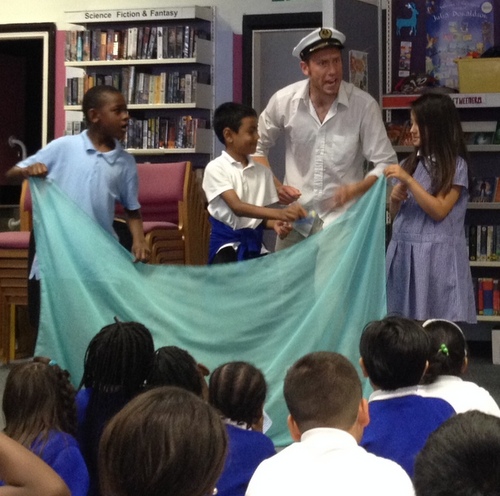
Odysseus and Poseidon

How is the experience going to be valued by the rest of the community?  In some environments everybody must take responsibility for the experience.  In school halls, museums and public libraries my stories have been interrupted by all manner of people who failed to recognise that their activity meant they had become the most interesting thing in the room.  In my view (and this is only my view) we all have a responsibility to children and their literacy and whilst disruptions in a public setting are often unavoidable in some settings they are inexcusable.

I’m sure that I’ll have other supermarket experiences over the course of my storytelling life but my first is indelibly etched on my mind.  For now my work is about collaboration.  It is about effectively communicating with organisers what I do and how I do it ahead of the event and then it is about working in partnership to ensure that every session is memorable for the right reasons.

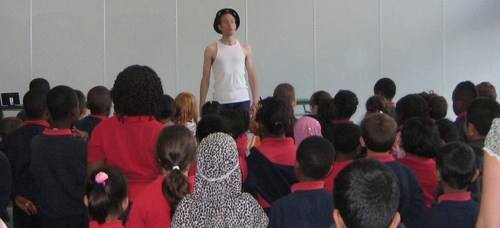
A Night at the Theatre

John Kirk is a storyteller and drama facilitator specialising in drama workshops and theatre for young people.Just before Christmas the ceiling at The Apollo Theatre collapsed during a performance of “A Curious Incident of the Dog in the Night Time” (see my previous blog on technology for my endorsement of this show). It was reported that audience members in the Upper Circle, Dress Circle and Stalls were injured by falling masonry and the theatre would be closed until the New Year.

My Twitter feed went crazy – I have many friends working onstage and front of house in West End Theatres – some people wanted to express their sadness at what was a shocking event, some people wanted to blame Theatreland for failing to invest spiralling ticket prices in the ageing bricks and mortar.

It got me thinking about the pitfalls of a night out at the theatre. Don’t get me wrong – I’m a big theatre fan.  In my opinion nothing is more spellbinding than the magic of theatre and I would encourage everybody to go more often but what are the risks when you are in charge of a large group?  I’m not going to take a swipe at the theatre establishment because the “incident” (excuse my pun on the name of the show) at The Apollo Theatre was a freak occurrence but taking a large group into any unfamiliar environment has challenges.

First there’s getting there. Sharing information and collecting ticket money can become a cycle of phone calls and letters. Once this is done you have to organise or navigate the transport. This can be a real headache.

Making it to the theatre is not the end of the logistical problems. Minding a large group in alien territory can be stressful and depending on the age of your group can involve anything from mass toilet runs to keeping teenagers out of the bar!

The quality of the show can also present a risk (see my blog about quality and storytelling).  When you book a show you are restricted to what’s playing. Can you guarantee that the production is going to be worth the entrance fee? Its easy to be open minded about quality when you’re spending your own money but with a group it’s a gamble.  Sadly, if your group aren’t engaged by the presentation (and sometimes even if they are) theatre audiences have little sympathy for young people who don’t understand audience etiquette.John Kirk specialises in drama workshops and theatre for young people.

Oh and don’t think that at the end of the show you can relax. When the curtain comes down and the lights go up its time to get everybody home.

When you present it like that it’s little wonder people contact me.

As a bespoke storyteller I am flexible enough to bring the show you want to your location. This means that you get a convenient, professional product at a much more reasonable cost.

I’m used to working with young people so there is an expectation that it will be an audience’s first experience of live performance. My classic and traditional stories are intentionally snappy and incorporate audience participation and other devices so as to engage even the youngest children. In your own environment the skill of listening and responding appropriately can be nurtured and your group remain free to enjoy live performance in their own way.  With older students I offer workshops to explore the themes, characters and ideas behind texts (“An Inspector Calls”, “Chatroom”, “The Crucible” etc).

John Kirk specialises in drama workshops and theatre for young people.A storyteller offers an alternative live performance experience. I believe in the value, power and legacy of quality storytelling and it is undoubtedly a privilege to share stories with young people be it in a theatre, a hall or a living room (see my Unbirthday blog).

In a way, although it was shocking, I’m glad those people were injured by the falling roof at the Apollo Theatre because it proves that live performance is still attracting big crowds.  It wasn’t very long ago that plays in the West End were reporting less than 25% houses and in some ways it would have been a lot more tragic if the ceiling had fallen onto empty seats.

It would be ridiculous if people stopped going to the theatre because they were scared a ceiling might fall down.  More realistically the greatest risks to a group attending the theatre are posed by the ever increasing cost of theatre tickets and the bureaucracy of organising trips.   Whilst I hope that theatre in the United Kingdom continues to flourish I also hope that to those put off a night at the theatre, booking a visiting creative practitioner is an attractive alternative.

istorytelling

John Kirk is a storyteller and drama facilitator specialising in drama workshops and theatre for young people.Many academics believe, “the attention span of a child is there age plus two minutes”.  In teenagers and adults this apparently maxes out at about 20-40 minutes but by this point in life we are able to refocus on tasks which mean we can do things for longer periods of time (ie watch films).

This rationale is very useful to anyone working with children and young people.  It helps to determine how long a participant can stay on task, how long it will be until they will need further stimulation or how long you have before distraction (in some cases) leads to disruption.

Sadly some experts believe that with the development of technology people’s attention spans are decreasing.  In a world of high speed information, full of fast moving colour and sound some things seem slow.

I was recently introduced to the idea of FOMO (Fear of missing out).  It’s a concept that explains the need to be hooked up to technology 24/7 and explains anecdotal evidence from parents and teachers of a need to teach younger and younger children the dangers of technology and in-school technology agreements (the class are allowed to check their phones in plain sight rather than under the desk).

As a storyteller I have a fear of missing out and sometimes fell that I’m old school.  I’m all for technology but my medium of communication remains much more low tech.  I use the costumes and props I can carry in a suitcase to accentuate a story told using my voice and my body.  My devices are generally theatrical and not electronic.

Some work surfs the new media wave.  In the past year I have seen two striking pieces of work supported by The National Theatre.  “The Animals and Children went into the Streets” (1927) and “The Curious Incident of the Dog in the Night Time” (Mark Haddon).  Both incorporated multimedia boldly, combining sound, light and projection techniques to extraordinary effect.  For all the bells and whistles though , these pieces have brilliant storytelling by exceptional creative talent at their heart.

John Kirk is a storyteller and drama facilitator specialising in drama workshops and theatre for young people.At the same time as society embraces a new media revolution, nostalgia continues to infiltrate our culture with businesses offering us more and more vintage clothing, furniture, food and even experiences.  Perhaps this is a sub culture but it does point towards people yearning for something simpler.

Storytelling is embedded within our culture and I wholly believe in its value, power and legacy.  Exchanging stories is a privilege and when you work in front of a live audience the relationship is always special and different.  Storytelling is everywhere you look and I’m not suggesting that we are in danger of losing this most ancient of traditions.  I am questioning how this brand of live entertainment fits into a world where baby’s first book is a tablet computer.  Is oral storytelling with simple props and costumes enough of a reward for patience or is it too much effort?  Is radical innovation the key to engaging a digital generation?  We’ll have to see…

—

istorytelling

You can’t rewind this if you leave

its not for tablet or box set.

There’s no multi player function

and you cannot hit “Refresh”.

*

A tweet won’t do it justice

and neither will your lens.

If you put this onto Youtube

you’d spoil it for your friends.

*

My interface is wireless

and my network is offline.

My errors are unique

but my “selfie” is defined.

*

I share my profile everyday,

I’m low tech but compelling.

I may lack tricks but I’m still proud

of my storytelling.