All posts by johnkirkstoryteller

About johnkirkstoryteller

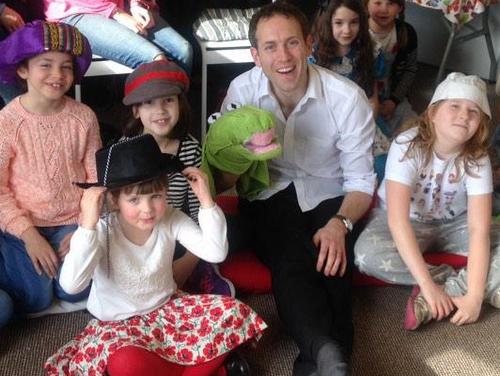
John Kirk - father, teacher, compere, poet, workshop leader, storyteller.

A letter to Ezra..

I was recently asked if I would contribute to a young man’s life book.  I’m sharing it here because I hope its relevant to other young people.  This is what I wrote:

Dear Ezra,

First of all Happy Birthday!  I vaguely remember being thirteen.  It was tough but I got through it and so will you.  Your Mum and Dad asked me to write something for your lifebook so here it is:

Here’s a slice of perspective for you.  Supposing you live to be 81 years old (I know that is a strange thought when you are coming to terms with being a teenager) the following points will apply:

1) You will have slept for around 200,000 hours – that’s a massive amount of time so I suggest avoiding it (particularly when at music festivals).  May be you’ll be tired but you’ll achieve more (see point two).

2) You will have worked for around 81000 hours – that’s based on you working 35 hours a week for 45 years.  Again I advise avoiding it or at least doing something cool which you won’t resent.

3) At 13 years old you had 90% of your life ahead of you – that is seriously exciting.  I hope you enjoy every second of it; challenge yourself to be your best, cherish the highs and get through the lows.

4) Your teenage years will have represented 4% of your life – it may seem crazy when your body and emotions are changing and when you are being bombarded and information, choices and unless you’re very lucky, exams, but however hard it gets remember that 4% is nothing – you’ll get through it and be free to get on with the remaining 86% of your life.

5) If your teenage years represent 4% of your life, what percentage would you give to some of your “friendships”?  1%?  0.1%?  If you love somebody hold them close and share your life with them -this isn’t a dress rehearsal so fill your life with those you value.  When you meet (and we all do) opposition don’t waste your time with hate; show them how to live better.  Many of your acquaintances will be distant memories for a lot longer than you ever know them and why should 0.1% of a life ruin a good thing?

6) If some of the people you’ll meet are there and gone in the blink of an eye, what about your family?  My Dad once said to me, you can’t choose your family, and it’s true; the day will come when you fly the nest and make your own way in the world but your parents and your siblings will always be there for you and you’ll be stronger for it (honestly).

In the heat of the moment there could be rash choices which later become regrets.  I encourage you to take a breath and a slice of perspective.  Does it matter that I can’t watch my TV show – probably not.  Life’s a marathon and not a sprint.

So Ezra on your thirteenth birthday, as you journey into adolescence remember to love and live well and don’t worry about today because today is the tomorrow you worried about yesterday.

All the best,

JKx
 

A case and mistaken identity

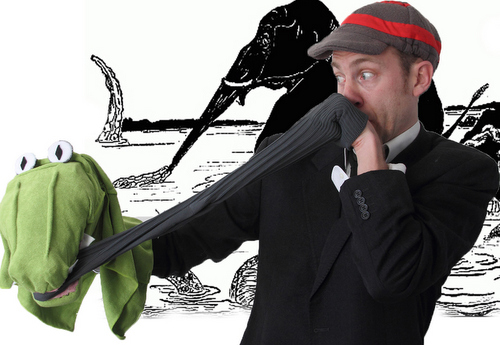
Elephant's ChildWhen I visit a library or school one thing is pretty certain; I will have a case with me.  My suitcase was purchased from a charity shop in Ilford back in 2012 for the princely sum of £3.00.  Originally intended to be used as a prop at my wedding I appropriated as a work bag.  Its very handy for carrying hats, props and costumes and is often a talking point with my neighbours, who are convinced I spend my entire life on holiday, and on public transport, where despite its size, it is a regular trip hazard (the case itself also stars in Dracula).  As the stories have got heavier I have appropriated a trolley which I bought for Glastonbury.  This makes most journeys much easier (and the trip hazard much larger!).

You may wonder why I am telling you about a fairly unremarkable suitcase.  Well, my story, for this blog is a story, concerns my case and mistaken identity.

I recently visited Oxfordshire where I was to be picked up and taken to the school where I would be working for the day.  Typically my train arrived almost fifteen minutes late at a station.  As I  rushed from the train to meet my lift to school I waved over to the car park where a lady wearing a yellow hi-vis was standing next to her car.  She waved back and I dashed up to the car.  We shook hands as she asked me my name, “John?”.  With my name confirmed we then began loading my suitcase into her car.

At this point another lady appeared from the vehicle parked next to the car now containing my case, “John?”.  At this stage another man with another case appeared, “I’m Tom”.

*Cue a double take and much laughter*

I had misheard the lady who had ben collecting Tom to take him to a luxury health spa.  Had the mistake not been discovered at the station, Tom would have been taken to school in my place!

In the end I had a fantastic day at school telling Just So stories but I can’t help wondering what the other spa guests would have made of my work or what the school children would have made of Tom the storyteller.

Federation of Children’s Book Groups “Share a Story” piece

DRAGONThe following appeared on the Federation of Children’s Book Groups blog during their Share a Story month – thanks to Christine Routh, super librarian at Leighton Park School, Reading for thinking of me – its all about Dragons…

In March 2015 I was contacted by a school in Norwich about telling stories relating to Dragons to link to the school’s involvement in the Go Go Dragons Project.  We decided I would tell my version of The Golden Legend “St George and the Dragon” and a version of “Beowulf”.

The choice of story was important.  Although its quite short and simple, I think the story of St George and the Dragon has a deeper message about facing fears and overcoming difficulties.  On the other hand Beowulf represents a huge challenge to me as a storyteller.  The narrative is action packed but I want to allow the words to tell the story.  What links these stories is english-ness and Dragons.

Dragons are wonderful creatures.  They have existed in stories around the world for hundreds of years and everybody has their own ideas about them.  I suppose that my idea of a Dragon is formed somewhere between “The Hobbit”, “Puff the Magic Dragon” and a painting my parents had of The Golden Legend (George slaying a classic green Dragon) but I am also a fan of the film “How to Train your Dragon” in which the animators reimagine these creatures as anything from elegant to ugly.

The problem with Dragons is that they are a generally unfriendly bunch.  To St George and Beowulf they represent an evil that threatens a way of life.  For young children, anxiety about the Dragon may need to be managed (telling them that George will be victorious) but with older audiences building the description of a terrifying beast with an element of peril can be gripping.

To help young audiences understand the story I try to keep the same simple description throughout the narrative.  This is a technique used by Homer in “The Odyssey”.  Repeating simple descriptions of characters and locations also helps me remember the story!

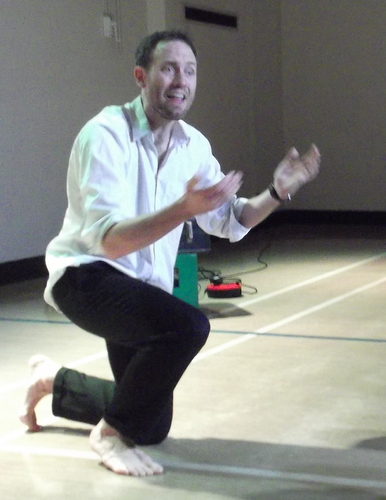
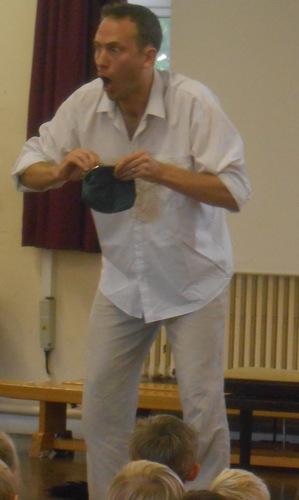
JK NORThrough choice and repetition of language I assist understanding but concentration can be a challenge for young audiences.  In many of my stories I use different devices which allow the audience to refocus after a period of time.  In a story like Private Peaceful this may be a song or some music.  In St George I am mixing imaginative play and drama activities into the story as audience members become knights.  Another technique I enjoy is to slide into characters (in A Christmas Carol I use elements of costume, my voice and small physical gestures to play 13 roles!).  Done badly this could be confusing particularly where differentiation is subtle (in a story like “The War Game” I take the roles of four different soldiers).  In the case of Beowulf I have devised a short story in which the dying hero remembers the deeds of his life.  This is complimented by a role play storytelling session in which the audience have the opportunity to explore the story through drama.  Involving a whole group in such an activity can be a very memorable storytelling experience.

If I do strike the right balance that means my stories appeal then it is difficult to qualify the impact of a storyteller.  By invigorating stories with expression, props, costume and activities I hope I play a part in honing my audience’s appreciation of live performance  and that I enthuse and excite them with language and stories.  The legacy of such a simple exchange as sharing a story could be almost as fantastic as a Dragon itself!

Happy half term!

Jack and the BeanstalkWhen I travel about the place I tend to forget stuff (I recently left a bag on a train back from Manchester).  Here’s a short poem about the effect of leaving things at home.

When I spend a night away

I pack a bag for where I’ll stay

I’ll put in socks and pants and stuff

(pyjamas and a shirt’s enough).

As I’m leaving, in my rush

I always forget my toothbrush.

This regular lapse of memory

means that in my bathroom, I have three!

The toothbrush collection causes a stink

they take up room around the sink.

The soap is squeezed to find a space

there’s just enough for my toothpaste.

Three is company and very nice

but I don’t brush my teeth three times!

This trio make the bathroom hectic

and there’s a fourth (it’s electric!)

Next time that I’m on a trip

I really need to plan for it.

Somehow or other I have to stop

buying toothbrushes from the corner shop.

But if I’m away and I’ve forgotten

another one would not be rotten.

Owning five might seem obscene

but at least I’m committed to oral hygiene!

Return to Hull

War GameYesterday I was in Kingston upon Hull (if you’ve never been I recommend the Old Town to you – some of the buildings are really rather lovely).  I was there to present Terry Deary’s “The War Game” for the last time.  This project has taken me all around the country and I have met some wonderful young people and librarians.  It therefore seemed appropriate to me that in Hull Paragon there are two monuments in keeping with the project which I’d like to briefly describe.

The first is a statue of the poet Phillip Larkin, who according to the inscription, was a librarian.  In my view librarians are amazing, stoic, versatile people with (like Larkin) hidden passions and talents.  It thanks to them that my project got as far as Swansea, Peterborough, Stevenage and Hull.  I’m happy to say I’ll be working with the library service in Hull again this August as we present The Mad Hatter’s Tea Party in the Queen’s Gardens.  I hope the weather is a bit better than it was on Monday!

HULL PARAThis brings me to the second and most poignant display at Hull Paragon.  Outside the station is an enormous memorial to those that fell during the Boer War but on the walls of the station are displayed the names of those soldiers who, a hundred years ago, passed through the station on the way to fight and never came home.  These simple wooden boards are a quiet reminder to all departing travellers that they might return where others before them made the ultimate sacrifice.  On Friday I will be piloting my latest Great War project, this time with Redbridge libraries.  I hope that my work has the same kind of impact on my audiences as these boards had on me.  Very moving stuff.

Guiding my own fate through diversification

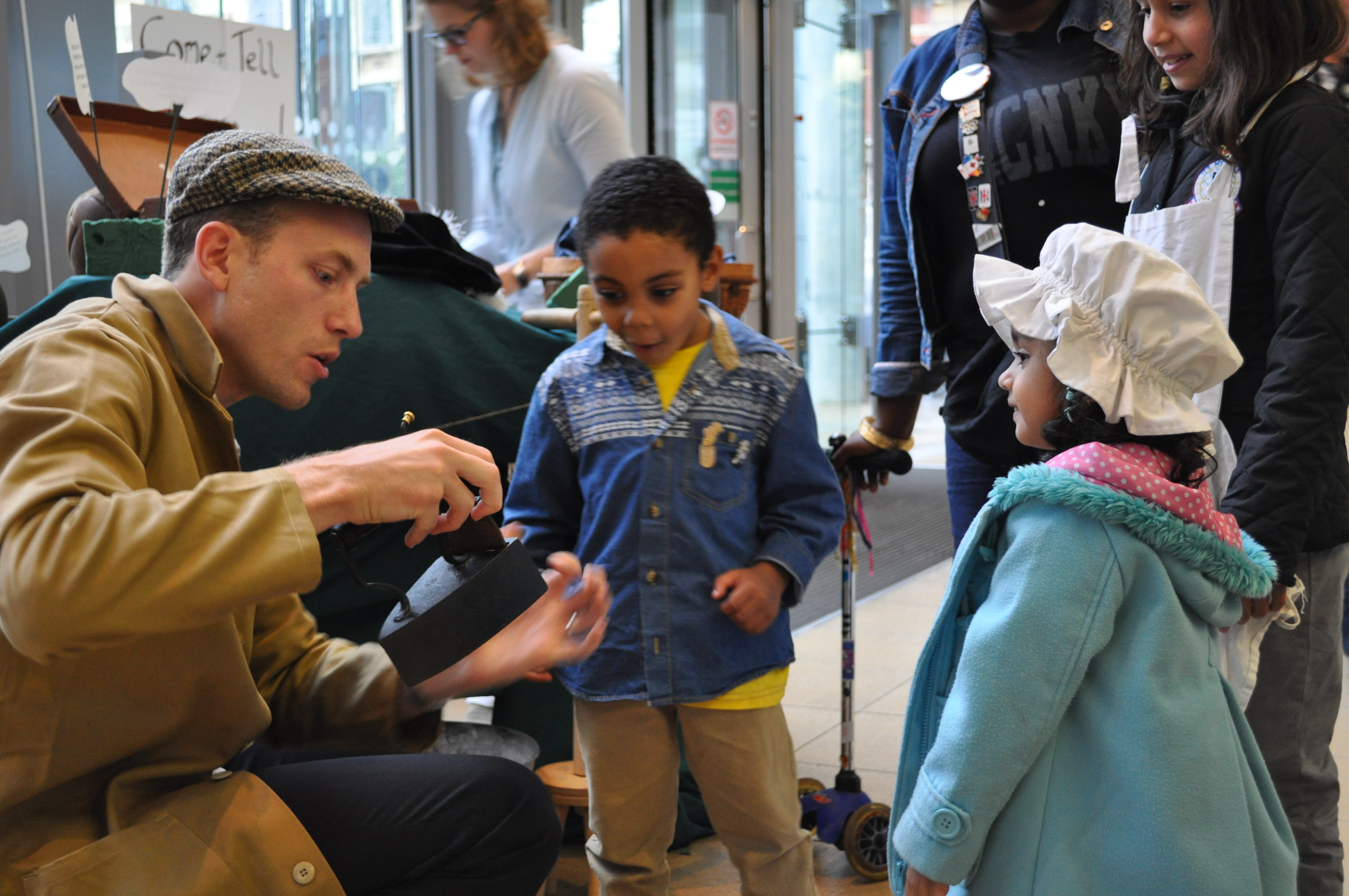
Hackney MuseumDo you have any phobias or superstitions?  I don’t like unprotected heights, the thought of planes crashing with me on them or pigeons flying at my head.  I enjoy stories about the supernatural as much as anybody and I also believe in fate.

Fate is an odd concept.  In Homer’s Odyssey, Tiresias makes a prophecy about Odysseus’ fate, saying how his life will turn out.  Odysseus tries to fight his fate but in the end it comes true.  I am no Greek hero but when I was at school I took comfort from the fact that however stressful the homework seemed I’d get it done.  Since leaving education I have left some key decisions to fate and however stressful things have got, happily (so far), something has always come along.  Immediately I hear you screaming at your screen that this isn’t truly fate or fortune but like Odysseus me fighting fate to make my own luck.  The homework was done because I did it, the work flows because I make it.  Some readers may find this admission reckless or even arrogant.  I don’t know but what I suppose it does show is that I believe I am fated to be successful.

That is a positive statement – I believe I am fated to be successful.  I think that a lot of people who take risks and make sacrifices to pursue what others would see as living precariously, deep down, would share this thought.  The problem with my statement is it comes with a caveat: I believe I am fated to be successful at something.  Whether that is the thing I am currently pursuing is a bigger more difficult question.  I have often thought that I am one of the best in the country at what I do because for many people (including myself at times) what I do is difficult to pin down.

The story so far: as a child bullying leads to a chronic lack of self confidence and a drama club.  In drama I find an identity.  At college I make like minded contacts and we put on plays together.  I am disillusioned by education but encouraged to audition for drama school.  Three years later I graduate without agent representation and for the next five years a career as an actor blossoms.  Five years on I have an agent but am disillusioned again and fall into office work.  A year later I am encouraged to write a one man show which begins to snowball into other presentations.  Four years later the label of a storyteller sticks and a world of museums, libraries and schools opens up.  Four years later I write a blog about fate and diversification.

The Elephants ChildYou see there are elements of my story where I fall into things (in my view fate) but when I read it back its clear that being proactive and willing to diversify has kept me relevant.  From enthusiastic amateur who put on his own shows, to professional actor with a string of credits, to workshop facilitator and storyteller carving a reputation, my work has moved forward; a metamorphosis brought on by needs and circumstances.  By developing my skill set and taking side steps when the path forward was blocked means that 24 years after I first encountered drama, creative arts is still central to who I am, what I believe and what I do.

This week the seeds of the next chapter of my journey through life have been sown with a TEFL (teaching English as a foreign language) qualification which I hope to be able to use in the UK within storytelling to enhance children’s learning of English.  How and where I’ll do that is a question for another day.

Stevie Wonder sang about superstition saying that the writing was on the wall.  Maybe he’s right and all this is just episode of my life.  I will always be my biggest critic because I qualify success as perfection and respect and perhaps diversifying means I am less niche and more “yes” man but my niche is also carved from determination and resilience.  Maybe I am fated to sit in an office, no one can truly say what the future holds for us.  For now, Stevie Wonder’s graffiti artist can keep his spray cans in his bag and stay away my house.

I’ve a hat for that…

STORYTELLING 1This morning I wanted to write something meaningful about the state of the nation ahead of the election.  I wanted people to understand what choosing cuts to public services means to arts practitioners like me, who are funded pretty much entirely by schools and local authorities.  In the end I couldn’t find the right words so instead I wrote a poem about my many different hats.

 

For the ‘I-don’t-get-its’

For ‘it-doesn’t-make-sense’

For ‘schools-dead-boring’

and sometimes parents.

For learning about stories

For learning about the past

For learning you’ve a future

if you give yourself a chance.

For moments you’ll remember

For memories you will make

For adding joy and inspiration

for someone else’s sake.

For a light bulb or a penny

For a different point of view

For an experience or something fun

I’ve a hat for that, have you?

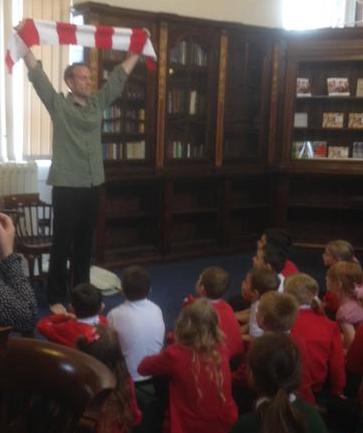
Clapton Orient’s War Game

This article is taken from Leyton Orient Football Club’s website.   I would like to acknowledge Steve Jenkins as researcher and author.  I post it here to mark the 100th anniversary of Clapton Orient going to war.

Clapton Orient’s ‘Brothers In Arms’

Posted: Wed 01 Aug 2012
Author: Steve Jenkins
Image by:
by Steve JenkinsHaving supported the O’s for over thirty years and being very keen on local history, the story of Clapton Orient’s involvement in the First World War has been of particular interest.I have spent nearly three years researching the background to the O’s ‘War Effort’ and I am extremely proud to be able to share this story with you.Season 1914-15 was the last prior to the Football league being suspended due to the First World War. Clapton Orient had finished in 9th position with Richard Mcfadden top scorer with 21 league goals.

People realised things were getting serious when an anti-aircraft gun was positioned on top of the ‘Spion Kop’ at the O’s Millfields Road ground, the local population then knew the threat of an arial attack was for real.

The male population of the country was being urged to ‘Join Up’ and Clapton Orient took the lead with no less than 40 members of staff volunteering their services, the first two players to sign on the dotted line being the O’s Captain Fred Parker and their Goal keeper Jimmy Hugall, all served in The Duke of Cambridge’s Own (Middlesex Regiment) 17th (Service) Battalion (1st Football).

A crowd of over 20,000 attended the O’s final League match of that season on 24th April 1915 verses Leicester Fosse, they witnessed not only a fine 2-0 victory for the Orient but also a final farewell Parade of all the Clapton Orient players and staff around the Millfields Road pitch.

The anticipation and euphoria of the early days of the war soon changed when the vast majority of British and allied forces found themselves in the Somme Region of Northern France having not only to contend with fighting a fierce German Army but also having to put up with at times terrible conditions with mile after mile of decimated country side from the incessant shelling by both sides and then having to live in and amongst mud, bodies and total desolation.

One can only guess at the extreme hell Soldiers went through in this conflict.

It was during the Battle of the Somme in the summer of 1916 that Clapton Orient lost three of its finest players: Company Serjeant Major Richard McFadden MM F/162, Private William Jonas F/32 and Private George Scott 1583.

The following article appeared in an O’s programme in November 1916.

The Club received a letter from Richard McFadden, which read:

“I, Richard McFadden sadly report the death of my friend and O’s colleague William Jonas on the morning of Thursday 27th July, aged 26.

Both Willie and I were trapped in a trench near the front in Somme, France.

Willie turned to me and said ” Goodbye Mac”, Best of luck, special love to my sweetheart Mary Jane and best regards to the lads at Orient. Before I could reply to him, he was up and over. No sooner had he jumped up out of the trench, my best friend of nearly twenty years was killed before my eyes. Words cannot express my feelings at this time.

Yours
Company Serjeant Major Richard McFadden.”

Richard McFadden died on the 23rd October 1916 from wounds received in the same conflict whilst George Scott was killed on the 16th August 1916.

Stephen Jenkins
Vice Chairman
Leyton Orient Supporters’ Club

Clapton Orient were the first team to enlist as a team to fight in The Great War together.  By the Autumn so many teams had followed suit that the league had been suspended.

Tributes poured in, including a special note from King George V, which stated:
“Good luck to Clapton Orient FC, no football club had paid a greater price to patriotism”

#wewillremember