Category Archives: Children

The Great Fire of Guilden Morden (Part Two)

John Kirk specialises in drama workshops and theatre for young people.Time to bring you up to speed on The Great Fire of Guilden Morden project.

As you’ll recall from my previous blog on this three month project  last year I was contacted by Guilden Morden Primary School who were looking for a creative partner for a Heritage Lottery funded project.  Working over 12 weeks between May 2014 and July 2014 the school would devise and develop a creative response to The Guilden Morden Fire (22/5/1881).  This creative response would be documented using web based, digital technology.

The project has now finished so it seems appropriate to reflect on what we got up to in my final weeks in Cambridgeshire…

John Kirk is a storyteller and drama facilitator specialising in drama workshops and theatre for young people.Week Six

Polishing our story – I worked with the groups to consider the structure and language we might use in our poetry and scenes.  We explored atmosphere and how it might effect the urgency of our words (particularly as our story is about a fire).  We began rehearsing our scenes and thinking about how we could use transitive verbs to help a performer better understand character and events.  Elsewhere we explored the local legend of Jack o’Legs and the area’s connections to agriculture.

Week Seven

Staging a Chorus – The group continued to think about how vocal expression could bring the story to life.  Conscious of the looming deadline to create a piece of community theatre this week I also introduced some basic ideas about Greek Chorus Work.  With the youngest classes we set up a water relay race as we explored the difficulties the Fire Brigade might have faced in 1881.

Week Eight

Rehearsals – With two sessions scheduled this week we staged the main structural elements of our story; the scenes and poem.  It is worth mentioning that most of the ideas for the words and actions came from the children rather than from the teachers or myself.  It was very important that the children felt this was their project and that my role was to challenge and enthuse them.

John Kirk is a storyteller and drama facilitator specialising in drama workshops and theatre for young people.Week Nine

More Rehearsals – Working with each group for short bursts to ensure they didn’t disengage from the story we continued to rehearse the groups.  As we began to bring the different elements of the story together the process became very technical and I confess to confusing myself at times!  Despite this the group took things in their stride.

Week Ten

Show Time – For the first time we brought all 73 performers together and on two sweltering afternoons the children presented their story to their families and community.

The Great Fire of Guilden Morden is documented by the school here but this is a taste of what we came up with…


“It was a charming summer’s day in the year of 1881.

In Guilden Morden, the golden hill in the marsh,

the sun’s warm rays are dancing on the faces of children playing outside.

Birds sit amongst the fresh green leaves of silver birch trees

singing their beautiful songs,

and a gentle breeze carries cares and worries away.

Peace reigns over the village, fields and lanes.

None suspect what is to pass on that terrible Sunday.”


From start to finish this was a special experience.  The staff and all the pupils were wonderful to work with and I will truly miss being a part of the school.  I take away a lot of memories and a folder of thank you messages from the children which I will treasure.  Most of all though I leave this project inspired by the potential of young people and certain that creative practitioners have a future within education so long as schools remain willing to take creative risks, commissioning projects where the outcomes are more difficult to quantify.  So long as there are teachers like those at Guilden Morden Primary School creativity has a very bright future.

Gods and Monsters: Approaching Homer’s Odyssey

John Kirk specialises in drama workshops and theatre for young people.A year ago I devised Dracula to coincide with The Summer Reading Challenge (SRC) 2013.  The piece was hugely successful and it has been my pleasure to present it across the rest of the country at schools and events since.  Time waits for no man and a year later I am about to embark upon an even bigger tour with an even bigger challenge: Homer’s Odyssey.

I had originally thought to give SRC 2014 a miss – Private Peaceful was a very demanding and very consuming project and I thought that perhaps I needed some time to reflect.  In February I was booked by Hammersmith and Fulham Libraries for four days of storytelling.  I knew that the obvious choice considering the theme this year is Mythical Mazes, would be Theseus and the Minotaur but I tell this already as part of my traditional storytelling offer to schools.  I briefly considered “The Secret Garden” as an alternative slant on the theme before settling on Homer.

There are many good reasons for children to hear The Odyssey.  It may be 3000 years old but its a really famous and influential story packed with Gods and Monsters.  Be it the Coen Brothers’ Oh Brother!  Where Art Thou? or the test of the Glass Slipper to find true love in Cinderella, shades of The Odyssey are everywhere.  The original is very skilfully written and as the plotlines merge it is clearly much more than an adventure story.  There is a strong message through the narrative about the foolishness of men and the wisdom and fortitude of women.  I have used this blog to talk about the role of strong women in fairy tales before and whilst Odysseus truly is a man of exploits and trials (many of which are brought about by ill judged decisions) loyal Penelope is admirably steadfast and dignified as she waits for his return.

John Kirk is a storyteller and drama facilitator specialising in drama workshops and theatre for young people.In recent months I have been doing more and more work around narrative poems.  I have explored Alfred Noyes’ Highwayman, Tennyson and even used narrative poetry as a device for telling the story of The Great Fire of Guilden Morden.  I have been keen to retain the sense of a narrative poem, its language and imagery, in my reinterpretation.  I say reinterpretation because mine will be an adaptation of Homer.  There is no way I could remember twelve and a half thousand lines of poetry but I hope that I offer a flavour of the journey as we follow Odysseus home in just 40 minutes.  My story must also have a sense of progression and therefore cannot afford to linger.  My other big challenge is making the piece accessible to very young audiences.  I want the experience to be fun but its important that the tone is right and any jokes mustn’t cloud the narrative.

John Kirk is a storyteller and drama facilitator specialising in drama workshops and theatre for young people.The result is a series of short stories which in the future I will be able to tell independently or present as a show following Odysseus from Troy back to Penelope.  I’ll be doing my usual array of voices, physical attitudes and helping the audience to identify Gods from the Monsters with suggestions of costume and some more visual setpieces.  (I have already redecorated my Kitchen with tomato juice in a failed attempt to produce a suitably gory effect for the blinding of Polyphemus).

If the preparation is an indicator of the summer to come then it’s going to be epic!

Dates from 9th July 2014 in London Libraries.  Follow link and check local listings for details of presentations.

The Great Fire of Guilden Morden (Part One)

John Kirk specialises in drama workshops and theatre for young people.Three years ago it was my pleasure to be involved in two projects which were funded by the Creative Partnerships initiative.  The programme saw artists working with schools and exposing pupils and staff to new ideas of working.  In Stoke we worked to explore how we identify with urban spaces through stories and in Lincolnshire we created a story trail for the school and wider community.

Rather than doing a day in a school I was able to present a series of workshops as I took up residency in my partner schools.  The projects were very rewarding and I feel that I learned a lot about my practice from being involved.  I was supported by my partner schools to try out ideas (to take risks) and organise really memorable learning experiences for the children (we did a Q&A in Stoke with some local VIPs as well as a creative walk, whilst in Lincolnshire I organised storytelling experiences around the school to help the children’s imaginations).  Sadly (as is the way with these things) the programme came to an end just as I was discovering it.

Last year I was contacted by Guilden Morden Primary School who were looking for a creative partner for a Heritage Lottery funded project.  Working over 12 weeks between May 2014 and July 2014 the school would devise and develop a creative response to The Guilden Morden Fire (22/5/1881).  This creative response would be documented using web based, digital technology.  Remembering my previous Creative Partnership experiences I jumped at the chance.

At the time of writing we are approaching the midway point of the project.  I have tried to summarise what we’ve done below…

John Kirk is a storyteller and drama facilitator specialising in drama workshops and theatre for young people.Week One

Celebration.  Our first session fell on May Day.  In Cambridgeshire at the time of our story May Day would have been an opportunity for the community to celebrate the coming of Spring.  I want celebration to be central to our final presentation so I introduced a simple group dance to the children.  The dance will be incorporated into the final presentation and offer our work a communal spectacle.

Who are you?  Through simple storytelling games I found out more about the groups and we used objects to stimulate more personal stories.

Week Two

Who am I to you?  The pupils brought objects from home to tell their personal stories.  We then used the objects to build a map of their school community.  By spending two weeks focussed on identity we are better positioned to introduce the heritage aspect of the project (I have a better understanding of who I am but where do I come from?)

Week Three

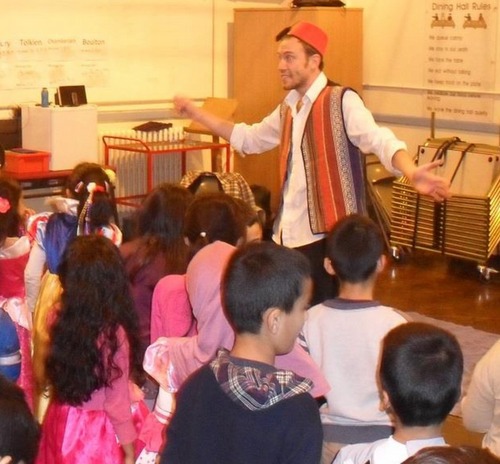
The Great Fire of Guilden Morden Walkabout.  I lead walks around the village, introducing the children to the story of the fire in role.  Each walk took us on a 40 minute stroll about Guilden Morden stopping at the (assumed) site of the fire, The Independent Chapel, Old School, War Memorial, Church and Vicarage.  At each stop I role played a different character who had a part in the story of the fire.

Week Four

Commemoration.  This session fell on the anniversary of the fire.  To mark the date the school organised a fire drill and I read the newspaper report of the fire to the children in assembly.  Our commemoration was in sharp contrast to the celebration of Week One.

In their own words “The Guiden Morden Fire”.  The groups retold the story of the fire using drama games.  The groups used drama to structure their own version of the story.  These structures will be used as a starting point for building a narrative poem and dramatic scenes.

John Kirk is a storyteller and drama facilitator specialising in drama workshops and theatre for young people.Week Five

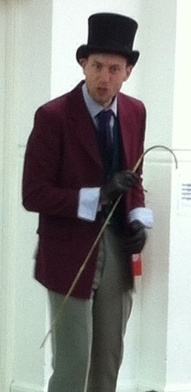
Acting Out the Events of 1881.  With the younger classes I appeared as a Victorian Schoolmaster and with the older classes we turned our version of the story into a series of scenes.  In the next week the classes will transcribe these scenes to form the basis of scripts and stories.

Over the next six weeks we have a lot of work still to do but I hope to be able to share news of our success, images and video here over the next few months.  Stayed tuned!

A Guide to Guidance: how can you be sure a story is suitable?

John Kirk is a storyteller and drama facilitator specialising in drama workshops and theatre for young people.Whenever I take a booking or ask for feedback on my work, suitability is mentioned.  For each of my stories I have suggested the age or level the audience should be at in order to watch it.  You did read that correctly, I said suggested.

Most recently I have been presenting “Private Peaceful” as part of the Cityread 2014.  My brief was to work with young readers in public spaces (lots of libraries!).  Michael Morpurgo’s story is quite rightly, not pitched at younger young readers but I know from experience of working in public spaces to expect very young audiences.  I therefore devised a piece which could be accessible to an audience of young people aged 7 plus.  This was challenging as I did not want to compromise the language or the tone of the original in my work.  In my interpretation I remove elements of the story which are too disturbing for a young audience or too difficult to do justice in a 40 minute presentation (the shooting of Bertha, Molly and the baby).  Similarly, I say that my version of “A Christmas Carol” can be enjoyed by audiences of young people aged 4 plus.  I don’t deviate from Dickens’ story or his language and in places my ghost story can be scary but I include elements of slapstick, pantomime and colourful, comic characters to entertain the very youngest audience members.

John Kirk is a storyteller and drama facilitator specialising in drama workshops and theatre for young people.The truth is that when I say a piece is suitable for a particular age or level I am making a broad statement.  If I am liaising with a school directly it is much easier to advise them on a story to choose for their children.  Here my statement on suitability is definitely “this story is suitable for a person of the stated age or level”.  When I work In public environments I have less control over who will be watching.  I can put a statement of suitability on my literature or speak to the audience briefly before the presentation begins but my statement is more ambiguous, “a person of this age or level can access this story in some way”.

Perhaps it shouldn’t be like this but in the end I don’t know the audience who will watch my work.  When I work in schools, a child who is particularly sensitive will respond to my work differently compared to one who is bomb proof.  During the school holidays a parent will not be able to leave one child in order to monitor their sibling so I often present stories I deem inappropriate to very young children.  Saying this, I have had two year olds howling with laughter at Dracula because of my presentation style and teenagers who have disrupted my stories because they weren’t prepared to engage with my work.

John Kirk is a storyteller and drama facilitator specialising in drama workshops and theatre for young people.There are risks when booking or attending stories for children but many pitfalls can be avoided with insight into the work.  Just because it says its suitable for a seven year old doesn’t mean its not Michael Morpurgo.  Just because it says its suitable for four year olds doesn’t mean that its not Charles Dickens.  A statement of suitability is to say you can rather than you should watch.  It is for adults to exercise their discretion in choosing an appropriate story for their audience.

“Saluting” my CityRead 2014…

Here is the story of my CityRead2014 in pictures.  The saluting came about when the group piled into the photograph at New X Learning.  It became a trend that would be repeated across London.

I started in Lewisham…

John Kirk is a storyteller and drama facilitator specialising in drama workshops and theatre for young people.

and was next in Wandsworth.

John Kirk is a storyteller and drama facilitator specialising in drama workshops and theatre for young people.

April rolled in with presentations in Barking and Dagenham…

John Kirk is a storyteller and drama facilitator specialising in drama workshops and theatre for young people.

and Islington.

John Kirk is a storyteller and drama facilitator specialising in drama workshops and theatre for young people.

As the Easter Holidays began the dates came thick and fast with presentations in The City of London…

John Kirk is a storyteller and drama facilitator specialising in drama workshops and theatre for young people.

Waltham Forest…

John Kirk is a storyteller and drama facilitator specialising in drama workshops and theatre for young people.

and Ealing.

John Kirk is a storyteller and drama facilitator specialising in drama workshops and theatre for young people.

I did nine presentations in Croydon…

John Kirk is a storyteller and drama facilitator specialising in drama workshops and theatre for young people.

eight in Haringey…

John Kirk is a storyteller and drama facilitator specialising in drama workshops and theatre for young people.

with days in Merton…

John Kirk is a storyteller and drama facilitator specialising in drama workshops and theatre for young people.

and Camden too – Phew!

John Kirk is a storyteller and drama facilitator specialising in drama workshops and theatre for young people.

When the schools went back we pressed on with huge crowds in Lambeth…

John Kirk is a storyteller and drama facilitator specialising in drama workshops and theatre for young people.

Redbridge…

John Kirk is a storyteller and drama facilitator specialising in drama workshops and theatre for young people.

and Brent.

John Kirk is a storyteller and drama facilitator specialising in drama workshops and theatre for young people.

Not forgetting Hackney…

John Kirk is a storyteller and drama facilitator specialising in drama workshops and theatre for young people.

Westminster…

John Kirk is a storyteller and drama facilitator specialising in drama workshops and theatre for young people.

Kensington and Chelsea …

John Kirk is a storyteller and drama facilitator specialising in drama workshops and theatre for young people.

and Hammersmith and Fulham.

John Kirk is a storyteller and drama facilitator specialising in drama workshops and theatre for young people.

As April ended I went to Bexley …

John Kirk is a storyteller and drama facilitator specialising in drama workshops and theatre for young people.

and Bromley to work with secondary school groups.

John Kirk is a storyteller and drama facilitator specialising in drama workshops and theatre for young people.

My CityRead 2014 finished with May visits to Richmond Upon Thames…

John Kirk is a storyteller and drama facilitator specialising in drama workshops and theatre for young people.

… and Kingston Upon Thames.

John Kirk is a storyteller and drama facilitator specialising in drama workshops and theatre for young people.

65 presentations in 27 days across 23 different London authorities to 2300 people.

My CityRead 2014 was incredible.

A Story? Really? A blog about managing innocence in storytelling

John Kirk is a storyteller and drama facilitator specialising in drama workshops and theatre for young people.As a storyteller I rely upon two presentation models: narrating events and being the character.  My relationship with the audience will change depending how I present the story.  If I am narrating events I inform the audience of our relationship.  I allow them to understand that the story and its events are a fiction and that they are watching a presentation.  I do this by introducing myself, talking about the story and clearly demonstrating different characters.  When I become a character my audience must do much more of the work themselves.

“So what?”, I hear you cry.  Well, when I present a session as a Victorian School Teacher the participants are briefly starring in a drama devised to expose them to the way education might have been in the 19th Century.  If the participants don’t respect the threat of caning then the session is less effective.  Equally, when I present a Detective investigating a crime the participants must be convinced that the scenario is credible.  A lack of investment in the world of the story can be a session’s undoing.

John Kirk specialises in drama workshops and theatre for young people.Cynicism can bedevil creativity as we grow up and the examples above relate to characters and sessions devised for pre-teens but what about when we are very young?  What are the dangers of investing too heavily in stories?  Can there be any harm in believing that you just met the Gruffalo?  I suppose that very much depends on the experience.  For a young child, meeting a creature with terrible tusks, terrible claws and terrible teeth in terrible jaws etc. will either be the best or worst day of their life.

Clearly telling a very young participant that what is happening (or about to happen) isn’t real can impact their experience.  You could go as far as to say that intentionally breaking the illusion robs them of an innocent experience.  There is unquestionable security in the truth and I think it is the storyteller’s responsibility to offer that security through the narrative by ensuring audiences see that the wicked get there just desserts.  If the participant absolutely believes is this more memorable or just confusing?  Is Miss Trunchbull scary if you know its an act or is the Mad Hatter as wonderful if you know its in some way false?  How a situation is managed will hinge on lots of factors including the sensitivity of the participant and the circumstances and legacy of the meeting.

From my point of view it isn’t easy to maintain the reality of being a character rather than a person for an extended period of time.  It can involve a lot of planning with a school or organisation ahead of the day.  Trying to think like a character at all times and allowing everybody to believe you are a character can be exhausting (once I spent an entire day in a Headteacher’s study in role pretending to work at her desk!).  I have however found that the legacy of this approach is huge and the feedback on such sessions is generally very positive.

John Kirk specialises in drama workshops and theatre for young people.“When you came in to work with the children during world book week, they were completely gripped!  The story narrative you came up with to engage the children was phenomenal, the children completely believed the 3 Little Pigs had been eaten!  You stayed in role all day and as a result the children played along too, the quality of writing and language we got from them was fantastic.   I have no doubt in my mind that we would use you again… as we are still talking about it a year later!!” (Teacher, St Wulstans and St Edmunds Primary School, Fleetwood)

I suppose that to some extent the purpose of the story will determine whether the participants are allowed to believe in the character.  After presenting the Victorian Classroom I will appear to participants as myself and discuss their experiences.  This is partly to assure groups that the monstrous school master is imaginary but also so that the group can articulate how my lesson and their lessons compare.

John Kirk is a storyteller and drama facilitator specialising in drama workshops and theatre for young people.The real world can be a hard place and sometimes we grow up too fast.  Its a sad day when a child becomes inhibited by doubt.  I was recently at a school and a little girl took me to one side and asked whether I really was Willy Wonka.  I told her that in life we can choose to believe or we can choose not to believe but that decision was ultimately hers.  She skipped away satisfied with my answer, having just chatted with the world’s greatest chocolate maker!

There are times when I wish I was a little more innocent.  As an adult and a storyteller I have an important role to play in maintaining the innocence of my youngest audiences for as long as possible.

The Merits of a Narrative Poem

John Kirk specialises in drama workshops and theatre for young people.When I was younger I didn’t think that I liked poetry.  Outside Shakespeare I rarely read verse for pleasure.  Last year though, I was introduced to Alfred Noyes’ “The Highwayman” and it changed my view of poetry completely.  Since then I have been reading other narrative poems including the “The Ballad of the Fleet” (Tennyson) and “The Walrus and the Carpenter” (Carroll) and incorporating them into my work.

A narrative poem tells us a story but it is set out in stanzas with the rhythms and rhyming patterns familiar in other types of poem.  It will contain a skilfully woven story packed with wonderful imagery and metaphors which compels its audience.

In my opinion the narrative poem offers so much that I have even used them in pieces for Birthday Parties!  Here are what I see as the merits of working with narrative poetry.

The narrative poem is perhaps one of the most ancient form of storytelling (The Iliad and Beowulf are both story poems).  As a Drama Facilitator I believe they are a fantastic way of introducing complex text to young audiences which demonstrates the breadth and depth of our literary heritage beyond Shakespeare.

It offers a whole story.  A chapter of a book or a scene from a play wouldn’t offer the beginning middle and end in this way.  If I want to guarantee that a group have heard the material a narrative poem is a concise way of quickly offering an entire story.

The narrative poem will capture the imaginations of boys and girls as it often recalls and romanticises some kind of adventure.

John Kirk is a storyteller and drama facilitator specialising in drama workshops and theatre for young people.Investigating narrative poetry through drama is a lot of fun and once a group has a story they are better positioned to explore the author’s imagery and language choices.  The poems I am talking about were mostly written in the 19th and 20th Century and whilst the language is certainly complex it is not impenetrable.  Accessing it allows young  participants to make their own judgements about themes, events and characters (perhaps physically characterising or hot seating characters about their decisions in the story or making up scenes based upon their deductions).

I have also found that exploring a narrative poem can become a catalyst for exploring rhythm, rhyme and meter and getting groups to write in poetry.

_ _ _ _

“The wind was a rushing train, dodging every tree

The moon was a shiny banana ripe and ready for me.

The road was a lonely wanderer, under an ongoing spell

and Mr Highwayman came riding, riding, riding

Josh Highwayman came riding, up to the Grand Hotel.”

_ _ _ _

“The snow was a breeze of coldness coating the leafy bush,

The sun was a ball of fire, gleaming upon rushing waves

The field was a soft green carpet, over the earthy road

And the Highwayman came skating, skating, skating

The Highwayman came skating up to the big mansion’s door.”

_ _ _ _

As well as getting excited about narrative poetry I have discovered narrative songs.  My taste in story song is eclectic ranging from Benny Hill (The Fastest Milkman in the West) to Charles Daniels (The Devil Went Down to Georgia) and Chris Wood (Hollow Point).  You could easily laugh some narrative songs off as being novelties but constructing an effective narrative within a poem or a song is a great skill.  Tennyson and Noyes might not be matched for their poetry’s beautiful imagery  but Hollow Point particularly is (in my view) a powerful piece of modern verse based storytelling.

Up to now narrative poems have formed the basis of workshops or featured within other work that I have presented but this summer to coincide with The Summer Reading Challenge 2014 I am taking my new found love of the narrative poem to a whole new level as I reinterpret Homer’s “Odyssey” for a young audience.

My final reinterpretation is unlikely to be a narrative poem but one thing is certain – it’s going to be epic!

Special thanks to the children of South Malling Primary School for sharing their “modern” takes on “The Highwayman”.

How Bertholt Brecht changed my life

Stone Soup 5As a student I was introduced to the ideas and work of Bertholt Brecht.

Bertholt Brecht was a German playwright and drama theorist who lived in the early part of the 20th Century.  The theatre of the time was shallower and more melodramatic than the theatre that would be familiar to us today.

Brecht was an advocate of Epic Theatre and sought to readdress the performer-audience relationship, believing that theatre should instruct as well as entertain its audience.

Rather than allowing the spectator to relax, Brecht wanted them to think about what was being presented.  He developed techniques to alienate audiences into objectivity and in his essays he talks about how an actor might encourage this alienation.

Over a decade has gone by since I first read Brecht’s ideas but today many of them are recognisable in my storytelling.

Directly addressing the audience 

Brecht believed that to readdress the relationship between performer and audience meant tearing down the conceit that the audience is somehow invisible to the performers.  In removing the “fourth wall” from the stage Brecht acknowledges the Elizabethan theatre in which delivering a soliloquy to the crowds would be commonplace.

As a storyteller I would find it almost impossible to share stories without looking at the audience.  My narratives often depend upon a more active rapport as the audience become characters or participate in activity and discussion.

IMGA0002Simplicity

Brecht talks about stripping back the paraphernalia of theatre (the lights, set, costume etc) to expose the audience to a story rather than allowing them to hide behind the experience.

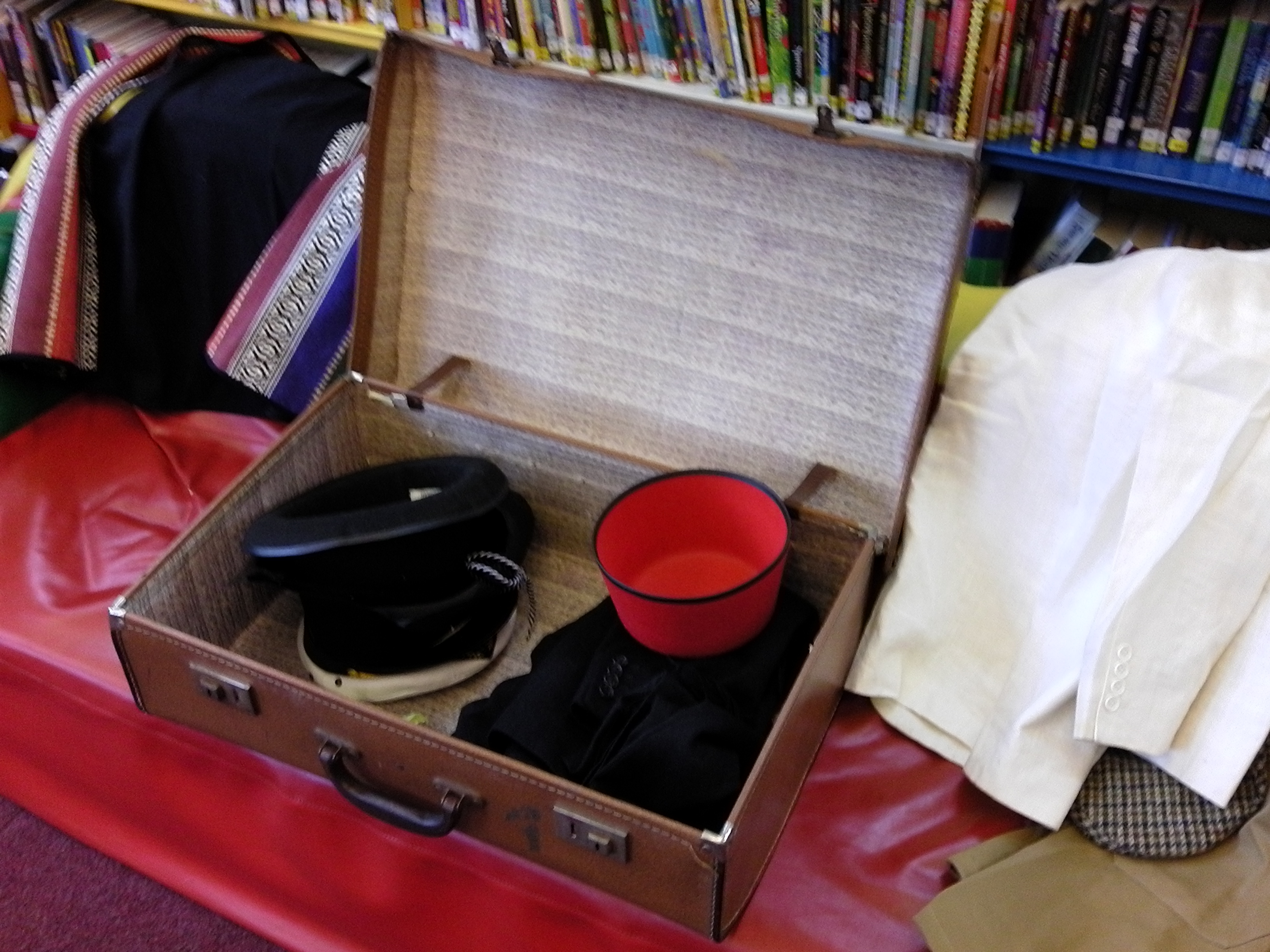
A stripped back style isn’t really a choice when you carry your set, costume and props in a suitcase!  I do believe that in stripping away some of the frills of performance my audiences are more focussed.

My further thoughts on technology, concentration and storytelling

Characterisation 

Bertholt Brecht admired the Chinese style of acting in which the performer demonstrated their character.  They do not become the role but play the gestus (a suggestion) of the role.

In my version of A Christmas Carol I play as many as 14 of Dickens’ characters, sometimes for no more than a few seconds.  The character is a vehicle for my narrative.  I must portray the gist of the character quickly with no time to consider my emotional connections to a part.  With small parts I achieve these lightning transformations by making distinct physical and vocal choices (Scrooge is spiky and nasal where Bob is small and timid).  Of course I work with young audiences so I incorporate bits of costume or props to suggest different characters.  The result is very entertaining (particularly when I get confused!) because its visually dynamic but it also forces audiences to concentrate.

My thoughts on the use of subtext in Naturalistic performance

Empathy vs Choice

Brecht believed that empathy shouldn’t be theatre’s primary currency.  Brecht was acutely aware of the theatre’s power to enlighten people to broader social issues.  Through his work he attempted to detach audiences from the sentimental and move them to take action by encouraging his actors to clearly present their character’s choices.

Brecht the playwright would probably have approved of the way I structure my presentations as I will happily mix narrative with drama activities.  In Brecht’s plays he regularly juxtaposes presentation ideas as narrative is interrupted by dramatic songs.  This means, like in a Music Hall presentation, his scenes can often stand alone and that the audience are again reminded that they are watching a play.

As I generally interpret other writer’s works I am rarely positioned to state personal opinions for the duration of a narrative but I will try to convey my thoughts and feelings on a story to the audience.  This could be in the choices I make in the wording of the adaptation or a pause or a look to the audience highlighting what I see as a crossroads for a protagonist in the narrative.

Unlucky MummyIt is difficult to say whether my audiences empathise with my presentations.  My style of presentation means that they probably remain quite objective toward characters (it can’t be easy to empathise with characters when I’m continually changing roles!) but empathy is still important to my stories (if we don’t care what happens to Hansel and Gretel in the enchanted forest then there is no real peril or adventure).

Truth in Non Naturalistic Storytelling

When we talk about alienating an audience from a presentation we must be careful about removing the truth entirely.  Non naturalistic storytelling is still storytelling.  At times it may be heavily stylised and may jar with an audience’s expectations but it’s success will depend upon a world being credibly sustained.  In my own work it is vital that the audience quickly accept that I will be demonstrating lots of different characters who will exist to serve the story.  If style takes precedence over substance then the story has been failed.


I believe that it was studying Brecht and non naturalistic storytelling techniques that lead me to be the storyteller I am today.  We are fortunate to have the benefit of past wisdom at our disposal when we make art today.  I could probably analyse my style in the light of other practitioner’s ideas, drawing comparisons and justifying their influence on my work but I feel that learning about Brecht has allowed me the freedom and confidence to tackle complicated and amazing stories that I couldn’t otherwise have done.

My further thoughts on the value of training and experience to the storytelling experience

It’s only by better understanding rules about form and content that we can begin to bend them to our advantage.

Brecht on Everyday Theatre

You artists who perform plays
In great houses under electric suns
Before the hushed crowd, pay a visit some time
To that theatre whose setting is the street.
………………………………………
Here the woman from next door imitates the landlord:
Demonstrating his flood of talk she makes it clear
How he tried to turn the conversation away from the burst water pipe.
A drunk gives us the preacher at his sermon, referring the poor
To the rich pastures of paradise. How useful
Such theatre is though………………
These actors do not, like parrot or ape
Imitate just for the sake of imitation, just to show that
They can imitate; no, they
Have a point to put across. You
Great artists, masterly imitators, in this regard
Do not fall short of them! Do not become too remote
However much you perfect your art
From that theatre of daily life
Whose setting is the street.
Take that man on the corner: he is showing how
An accident happened. This very moment
He delivers the driver to the verdict of the crowd: the way he
Sat behind the wheel, and now
He imitates the man who was run over, apparently
An old man. Of both he gives
Only so much as to make the accident intelligible, and yet
Enough to make you see them. But he shows neither
As if the accident was unavoidable. The accident
Becomes in this way intelligible, yet not intelligible, for both of them
Could have moved quite differently; now he is showing what
They might have done so that no accident
Would have occurred. There is no superstition
About this eyewitness, he
Shows mortals as victims not of the stars, but
Only of their errors.

“The Highwayman” from an Ostler’s Point of View

I also offer a “Highwayman” workshop!!

Highwaymen are often referred to as “Gentlemen of the Road” but they were in fact nothing more than common thieves.  “Stand and Deliver!” (the command rather than the song), was last uttered by a Highwayman in Britain in 1831 but their exploits were (and are) popularly romanticised.  Alfred Noyes’ epic poem chronicles the night time adventures of one such rogue and the Landlord’s daughter, who tragically meet their ends in the cobbled inn yard.  Alfred Noyes’ “The Highwayman” is a brilliant story of love that has been reinterpreted by artists, film makers and musicians around the world.

As part of a workshop exploring Alfred Noyes’ “The Highwayman”, I was challenged to reinterpret the poem for a group of Primary School children.  This video is a part of the result and this blog came about as more and more people watched it online.

PLEASE VISIT 1000 UP! TO VIEW THE VIDEO

Rather than tell the Highwayman’s story I wanted to explore the world of the other characters mentioned in the poem.  I wanted the tone to be quite serious so taking Bess’ perspective was out.  The Landlord and the King’s Guards presented possibilities but the most interesting character seemed to be Tim the Ostler.  In the original poem Tim is mentioned by name but appears in just one stanza:

“And dark in the dark old inn-yard a stable-wicket creaked
Where Tim the ostler listened; his face was white and peaked;
    His eyes were hollows of madness, his hair like mouldy hay,
    But he loved the landlord’s daughter,
The landlord’s red-lipped daughter,
Dumb as a dog he listened, and he heard the robber say—”

Who was this man?  Why was he there?  What was his role in events and what was his story beyond the inn yard?

What follows is the transcript of the above video.  My version is actually longer than this as I introduce the Captain of the Guard and explain what happens to Tim (I reserve those verses for live presentations).

What was most striking for me in Noyes’ poem was his rhythm and rhyming structure.  When I listen to the poem I always think about a horses hooves and I wanted my poem also to respect a regular meter (which it loosely does).  I also love his imagery and try to include some bold similes and metaphors.  Like Noyes I was drawn to his original themes of love, jealousy and violence but I have chosen for Tim the Ostler to recount his bitter betrayal rather than a third party.


Tim the Ostler

Now the landlord he has a daughter, whose lips are as red as a fire

Her hair is a perfumed cascade you couldn’t fail to admire

Oh how I longed for this young girl, who goes by the name of Bess

My master’s black eyed daughter

She smiled at me, his daughter

I dreamt that this sweetest lady would someday be my Princess….

I also offer a “Highwayman” workshop!!

Fairy Tale Stepmothers do ‘ave em!

Stone Soup 2Once upon a time the Fairy Tale was born…

The popular Fairy Tale has existed for well over 200 years and typically demonstrate good’s victory over evil.  Good being traditionally described as young, brave, kind, clever and beautiful, evil being old, wicked, corrupt and all too often female.

Witches, Queens, Stepmothers – there are plenty of examples within the genre but is there any common ground between them?

The fairy tale villain is an outsider, standing apart from society.  The Witch is ostracised for her appearance or habits, The Evil Queen is removed by her power and wealth but what of the Wicked Stepmother?  The Stepmother is the antithesis of what we might think of as a stock Mother figure (caring, nurturing, supportive).  Whilst the Witch and Evil Queen often threaten an entire community, the Stepmother represents a challenge to the family unit, her presence creating tension between the children and their Father.

There are several examples of Stepmothers in fairy tales; Hansel and Gretel, Cinderella and Snow White all have to deal with them.  In fact Stepfathers have far less nasty reputations.  This could be because many of the most famous fairy tale writers were men (Hans Christian Andersen, The Brothers Grimm to name but a few).

John Kirk specialises in drama workshops and theatre for young people.In the Stepmother the fairy tale writer has a character with an axe to grind.  The Stepmother has won the heart of her husband and wields power over his children mercilessly (Snow White, Hansel and Gretel are forced out into the forest and Cinderella is used as a slave).  The Stepmother’s motives are broadly similar to that of the Witch or the Evil Queen; jealousy and the lust for power.  Her new child(ren) are more beautiful than she is and they are in the way.  In the family unit, the Stepmother is Queen and her throne must be ruthlessly consolidated.

Of course like all fairy tale villains it will not end well for the Wicked Stepmother.  Her death or banishment will not only be gruesome but in it there will be a valuable moral lesson about love and virtue.  These lessons are highlighted, not by the downfall of the villain, but by the child(ren)’s relationship with their Father.  Throughout the Fairy Tale the Father neglects his responsibility as protector; he is blind to his new wife’s behaviour sometimes going as far as to carry out her dastardly wishes.  In the end he realises who he truly loves and seeks forgiveness.

Perhaps the reason that the Wicked Stepmother endures as a villain can also be found at home.  It’s unlikely that in the 21st Century we will ever meet a Giant or a talking Wolf but each of us understands the role of the Mother.  A Witch may be more mysterious and a Queen may be more powerful but it doesn’t take a flight of fantasy for even the youngest child to recognise the threat a Wicked Stepmother poses.

Wicked WitchIn my Traditional Tales I enjoy playing the wicked characters (even the female ones).  Playing a Witch or a Wicked Stepmother brings life to the story and is the perfect excuse for a wig or a shawl!

It can be very scary for young audience members to come face to face with a truly terrible character in any context (Miss Trunchbull’s School Inspection or The Victorian School Room) so I work hard to assure my audiences that they are safe.  Exposing children to danger, be it a Witch, a Dragon or a Stepmother, in my view, comes with responsibility.  If I am going to present bad characters I must demonstrate their ridiculousness; my audience must see that villains always get their comeuppance and that good will triumph in the end so that we can all live happily ever after.