Tag Archives: The Unlucky Mummy

A storyteller in search of a story

—

Aspects of this blog are superseded by A Twit Update and My adventure with Dennis continues!

—

So this week it has been confirmed that I can no longer offer Roald Dahl’s “The Twits”.  It’s a sad day but not totally unexpected.  Over the last two years I have presented this marvellous tale on almost 200 occasions across England and then in Wales, Scotland, the Channel Islands, Germany and the United Arab Emirates.  It been the most wonderful period and I’ll always be thankful for the opportunities my brief association with the Roald Dahl Estate created.  I will miss sharing what I consider to be a terrific story.

Knowing when to archive a story is as much a part of the creative process as developing the project in the first place.  Telling stories is a lot of fun but the bottom line is that a storyteller is a small business and once a client has seen your entire repertoire the opportunity for a future booking is greatly reduced.  Changing up material helps a storyteller’s repertoire remain fresh and the teller themselves remain energised but it can mean making some tough decisions about old or “well loved” material.

Over the years I have mothballed many projects for many different reasons.  Some decisions were forced upon me because of licencing issues (Private Peaceful and The Twits).  Some stories were very enjoyable to deliver but I found that my style had evolved in a different direction (The Mad Hatters Tea Party!, Dracula and the Unlucky Mummy).  Some stories were shelved because of a lack of demand or, in very rare cases, because what I did with them wasn’t very good.  In some cases when it hasn’t worked or I have been sick to the back teeth of a story I’ve managed to salvage something by finding it a new lease of life.  I don’t mind admitting that I didn’t like Anansi the Spider and the Stories of the World until I significantly altered the way I was telling it so that I was more comfortable with the material and it now sits amongst my favourite projects.  Generally though, if no one’s laughing anymore and the applause is polite rather than enthusiastic it’s probably time to let a story go.  After almost 200 presentations, as much as I love telling The Twits, I think the project has reached and exceeded its end point.

So what next?

My current project Dennis and the Chamber of Mischief will occupy me into the autumn but I am already aware that Beano Studios have another party interested in the book so I have no plans to make it available for schools presentations.  Instead I have been working up two new projects; Band of Brothers: the story of three Lions, which explores The Great War through the stories of three young men who fought it and It’s all Greek to Me!, in which I delve into some of the stories of Greek Mythology’s heroes.  I’m also toying with the idea of bringing Beowulf Sleeps back into my repertoire.  This was a project I did for a school three years ago.  I didn’t take it further at the time because it was at odds with the way I was then telling stories.  This autumn, as I move in a more traditional storytelling direction, I feel that it would sit nicely within my revamped repertoire.  I will of course continue to offer my usual array of folk and fairy tales, myths, legends and Shakespeare but beyond that I am really looking for the next challenge.  What that will be is a mystery right now but I hope that a famous author or publisher will have taken notice of what I do and offer me a title I simply can’t refuse but I’m not holding my breath!  In the meantime I can look forward to Mr Twit’s farewell party to be hosted on Saturday the 20th October 2018 as I take part in one final reading festival in Grantham being hosted by The National Trust.  When one door closes…
Which stories shaped you?

I live in London.  I went to drama college there have a family there and love its bright lights and history.  I wasn’t raised in London though.  I am from Lancashire and it’s there that my cultural vocabulary was shaped.  It was in the north west that I was inspired to set out on a creative journey which means that when I head north these days I have a small rucksack for my clothes and two suitcases of props, wigs and hats (this week I have been working in libraries and schools in Chorley, Blackburn and Huddersfield).

It was recently pointed out that I have been living outside the north west for longer than it was ever my home.  Still my affection for north grows with every visit.  I am always struck by the friendliness of the people, the beauty of the landscape, the changes and developments in places like Manchester and Liverpool and, as a working storyteller, the wonderful folklore.

In this blog I wanted to reflect not on my favourite stories but on the stories and the moments that have shaped my creative journey from Chorley to London and back again.  Some of the moments I’ll describe weren’t witnessed by many or indeed any people but they are nonetheless significant to me.  Saying this the more I think the more I think I’ve done a lot of stuff and if I were to repeat this exercise next week my list might be entirely different.  I set out to shortlist 5 moments but have settled with six (its my blog and I’ll cry if I want to).  I am going to bypass the various stories I told as an actor and the various books I have read which helped form my views and character and focus on the stories that saw me to where I am today (although To Kill a Mockingbird, Behind the Scenes at the Museum, Cooking with Elvis and We need to talk about Kevin all might have been mentioned)

1. The Hobbit – my Dad, my bedroom.  Some of my fondest memories are sitting on my bed with my Dad reading us stories.  Hearing stories like the Hobbit really enlivened my imagination and left me with a lifelong love of fantasy worlds.

2. The Suicide – Bolton Octagon.  I must have been in my mid teens when we went to The Bolton Octagon to see Nicolai Erdman’s The Suicide.  The entire experience blew me away.  The Octagon is an incredible space and the play was like nothing I had ever seen before (although having seen it again recently at the National perhaps it was the stage design rather than the story that truly grabbed me).  By this stage I wasn’t reading a lot on my own so it was at the theatre that I was exposed to stories.

3. History GCSE – school.  The way I have always viewed history, rightly or wrongly, is as an enormous story.  Like any good story if you like it you remember it and I loved hearing about the Great War.  Like any story though a good storyteller makes all the difference and our history teacher was very good at telling the story of the war.  When I first started writing history workshops it was these lessons which I thought about.  To date it’s this inspiration that has seen me write history workshops for several of London’s local heritage museums.

4. Of Mice and Men – Chorley Little Theatre.  Whilst at sixth form college I got to know Hywel Evans.  Hywel is phenomenon.  He has had a massive bearing on my life – I probably wouldn’t have gone to Drama College if it hadn’t been for him.  He was and still is a creative dynamo and has gone on to be successful in everything he has chosen to do.  Together with Ben Hilton we established Low Fat Productions and put on shows for money including Of Mice and Men.  We got the local theatre and people paid to come and see us.  I remember that I was supposed to be the producer but I was completely hopeless at it.  The experience of working with Hywel and Ben taught me that sometimes to be creative you had to be proactive and if you are proactive enough you could make money.  When I think back about what we did as 16 and 17 year olds I find it incredible.

5. Solo story – Rose Bruford College.  During the Brecht term at college we were divided into groups and prepared plays by Bertolt Brecht for in-house presentation.  Our group were doing St Joan of the Stockyards (which looking back was probably the high point of my entire acting career) but at the same time we had other classes; voice, movement and a thing called solo story.  The idea of solo story was to tell a story to an audience.  It was a massive challenge because to this point we had always worked on ensemble pieces of theatre.  We were essentially left to our own devices as we developed a script and made up a short presentation of a story.  I told a story about watching my beloved Wimbledon Football Club play an FA Cup tie at Old Trafford.  It was probably the first time I had ever told a story solo in front of an audience.  It was nerve wracking but some of the techniques I used in that project I still use to this day.

6. The Unlucky Mummy – all over the place.  In 2012 I was approached about delivering a story in a museum setting about Egypt and when I found the legend of the Unlucky Mummy the project turned out to be a gift.  I created an interactive slapstick piece which could be enjoyed by family audiences.  After the initial delivery I offered it for free to the libraries in north east London.  Impressed by what they saw I was invited back to do Dracula and recommended to the CityRead 2014 for Private Peaceful.  One thing lead to another and The Twits, #Shakespeare400 and The Hundred Mile an Hour Dog have followed it all started though with a newspaper mummy wrapped in toilet roll in a spray painted show box.

So you see you can take the boy out of Lancashire but the north runs in his blood.  I hope that as Verity grows up I’ll be able to share some of the best bits of the north of england with her so whilst she maybe a Londoner her father’s roots will be part of her identity too.

A Story? Really? A blog about managing innocence in storytelling

John Kirk is a storyteller and drama facilitator specialising in drama workshops and theatre for young people.As a storyteller I rely upon two presentation models: narrating events and being the character.  My relationship with the audience will change depending how I present the story.  If I am narrating events I inform the audience of our relationship.  I allow them to understand that the story and its events are a fiction and that they are watching a presentation.  I do this by introducing myself, talking about the story and clearly demonstrating different characters.  When I become a character my audience must do much more of the work themselves.

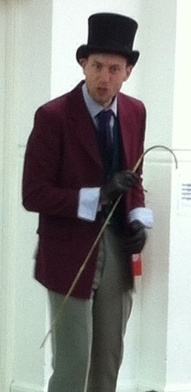
“So what?”, I hear you cry.  Well, when I present a session as a Victorian School Teacher the participants are briefly starring in a drama devised to expose them to the way education might have been in the 19th Century.  If the participants don’t respect the threat of caning then the session is less effective.  Equally, when I present a Detective investigating a crime the participants must be convinced that the scenario is credible.  A lack of investment in the world of the story can be a session’s undoing.

John Kirk specialises in drama workshops and theatre for young people.Cynicism can bedevil creativity as we grow up and the examples above relate to characters and sessions devised for pre-teens but what about when we are very young?  What are the dangers of investing too heavily in stories?  Can there be any harm in believing that you just met the Gruffalo?  I suppose that very much depends on the experience.  For a young child, meeting a creature with terrible tusks, terrible claws and terrible teeth in terrible jaws etc. will either be the best or worst day of their life.

Clearly telling a very young participant that what is happening (or about to happen) isn’t real can impact their experience.  You could go as far as to say that intentionally breaking the illusion robs them of an innocent experience.  There is unquestionable security in the truth and I think it is the storyteller’s responsibility to offer that security through the narrative by ensuring audiences see that the wicked get there just desserts.  If the participant absolutely believes is this more memorable or just confusing?  Is Miss Trunchbull scary if you know its an act or is the Mad Hatter as wonderful if you know its in some way false?  How a situation is managed will hinge on lots of factors including the sensitivity of the participant and the circumstances and legacy of the meeting.

From my point of view it isn’t easy to maintain the reality of being a character rather than a person for an extended period of time.  It can involve a lot of planning with a school or organisation ahead of the day.  Trying to think like a character at all times and allowing everybody to believe you are a character can be exhausting (once I spent an entire day in a Headteacher’s study in role pretending to work at her desk!).  I have however found that the legacy of this approach is huge and the feedback on such sessions is generally very positive.

John Kirk specialises in drama workshops and theatre for young people.“When you came in to work with the children during world book week, they were completely gripped!  The story narrative you came up with to engage the children was phenomenal, the children completely believed the 3 Little Pigs had been eaten!  You stayed in role all day and as a result the children played along too, the quality of writing and language we got from them was fantastic.   I have no doubt in my mind that we would use you again… as we are still talking about it a year later!!” (Teacher, St Wulstans and St Edmunds Primary School, Fleetwood)

I suppose that to some extent the purpose of the story will determine whether the participants are allowed to believe in the character.  After presenting the Victorian Classroom I will appear to participants as myself and discuss their experiences.  This is partly to assure groups that the monstrous school master is imaginary but also so that the group can articulate how my lesson and their lessons compare.

John Kirk is a storyteller and drama facilitator specialising in drama workshops and theatre for young people.The real world can be a hard place and sometimes we grow up too fast.  Its a sad day when a child becomes inhibited by doubt.  I was recently at a school and a little girl took me to one side and asked whether I really was Willy Wonka.  I told her that in life we can choose to believe or we can choose not to believe but that decision was ultimately hers.  She skipped away satisfied with my answer, having just chatted with the world’s greatest chocolate maker!

There are times when I wish I was a little more innocent.  As an adult and a storyteller I have an important role to play in maintaining the innocence of my youngest audiences for as long as possible.