Tag Archives: Bruce Castle

My work with museum and heritage services

Back in 2009 my father put me up to writing a show for the National Trust.  So I gave it a go.  I wrote a one man presentation based around the premise of a carnival sideshow quack called Professor Montague Rumpleseed Drake in which I promised to demonstrate to the audience when the best era of history to live was.  In a 30 minute presentation I’d peel back the layers of time until we came to the conclusion “we’ve never had it so good!”.  When I look back on it, this initial piece was by no means perfect (for one thing I used to cart a small cupboard all over London tied to a shopping trolley!) but what I latched onto was the idea that children have short attention spans so I had to be constantly looking for ways to change things up.  The Professor never darkened the door of a National Trust property but he became the first of many attempts to communicate thousands of years of history to young audiences.

The Professor and his time travelling machine allowed me to showcase my ability and led to museums in Hackney, Haringey, Southwark and Bromley inviting me to run workshops for them and to write other presentations.  During the Olympics I worked with Hackney Museum to deliver an outreach presentation to school children about change in the local area.  Ever ambitious in 30 minutes I tore through 30,000 years of history!  I structured this presentation in much the same way that I’d structured the Professor’s shtick three years earlier but without a bowler hat and  lab coat and with added elements of participation.

Spin on again to 2014 and the commemoration of The Great War.  This time it was Redbridge Libraries looking for a way to enhance their pop up library events.  I had done a few bits and pieces with Redbridge and they asked for something for adults and I gave them something for children (oops!).  Again this was borough specific and instead of 30000 years we were looking in detail at just four and this time I incorporated elements of participation and roleplay into 40 minutes exploring Redbridge’s home front.  The Great War didn’t just open doors in Redbridge; in 2014 I developed sessions for Hackney and Vestry House Museum, each time cherry picking what had worked elsewhere and doing it again.

Now to the present day.  I have been working with Vestry House Museum for four years.  We have developed workshops about The Great War, the Walthamstow Workhouse, Crime and Punishment and Roman Waltham Forest.  I have developed a formula that works for the children of Waltham Forest and the feedback on our latest sessions (the Romans) has been beyond my wildest expectations.

As part of my work with the Vestry House I have gone full circle and find myself telling the story of another London borough with a view to building relationships between the museum and schools.  Between now and May I’ll be visiting 16 Waltham Forest Primary Schools, meeting hundreds of children and sharing the story of the place they call home.  My latest dash through history covers 2000 years; from the Romans to the present day.  We interview a Roman, play a multiple choice game with the Anglo Saxons, learn a Tudor inspired dance, debate moral dilemmas in the 18th Century and learn new languages in the 20th Century.  Its a lot of fun and I hope it inspires some more children and schools to visit Vestry House Museum.  For me it represents nearly a decade of work.  I feel comfortable doing it and I am still loving sharing the story of how London has developed after all these years.

Its a strange thing to spend so much of your time working in isolation so whenever I work regularly with museums and libraries I enjoy the feeling of being a part of a team.  I owe London’s museum services a great debt after all had it not been for the staff of the Hackney Museum who encouraged my madness and supported me when I went wrong I’d probably still be working in as an office administrator and these days its the team at Vestry House who put up with my daft ideas.

The person I find that I have to thank the most for my rollercoaster ride into the wild west of heritage services is not Professor Montague Rumpleseed Drake but my Dad.  He and my Mum may not be completely comfortable with some of my life choices but it’s been their faith in me that’s pushed me to be more than a jobbing actor and office temp and for that I am very grateful.  Verity is now a year old and there are likely to be big changes over the next few months and years but if I’ve learned one thing from working in museums and heritage services its that whilst none of us can accurately predict the future you can have an awful lot of fun trying to make sense of it once its in the past!

The Victorian Classroom Experience

John Kirk specialises in drama workshops and theatre for young people.I had just marched out of the hall, my cane tucked under my arm, the children quivering with fear.  In the quiet of the staffroom I reviewed my morning as a Victorian School Master.

The session had come about after I was contacted to provide an authentic Victorian Classroom experience.

About three years ago I was commissioned to write a School Room session for The Bruce Castle in Haringey.  This would be a fabulous opportunity to revisit the piece.

The Bruce Castle School in Tottenham was run by the Hill family during the 19th Century (Rowland Hill gave us the Penny Black).  The school was renowned for its progressive approach to discipline.  Rather than using corporal punishment, The Bruce Castle School introduced a system of points and rewards which was administered by the pupils themselves.  It had many supporters including Charles Dickens who is known to have visited the school.

Unfortunately The Bruce Castle is something of an exception to the rule in the period.  It was only late in the reign of Queen Victoria that education became compulsory and then only for the very young.  Many children found school either voluntarily or via the workhouses.  With sometimes eye watering class sizes order was maintained through fear.

Having reworked the piece to incorporate references to potential punishments I have tried to communicate the importance of the credibility of the session to the school.  If the children don’t buy into the experience then the experience is liable to collapse (he’s not really a teacher/he isn’t really going to cane us etc) 150 years ago it was acceptable to hurl board rubbers at pupil’s heads – 150 years is clearly a very long time!  When I arrive, the school has excelled.  They have a free standing white board and arranged rows of benches in their hall.  There is even a lectern for the register.  With my bell and my cane we have created a pop up Victorian Classroom!

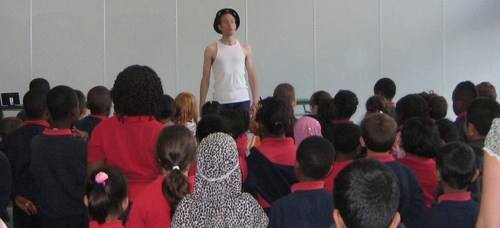
OLYMPUS DIGITAL CAMERAJust before 9.05 I go to get the class.  They are ready.  We head to the hall where the boys and the girls stand in front of separate benches.  The atmosphere is nervous.

“No speaking, Eyes front”.

I register the class, addressing them by surname.  As I stumble through the register I am reminded of how far removed the Victorian world is from the present day.

“Sit down”.

The lesson today is divided into reading, writing and mental arithmetic.  It begins however with physical drill.

Whilst researching for the original piece I discovered that quite often PE would take place in the classroom because the school didn’t have outdoor facilities.  The children would take part in physical drills at their desks!  We often take public parks for granted but at this time open spaces in urban areas must have been truly oases.

Drill over its into learning by repetition.

“Sit up straight!  Eyes front!  No slouching!”

Victims are selected.

“What is 4×5?”

Pressure can make the most intelligent child look very silly.

“What is the superlative in the passage?”

The point of this isn’t simply to intimidate or make a child feel silly.  The point is to demonstrate a method of learning.  This isn’t the learning of compromise this is the learning of fear – my way or the highway.  if a girl hesitates on an answer its also an opportunity to reinforce attitudes towards educating young ladies with a jibe about needlework.

OLYMPUS DIGITAL CAMERAThe lesson moves onto a writing exercise.  Today as substitutes for slates we have portable whiteboards.

“Why are you writing with your left hand?  You will write with your right hand”.

As School Master I maintain an unsympathetic air to the teachers and pupils and the lesson continues in silence.  What rapport there is between class and instructor is cold and dangerously sharp.

“Sit up straight!  Eyes front!  No slouching!”

The lesson concludes with three cheers for Queen Victoria.

Afterwards there is time to discuss the experience with the class.  The feedback on the session is interesting.  Words like “unfair”, “shocking”, “mean” and even “rude” are used.  Comparisons are made (everybody prefers their class teacher to my incarnation!).  There is general relief that I am not the monster of the Victorian classroom.

Sitting in the staffroom I can’t help but smile.  As the children return to their classroom and life gets back to normal there is legacy in their participation.  Undoubtedly this morning’s interaction will provide context to their learning, stimulus for their writing and renewed enthusiasm for their study but you only need to listen to hear them recalling moments from the session to know that this has affected them.

It has been an unforgettable experience.