When I did my round up of my mad March I said that I’d write in more detail about my experience working in St Albans and about using open resources in telling stories.
A few years ago I worked at a Primary School in Hemel Hempstead. I’ll be honest and say that I could only vaguely remember the school but I did remember the teacher who booked me and fortunately they remembered me when they changed jobs. So it was that I was invited to work with an EYFS/foundation group not far from St Albans but this wouldn’t be a routine booking. I was given the brief that I could only use open resources to tell the stories.
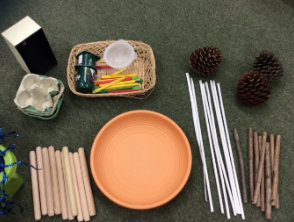
My immediate question was what is an open resource? Well, an open resource is something that could be used for anything. There is a popular drama game in which an object is passed around the circle and the participants explain its function. The only thing it can’t be is what it actually is. There are some objects that this is pretty difficult to do this with but there are others that allow the participant to use their imaginations; an empty plastic bottle can easily be imagined to be a telephone, a magnifying glass or a pneumatic drill, its far trickier to do this with a branded toy like a remote control car (although the remote control would probably be a lot of fun!). Before arriving I was given a list of stories and a photograph of piles of coloured fabric, egg boxes, colanders, pine cones and lollipop sticks.
As a storyteller I am used to using my imagination to turn an object into something else for the benefit of the audience. When I tell folk tales I often use gloves to represent birds and fabric to represent mountains, the sea or even blood. In Roald Dahl’s The Twits and The Enormous Crocodile a walking stick becomes a rifle and oven gloves become crocodiles and coconut trees. When I told Jeremy Strong’s The Hundred Mile an Hour Dog I used a dog lead as a tongue, a steering wheel, a rope and well, a dog lead. Sometimes these ideas come about because I am on a budget, sometimes its because I’m looking for ways to encourage participation and sometimes because I want to encourage repetition – teachers often tell me that their children have demonstrated the ideas they have seen in a story at their playtimes. In every case the simplest idea is often the best.
So it was that I visited a nursery without any props or costumes. I introduced myself and my work before immediately apologising to the children for “forgetting” my work bag. I asked if they could help me tell the stories using the resources provided by the setting. Then working in a side room with a small group at a time the children were given a few moments to explore the resources before we told The Billy Goats Gruff and The Three Little Pigs. I started each story the same way, by using some of the resources to build a map. Just to make my task slightly more risky I invited the children to decide on the use of certain resources – Can you choose something to show a river? Can you make a rickety rackety bridge? – we used pine cones and lollipop sticks and some rudimentary puppetry ideas to create the billy goats and yoghurt pots to create the pigs. Working on the fly was very liberating and it was wonderful to incorporate the children’s ideas about things like the appearance of the troll into the storytelling. The whole experience may have been low budget but it was a huge amount of fun. Here is the feedback from the nursery:
Having seen your work before, I knew that you were a great storyteller, however, it is always a little worrying when you recommend someone to a new school. I need not have worried because you blew both children and staff away with your stories and wonderful energy and enthusiasm. You were able to engage all the children and included them all, even those that were hesitant at first.
You were not at all phased when I asked you to tell the stories in a different way, using open ended resources (junk) and in fact, embraced the new challenge enthusiastically. You delivered a session, specifically tailored to the needs of our children and they responded beautifully. I loved the way that you gave them the freedom to choose their own resources and add their own ideas, this built their confidence and this was reflected in their own storytelling play after the session.
Many parents have also approached me and told me that the children could not stop talking about you at home, so, I am sure, that the children would love to work with you again too.
Over the years I have received feedback suggesting I use more hats, more props and more costumes despite the fact I have packed an entire wardrobe into my session (I used to use a rubber glove tied to an alice band in Jack and the Beanstalk; recently used 35 hats to tell The Enormous Turnip!). Some settings have cupboards full of story bags, dressing up rails and hand puppet sets for their children to tell stories. Whilst this is brilliant and I appreciate that younger audiences require more resources I also wonder if in enhancing a child’s play with accessories we are sometimes overly prescriptive about how to play and may inadvertently be stifling some children’s imaginations and ability to create. As I led these sessions I could see that the children got a lot from the experience of stripping things back and I hope to be able to offer similar sessions in the future.



 In March 1951 Dennis the Menace and his dog Gnasher made their first appearance in The Beano. Dennis, the trouble making school boy who terrorised his arch enemy Walter, proved popular with readers and soon became the Beano’s most famous character and their longest running comic strip. As the world has changed so too has Dennis and as he approaches 70 years old Dennis, with his trademark black spiky hair and red and black striped jumper, is now more than a comic book hero, he’s a British institution.


 —


 Back in 2009 my father put me up to writing a show for the National Trust. So I gave it a go. I wrote a one man presentation based around the premise of a carnival sideshow quack called


 So for the third time in as many months I’m away from home for work. This time I’m in south Wales to tell The Twits. As I write this it is almost 2am on Monday morning and I have recently arrived at my waterfront Premier Inn (the room is reminiscent of the rooms in Sheffield, Hemel Hempstead, Poole and just about every other Premier Inn I’ve ever stayed in!). The original plan had been that Lauren, VBz and I would come down together but a combination of circumstances (those being that I worked on Saturday and am working in Horsham on Wednesday and that our camper van is in the garage being serviced) has meant that I am here alone although the cot in the corner of the room is already a constant reminder of the family I left in London.
 The reason I’m so late is that I got the last train out of London. This was an interesting experience in itself. It took four and a half hours, which when I think about it means that had the van not been in the garage I could probably have actually driven here quicker. The people on the train were an eclectic bunch; the last train from London it turns out is also the last train from Bristol and Cardiff. What started out as a regular inter city service becomes the slow stopping service for revellers. Fall Down Drunk fell on in Cardiff and fell off in Neath. Then there were the colour runners still covered in powder paint and the anarchist sporting a pair of garish yellow tartan bermuda shorts. By the time I got off the train it was spitting with rain. I dashed past the bars and clubs of Wind Street over the sail bridge and into the hotel.
 I met with Carole Billingham from Swansea Libraries and Irene Picton from the Literacy Trust just before 8.30am. Carole is our host and chauffeur for the next couple of days. This makes a huge difference because not only does she understand the geography of Swansea so we won’t get lost but she also knows the schools we’re working with and the children recognise her during our visits. Like me, Irene is London based and is running the Young Readers Programme in towns and cities across the country. The programme is a brilliant initiative to encourage reading for pleasure rather than as just as a means for academia. At the beginning of each session Irene speaks to the group about their participation in the project and the children’s responses show that it’s been making a difference to their exposure to literature.
 Last night I had a wander into Swansea. I walked from the hotel over the Sail Bridge, past The Dylan Thomas Centre up to Swansea Castle before heading through town and down onto the beach. It has always struck me as very appropriate that the Civic Centre which houses the library overlooks the coastline. I’m sure Wales’ great writers and poets of the past would’ve found inspiration by gazing out the library window onto such an impressive vista. Stood on the beach looking out toward Mumbles or Port Talbot with the hills and town behind you it is simply awesome. After filling my boots with the scenery I headed back to Wind Street for dinner (that’s wind like curl although in a Welsh accent you’d be forgiven for thinking this street of many pubs, clubs and bars was aptly called Wine Street!).
 Today we visited two more schools and once again the children we met really responded to my storytelling. What’s been fascinating has been the way in which five very different groups of children and five different schools engage with the same story. Live presentation is often a unique experience for all concerned; sometimes a group of children will sit very quietly and listen very politely and sometimes you are thrown into the chaos of school life and end up chasing a child around the building with a water pistol!
 So my flying visit to south Wales is over. I’ve thoroughly enjoyed it which is good because I’ll be back next week to work with a sixth primary school we couldn’t squeeze in this week. Two days isn’t a very long time; it’s certainly not long enough to improve my Welsh pronunciation which is still woeful but I do feel I’ve made an impact. As I ride the train back to the big smoke I find myself in reflective mood. My involvement in the Literacy Trust’s Young Reader’s Programme although its been brief has highlighted a few things: