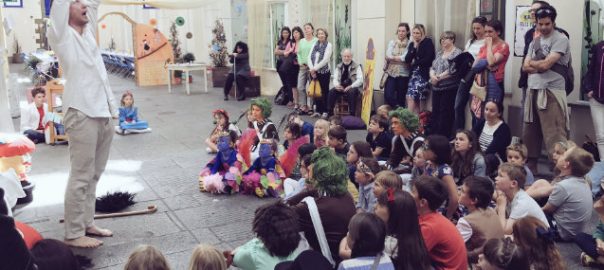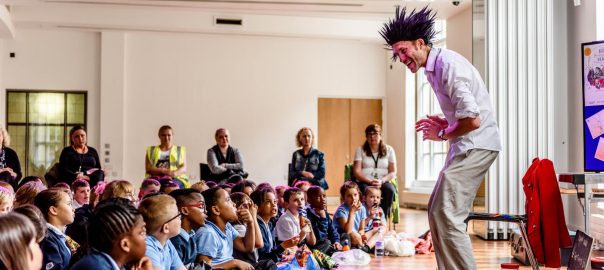
In another life it was my luck to be able to work in schools in Italy and Spain as an actor and English coach. This was an opportunity to see cities I had never visited like Granada and Venice but it also lead to an alternative way of working with an audience. You see for most of the people we performed to English wasn’t their native tongue which was a huge disadvantage in terms of following the story. To be understood the cast had to learn a sort of visual language. It felt very strange to a young actor only a few years out of college to be virtually signalling the audience but it seemed to work. As I’m writing this I remember some of the ridiculous conversations in the rehearsals about classical acting; in the breaks actors would talk about subtext and character objectives then go back to waving their lines! I knew then as well as I know now that what we were engaged in would have Stanislavski doing backflips in his grave but we were there to serve our audience and that was all that really mattered.
Flash forward to today and my experiences on these European tours have been very useful in my storytelling work at home. Every week I meet lots of young people for whom English is a second language and for some, they are quite new to learning it. English is pretty complicated and we have lots of ways to say similar things that can be quite baffling. Imagine you are not only unfamiliar with the language but the content too and one of my sessions is starting to look very alien. If I don’t offer more clues to aid my audiences understanding a story could be overwhelming.
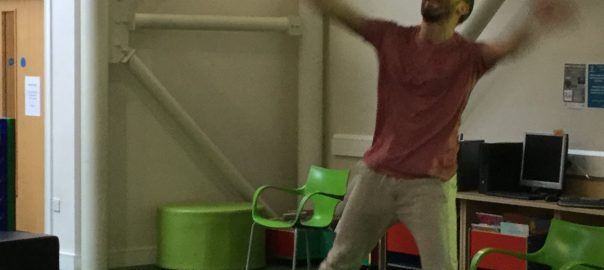
As I devise my flagship stories (The Twits, The Hundred Mile an Hour Dog, Dennis and the Chamber of Secrets) I consider a series of physical phrases which can be easily repeated to go with certain words and images. Makaton or British Sign Language it isn’t but, like in Italy and Spain all those years ago, a visual language is necessary to act as a framework for my audience or all of my words and imagery will be for nothing. An advantage of working in this way is that it’s a lot easier for me to remember a word or phrase if it’s linked to a gesture than it would be otherwise. Sometimes when I am in the groove it can be like remembering a dance as much as a narrative. It’s a very active way of working and popular with primary schools thanks to a scheme devised by Pie Corbett called “Talk for Writing” which encourages learners to use pictures and actions to recall and create stories. This means that for many schools my delivery of stories seems to consolidate their literacy work.
I don’t just rely on hand gestures. Most of my stories include lots of volunteers, participation, games, props, costumes, music and silliness. In a Shakespeare session where even native English speakers would struggle I approach the stories in a fun and easily accessible way. If I’m delivering traditional tales for pre-school and foundation age children I’ll use a lot of repeated language and actions, as well as rhythm and rhyme to encourage vocabulary. When I tell more complex stories to older audiences the quality of my voice, my use of pace, pausing and power communicates almost as much as my actual words. Big and visual works for children at home and abroad (the UAE loved The Mad Hatter’s Tea Party! because it was colourful and chaotic) and working overseas and with language schools in the UK is certainly something I’d like to do more of in the future.
There are those that would say that what I do isn’t storytelling and that telling a story should be a sedentary activity. I would say that I serve my young audiences, offering fun, inspiring and most of all accessible sessions. I like to think I’m taking an aural experience and making it into something visual. If it sounds different then maybe you should come and have watch/listen.
For a list of forthcoming events please visit my calendar or if you’d like to make a further enquiry contact me.
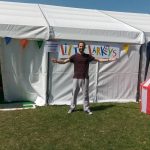 Its been a crazy week in which
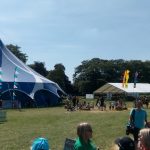
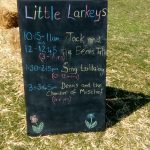
 This week sees me pilot (put in front of a test audience)

 Working on and off between other commitments my edit lasts three weeks and sees the story reduced from 31500 words to 3500 words. It’s savage but necessary. Authors have the luxury of time in their presentation of a tale that I don’t. Saying this, my editing process doesn’t end when I finally step away from the lap top. I’ll continue to edit during the life of the project and over time I will naturally adapt and adjust phrasing. I’ll also reinstate material once it’s clear how long my delivery is going to be.


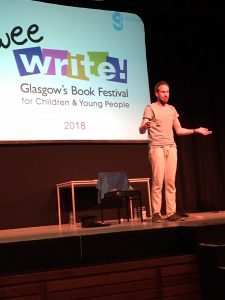 I love Scotland. I don’t really know why. Perhaps it’s because we went there a lot on our family holidays or because of the happy times spent at Edinburgh Festivals in the early noughties. Maybe it’s the accent or simply because I don’t have to spell out my surname to Scottish people but I have always had a soft spot for the place. Anyway, the last time I worked in Scotland was on a schools tour almost fifteen years ago. I have been trying to find a way of working there again ever since. Earlier in 2018 I thought I’d cracked it; I booked dates for the summer in Moray, Angus, Fife and Dumfries and Galloway but the plan was scuppered because of my family commitments. Then came The Beast from the East hit Britain. It caused chaos and lead to the postponement of the Wee Write! Festival. Determined to do something for young Glaswegians the organisers managed to pull together a wonderful programme of activity in just a few weeks. I hadn’t been originally invited to participate but when I was contacted I didn’t think twice – I was Ton my way to Scotland!
 The thing about living in London and working in Glasgow is it’s a very long way and travelling on a Sunday is not easy. So my day begins at 3.45am (you haven’t misread that) as my alarm goes and I hop in the shower having spent the night sleeping on Verity’s play mat in the living room. I creep out of the house, terrified of waking her particularly as we’ve been camping this week and her sleep is all over the place from spending the night in our van. By 4.10am I’m at the tube station. I have used the night tube once before but never in the very depths of the night. As a train geek this is brilliant fun and I’m excited to see that a service runs every 10 minutes through the night. When the tube arrives it’s pretty empty but it soon fills up with people heading home from their nights out or, like me, to the airport. When I reach Victoria I stroll along Buckingham Palace Road arriving just before 5am. I try to talk my way onto an earlier bus but I’ve got no chance – all the buses from Victoria Coach Station have been fully booked from 3am because there’s no other way of reaching Luton at this time in the morning. No worries, I wander back to Greggs for a sausage roll (yes, Greggs is open before 5am in Victoria Coach Station!).
 At this stage I am not worried at all. I have selected a bus which will get me to Luton in good time for my flight. I had foolishly bought a rail ticket only to discover that I’d miss check in by a minute if I used it so as the bus gets underway I’m feeling pretty smug. I read my book in the dawn light as we loll through the empty London streets. Looking out the window the dew in Hyde Park gives the grass a very eerie appearance. Everything is going fine until the bus suddenly stops. The driver informs us that a joy rider has crashed a car and abandoned it in the middle of the road. There is nothing on the road and the bus is still stuck. The minutes are now ebbing away as the Police arrive and inspect the vehicle. I know that they are working as fast as they can but as they check the vehicle over I am wishing they’d just find the hand brake and clear the road. The bus finally gets through and we arrive at Luton Airport ten minutes late. I have just enough time to check my bag before jogging through security and onto the the plane. An hour later I am reunited with my bag and am queuing for a transfer into the city of Glasgow.
 I have only been to Glasgow a couple of times but the central area has never struck me as being that big (it is however very hilly particularly if you misread the google map and go up the same hill twice!). I finally find the Mitchell Library. The Mitchell Library is one of the largest libraries I have ever been in and it has a beautiful early 20th century exterior. Today its grandness is somewhat overshadowed by the fairly busy dual carriageway it sits next to but as I go inside and see the gathering crowds it is clear that the Mitchell Library is a much loved community asset. Having said my hellos I make myself scarce for a while.
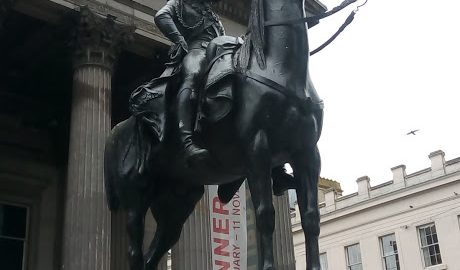
 I take a turn along Bath Street and Sauciehall Street toward Buchanan Street stopping off to see the Duke of Wellington’s traffic cone hat before heading out onto the river Clyde and meandering via BBC Scotland back to the library. It still pretty early and the city has a very relaxed feel about it; the city is awash with colour with everybody wearing either Celtic green or Race for Life Pink.
 When I get back to the library the place is buzzing and there’s a very friendly atmosphere; there’s cartoonists leading master classes, toddler story times, a science workshop and people hanging out in the cafe space. The children seem to be having a high old time. In the foyer as I listen to the Seussical Musical it’s easy to forget that I am here to work.
 Finally my moment arrives and I’m ushered into in the 400 seat Mitchell Theatre. This venue has seen some seriously big names play on it. I am doing a demanding double bill of “The Twits” and “The Hundred Mile an Hour Dog”. The presentations go down well. The audience seem to enjoy “The Twits” but it’s trickier to tell with Streaker. It’s quite quiet in the auditorium for both stories as the crowd give very little away. I worry that my brand of chaos seems to be getting lost in the vast auditorium and that I’m not getting up my usual momentum but there are still queues at the end of each session for photographs and lots of positive feedback.
 Then as quickly as it all began my participation in the festival is over. By 4.30pm I’m back on the street and after another couple of hours in Glasgow city centre its back to the bus stop and off to the airport only to find my flight has been delayed (it’s now nearly midnight and I’m still not quite home).
 There are signs all over the city reminding its inhabitants that “People make Glasgow” well I will certainly remember the people who made my Wee Write! Festival so memorable and I am very grateful to the organisers for their hospitality and the audiences for supporting my work. Its been a crazy day but it was a pleasure to have been part of a very special event in a very special city.