Tag Archives: key stage two

Qualifying my contribution to children’s learning

John Kirk is a storyteller and drama facilitator specialising in drama workshops and theatre for young people.This week I am using my blog to qualify my impact on learning by sharing some of the testimony I have received in the past 3 months.

“The day was absolutely fantastic and the feedback from children and parents was brilliant. It was lovely to see the children echoing the language you used when writing stories the next day. They all thoroughly enjoyed the day so thank you!!”  Teacher, Wychwood Primary School, Shipton Under Wychwood (Traditional Storytelling and Presentation Day, January 2014)

“I can honestly say that this was one of our most successful days!
John totally engaged the children and especially a group of boys who usually show very little interest in drama, storytelling or writing! The next day the children were still talking about John’s visit and the tips he had given them for story writing. I call that money well spent!” Headteacher, Gillibrand Primary School, Chorley (Classic Storytelling and Workshop Day, February 2014)

“Again, a fabulous day much enjoyed and talked about by the children all week… They have also been inspired to write their own poems and stories – ” Teacher, South Malling Primary School, Lewes (Alfred Noyes’ “The Highwayman“, February 2014)
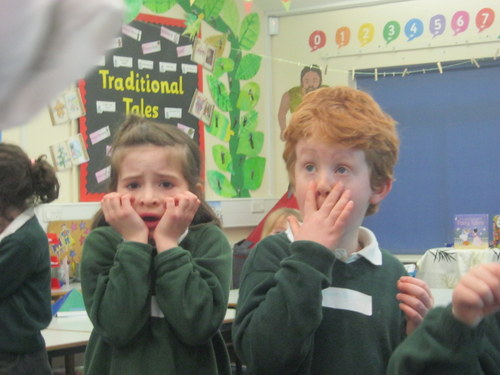
John Kirk is a storyteller and drama facilitator specialising in drama workshops and theatre for young people.Each of these teachers work in very different social, economic and geographic settings and yet their feedback demonstrates that my stories and workshops manage to transcend such obstacles, appealing to young people nationwide.  They also point to a lasting impact and legacy.

Positive and constructive feedback is always appreciated but I’d like to finish this piece by sharing a lovely comment I received from a school in Liverpool.  Leaving London at 5.30am I made it to Anfield for a 10.45am start.  I led a story and workshop session and was back in the big smoke by 7.45pm.  The children were wonderful to work with but getting this comment from their teacher made an epic trip to Merseyside more than worthwhile.

“The children got a lot out of the workshop! Thank you.”  Teacher, Whitefield Primary School, Liverpool

Related blogs

Fairy Tale Stepmothers do ave’em! – my thoughts on female Fairy tale villains

See also A Tale of Two Newspapers – a piece about performing in Chorley (my home town)

See also “The Highwayman” from an Ostler’s point of view – my thoughts on rewriting Alfred Noyes’ “The Highwayman”

See also Why Mickey Flanagan isn’t joking – my thoughts on quality
“It was so much better than German!”

John Kirk specialises in drama workshops and theatre for young people.At the beginning of January I was in Essex to help inspire a group of young writers.  I wanted to present a workshop in which the participants didn’t feel they were really doing any work.  As absurd as this may sound – I ran a creative writing workshop without doing any writing!

As a trained actor my strength is in the spoken word and its delivery.  Through games and activities I helped the group explore short stories and the work of Edgar Allan Poe.  Here are some of the games we played:

Exploring quality of their content and how we can manipulate atmosphere.

Person A sets up a simple mime.  Person B questions it.  Person A tells a lie about their action and that lie becomes Person B’s truth.  The quality of A’s lie will effect the quality of B’s mime (I’m eating a spicy chilli is far easier to demonstrate than I’m eating).  The game then develops as Person B informs Person A what they are doing.  Whatever B says A accepts as truth.  It is in B’s power to manipulate the scene (A is sitting on a chair watching television and B begins an interrogation).

John Kirk is a storyteller and drama facilitator specialising in drama workshops and theatre for young people.Building short stories

A small group is challenged to tell a story.  Each person in the group is responsible for a section of that story which must have a clear beginning, middle and end.  A character, a location and object are offered as a starter to the group).  As the group build their story ideas about tense (how does “I” rather than “he” effect a story?), sentence structure and vocabulary are introduced before the story is presented to the rest of the group.

Eventually my success will be qualified by how the participants take the ideas they explored on their feet into their written work.  For now though my success is qualified by their words…

“It was better than any day at school… Changed my view of storytelling.”

“Today was really good!  It was so much better than German!  I learnt a lot about building tension and suspense and I have learnt how to use it in my own work.”

“This experience was such a great learning curve for anyone invited and I will take skills with me.”

I really enjoyed today… everyone got involved with acting and storytelling.  It was lots of fun!”

“Thank you to John Kirk for a great experience toady, we learnt a lot of new things and had a really enjoyable morning.”


John Kirk is a storyteller and drama facilitator specialising in drama workshops and theatre for young people.
A letter from a student after a secondary school workshop exploring short stories and Edgar Allan Poe.
John Kirk is a storyteller and drama facilitator specialising in drama workshops and theatre for young people.
A display of Tweets after a Secondary School Workshop exploring short stories and Edgar Allan Poe.


“The Highwayman” from an Ostler’s Point of View

I also offer a “Highwayman” workshop!!

Highwaymen are often referred to as “Gentlemen of the Road” but they were in fact nothing more than common thieves.  “Stand and Deliver!” (the command rather than the song), was last uttered by a Highwayman in Britain in 1831 but their exploits were (and are) popularly romanticised.  Alfred Noyes’ epic poem chronicles the night time adventures of one such rogue and the Landlord’s daughter, who tragically meet their ends in the cobbled inn yard.  Alfred Noyes’ “The Highwayman” is a brilliant story of love that has been reinterpreted by artists, film makers and musicians around the world.

As part of a workshop exploring Alfred Noyes’ “The Highwayman”, I was challenged to reinterpret the poem for a group of Primary School children.  This video is a part of the result and this blog came about as more and more people watched it online.

PLEASE VISIT 1000 UP! TO VIEW THE VIDEO

Rather than tell the Highwayman’s story I wanted to explore the world of the other characters mentioned in the poem.  I wanted the tone to be quite serious so taking Bess’ perspective was out.  The Landlord and the King’s Guards presented possibilities but the most interesting character seemed to be Tim the Ostler.  In the original poem Tim is mentioned by name but appears in just one stanza:

“And dark in the dark old inn-yard a stable-wicket creaked
Where Tim the ostler listened; his face was white and peaked;
    His eyes were hollows of madness, his hair like mouldy hay,
    But he loved the landlord’s daughter,
The landlord’s red-lipped daughter,
Dumb as a dog he listened, and he heard the robber say—”

Who was this man?  Why was he there?  What was his role in events and what was his story beyond the inn yard?

What follows is the transcript of the above video.  My version is actually longer than this as I introduce the Captain of the Guard and explain what happens to Tim (I reserve those verses for live presentations).

What was most striking for me in Noyes’ poem was his rhythm and rhyming structure.  When I listen to the poem I always think about a horses hooves and I wanted my poem also to respect a regular meter (which it loosely does).  I also love his imagery and try to include some bold similes and metaphors.  Like Noyes I was drawn to his original themes of love, jealousy and violence but I have chosen for Tim the Ostler to recount his bitter betrayal rather than a third party.


Tim the Ostler

Now the landlord he has a daughter, whose lips are as red as a fire

Her hair is a perfumed cascade you couldn’t fail to admire

Oh how I longed for this young girl, who goes by the name of Bess

My master’s black eyed daughter

She smiled at me, his daughter

I dreamt that this sweetest lady would someday be my Princess….

I also offer a “Highwayman” workshop!!

Fairy Tale Stepmothers do ‘ave em!

Stone Soup 2Once upon a time the Fairy Tale was born…

The popular Fairy Tale has existed for well over 200 years and typically demonstrate good’s victory over evil.  Good being traditionally described as young, brave, kind, clever and beautiful, evil being old, wicked, corrupt and all too often female.

Witches, Queens, Stepmothers – there are plenty of examples within the genre but is there any common ground between them?

The fairy tale villain is an outsider, standing apart from society.  The Witch is ostracised for her appearance or habits, The Evil Queen is removed by her power and wealth but what of the Wicked Stepmother?  The Stepmother is the antithesis of what we might think of as a stock Mother figure (caring, nurturing, supportive).  Whilst the Witch and Evil Queen often threaten an entire community, the Stepmother represents a challenge to the family unit, her presence creating tension between the children and their Father.

There are several examples of Stepmothers in fairy tales; Hansel and Gretel, Cinderella and Snow White all have to deal with them.  In fact Stepfathers have far less nasty reputations.  This could be because many of the most famous fairy tale writers were men (Hans Christian Andersen, The Brothers Grimm to name but a few).

John Kirk specialises in drama workshops and theatre for young people.In the Stepmother the fairy tale writer has a character with an axe to grind.  The Stepmother has won the heart of her husband and wields power over his children mercilessly (Snow White, Hansel and Gretel are forced out into the forest and Cinderella is used as a slave).  The Stepmother’s motives are broadly similar to that of the Witch or the Evil Queen; jealousy and the lust for power.  Her new child(ren) are more beautiful than she is and they are in the way.  In the family unit, the Stepmother is Queen and her throne must be ruthlessly consolidated.

Of course like all fairy tale villains it will not end well for the Wicked Stepmother.  Her death or banishment will not only be gruesome but in it there will be a valuable moral lesson about love and virtue.  These lessons are highlighted, not by the downfall of the villain, but by the child(ren)’s relationship with their Father.  Throughout the Fairy Tale the Father neglects his responsibility as protector; he is blind to his new wife’s behaviour sometimes going as far as to carry out her dastardly wishes.  In the end he realises who he truly loves and seeks forgiveness.

Perhaps the reason that the Wicked Stepmother endures as a villain can also be found at home.  It’s unlikely that in the 21st Century we will ever meet a Giant or a talking Wolf but each of us understands the role of the Mother.  A Witch may be more mysterious and a Queen may be more powerful but it doesn’t take a flight of fantasy for even the youngest child to recognise the threat a Wicked Stepmother poses.

Wicked WitchIn my Traditional Tales I enjoy playing the wicked characters (even the female ones).  Playing a Witch or a Wicked Stepmother brings life to the story and is the perfect excuse for a wig or a shawl!

It can be very scary for young audience members to come face to face with a truly terrible character in any context (Miss Trunchbull’s School Inspection or The Victorian School Room) so I work hard to assure my audiences that they are safe.  Exposing children to danger, be it a Witch, a Dragon or a Stepmother, in my view, comes with responsibility.  If I am going to present bad characters I must demonstrate their ridiculousness; my audience must see that villains always get their comeuppance and that good will triumph in the end so that we can all live happily ever after.

Tale of Two Newspapers

I am originally from Chorley in Central Lancashire but live in North London.  I had learned about an event which was to take place called Chorley Live through Twitter.  The event was all about showcasing local talent so I was keen to support it.  I got in touch with the organisers and arranged to bring my work home to Chorley.  Knowing that I would probably struggle to publicise myself at a festival 200 miles away I phoned the local paper (The Chorley Guardian) in order to get a bit of publicity for my performance of Dracula at Chorley Library.  What I got was an amazing two page spread!

Chorley Guardian Interview

As you’ll imagine the piece meant that quite a crowd of people attended my performance.  It went really well and it seemed that everybody enjoyed themselves with many people taking away business cards.

Now, whenever I give out business cards I notice spikes in activity on my Youtube and Facebook pages.  That evening I noted such spikes with  audience members from the library going online to follow, like and comment on my performance but I thought nothing more of it than that.

A few weeks passed and I was contacted via Facebook by somebody who’d seen my October performance.  She had been so impressed by my work that she had recommended me to her children’s school!  Before I knew it I was back in Chorley in front of 300 children, opening the school’s library with my Mad Hatter’s Tea Party.  I had a fabulous day at school and it was an immense privilege to be asked to cut the ribbon and officially open the school’s library.

Once again my adventures made it into the local paper.

Chorley Guardian St Gregorys

This story proves two things: that work truly does breed work and that I wouldn’t be anywhere without the support of my many friends, family and supporters across the United Kingdom.

Thank you for continuing to spread the good word!

An INSET Epiphany!

John Kirk specialises in drama workshops and theatre for young people.In 2011 I worked on a Creative Partnerships project in Lincolnshire.  The project was massively successful and attracted plaudits from educational professionals across the region.  That Autumn I was invited to share my ideas with a conference of new Headteachers in Lincolnshire.  I was then asked to lead a training event for four of the Head’s schools relating to creativity and the Summer Olympics.  18 months I was invited to lead another training event.  The theme of the session would be Mental Maths.  I was set the challenge of offering creative ideas for engaging children (foundation to key stage two) with Mental Maths.

So it came to pass that at Epiphany in the year 2014 I followed the A1(M) and came upon an inn in Lincoln (well, a Best Western anyway).  Now, it is a well known fact that this Wise Man is diabolical at Mathematics.  The people who know me best would confirm that the idea of me teaching anybody else about maths is hilarious.  Why then did I get such positive feedback on the INSET?

“Thank you so much for the training, staff said it was the best training they have ever had!”

In the first part of the session I presented a series of games.  The participants then applied their specific need (to consolidate or introduce Mathematical concepts) using my selection of games.  The learning was not restricted to Maths as Sciences, Languages and Humanity subjects entered the discussion.  In the second part of the session we explored how we might use narrative and storytelling technique to include our groups in Maths based storytelling.  The participants created wonderful stories which considered number bonds, using money and addition as well as other aspects of learning (literacy).  It seemed to me that the participants found a lot of energy and freedom in our exercises.

John Kirk specialises in drama workshops and theatre for young people.The epiphany’s of my INSET days aren’t as shiny as The Three Kings gifts but they are things which all of us need sometimes:

A Different Perspective – I am an outsider to the group.  When I work with a group I will have little knowledge of individuals or circumstances.  I will offer constructive criticism based on my experience and will respond to what I am presented.  This is very useful when problem solving or in team work exercises.

Fresh Ideas – I have a unique base of games and ideas which I have developed over a decade of working in a range of environments.  I love sharing my knowledge with other professionals because its in this way that young people are offered a better deal.

Fun – Most people who teach or who have ever been taught will agree that fun is important.  I believe in the valuing the contribution of individuals and collaborating to achieve goals together.  It always important that the atmosphere is friendly and that the participants feel comfortable.

So why was my INSET successful?  It was a success because I am not a teacher, I am a facilitator.  Often the results are within the room before I arrive.  I help the participants to find them.

Storytelling and Code Breaking

Can you crack the code to continue the story?John Kirk specialises in drama workshops and theatre for young people.

1911 1955 1912 1916     1937 1972    1920 1981 1951!

Where A is 1908, Z is 2000 CODE IS FUN!

You might be thinking, what has code breaking to do with storytelling? Well, my work is nothing if not varied and I was recently invited to launch a Homework Club at a Library.

The challenges of storytelling for informal settings are numerous: who will attend, how old will the participants be, how can we best use the time to deliver something which will be engaging and not patronising?

On this occasion I came up with the idea of creating a story around a fictional counter terrorism agency to meet the client’s brief.  The agents were told at an initial briefing that the unit had been infiltrated by an enemy agent.  It would be the task of the group to crack the clues and root out the villain before the unit was destroyed.  Jack Bower meets Cluedo – the game was afoot!

As well as the date cipher above, I used the Dewey system and the characteristics of books to disguise information (page numbers, line numbers, even the number of characters into a line!)

John Kirk specialises in drama workshops and theatre for young people.

Allowing the participants to approach the narrative in a free form way is a risky venture but attempting to crack my ciphers was an important part of the session.  Like homework, the ciphers required the young people to work for their reward using problem solving and research skills.  The pay off for the young people was revealing their role in the narrative which they were then able to use to complete the story, taking part in a further game of conspiracy and intrigue at the end of the session.

It was encouraging that the group saw the session through to its conclusion.  It would be quite easy to struggle with the puzzles and drift away from the exercise but the group persevered and the final game was a hail of accusations, bluff and enthusiastic double bluff based on what they knew about themselves from the previous games.

In the end the enemy agent was brought to justice and everybody seemed happy with my deviously vexing games.

As I basked in a job well done one thing was clear – I wouldn’t have got away with it without those pesky kids!

An Unbirthday Party

A Birthday Party is a very special thing.  When a child reaches the age when there is innocent pleasure in parlour games and jelly and ice cream its up to you to take advantage before this briefest of windows closes and they become too cynical for pinning tails on donkeys.

In the planning and execution of a Birthday Party its worth remembering that you are creating an indelible memory which will effect the child’s relationship with birthdays forever.  Some of my clearest childhood memories are from such parties: the joy of presents, the disappointment at losing party games, the sickness caused by too many sweets and too much excitement.

DSC03063Organisation shouldn’t be taken lightly.  There’s the cake, the birthday tea and of course the party bag and prizes.  The song says “it’s my party and I’ll cry if I want to”; whilst it wasn’t necessarily referring to the party organiser, in an age of competition between parents the pressure to find an edge will drive you to distraction.

A storyteller offers a party just that edge.

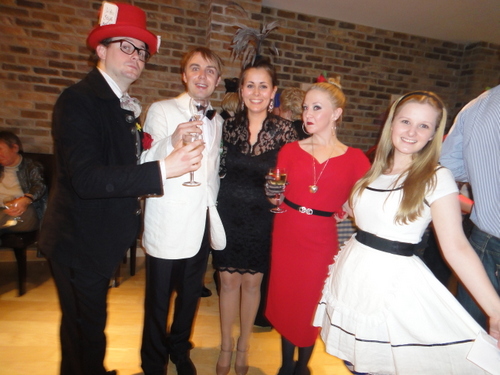
It has been my pleasure to offer my experience to both children’s and adult birthday parties where “Alice’s Adventures in Wonderland” was an overarching theme.  For a children’s party I appear as The Mad Hatter, weaving Lewis Carroll’s poetry into an afternoon of games and activities ranging from group storytelling to decorating paper hats.  In the case of adults I work as coordinator and consultant, bringing a team of performers to mingle at the party.

John Kirk specialises in drama workshops and theatre for young people.For any age group a storyteller adds value to the celebrations.  Storytellers will delight and entertain guests whilst a strong sense of the narrative can define and guide a party purposefully with energy, colour and imagination.  The ability to collaborate with a storyteller means that the party organiser is able to request personal touches as your wildest dreams are brought to life.

The legacy of great storytelling at a Birthday Party isn’t difficult to quantify and will make all the hard work seem worth it.

“That was the best birthday party ever!”

“That was brilliant!”

… or sometimes – “thank you”.

The Great Fire of London

John Kirk is a storyteller and drama facilitator specialising in drama workshops and theatre for young people.Recently I have being doing a lot of history projects in the name of education; The Gun Powder Plot, The Princes in the Tower and The Great Fire of London.

In 2013 it wouldn’t be uncommon to hear that a lesson was being in some way led or influenced by an artist but theatre’s relationship with education is historic.

As a visual and aural medium theatre has always been an effective method of communicating information quickly to an illiterate society.  The Greeks used comedy and drama to make social and political points, Mystery plays were a popular way of sharing the stories of the Bible with Medieval audiences and even William Shakespeare got in on the act with a series of plays we now recognise as his histories.

John Kirk is a storyteller and drama facilitator specialising in drama workshops and theatre for young people.Why though, are there so few plays concerning The Gun Powder Plot and The Great Fire of London?

I don’t really have an answer to this but I do have a couple of theories.

In the case of The Gun Powder Plot (the failed attempt to blow up the opening of Parliament and King James I in 1605 – “Remember, remember the 5th of November”) and to some extent The Great Fire of London (a fire in Pudding Lane leads to 4 days of devastation in 1666) my initial thought is that perhaps there were plays and they weren’t good enough to survive the test of time or that I just don’t know them if they are out there.John Kirk is a storyteller and drama facilitator specialising in drama workshops and theatre for young people.

My second thought is that 17th Century England is a politically volatile place where the censor still dictates what is appropriate for the public.  The Gun Powder Plot is an attempt on the life of a reigning monarch at the beginning of the century.  In 1643 Charles I was executed after a Civil War and England became a republic for almost ten years before the restoration of the monarchy and finally James II being run out of England for being Catholic.

Socio-political statement might also have jarred with the increasing public appetite for Restoration Comedy as the likes of Wycherley (The Country Wife) and Moliere (Tartuffe) titillate audiences with plays about gossip and the naughtiness of society.

My final theory and the one I’m sticking to as to why there are no really great plays about two of England’s most famous historical events is health and safety.  Plays about fire and combustion tend not to mix well with wooden theatres!  Perhaps sense prevailed and they left these two topics for another generation.

The Victorian Classroom Experience

John Kirk specialises in drama workshops and theatre for young people.I had just marched out of the hall, my cane tucked under my arm, the children quivering with fear.  In the quiet of the staffroom I reviewed my morning as a Victorian School Master.

The session had come about after I was contacted to provide an authentic Victorian Classroom experience.

About three years ago I was commissioned to write a School Room session for The Bruce Castle in Haringey.  This would be a fabulous opportunity to revisit the piece.

The Bruce Castle School in Tottenham was run by the Hill family during the 19th Century (Rowland Hill gave us the Penny Black).  The school was renowned for its progressive approach to discipline.  Rather than using corporal punishment, The Bruce Castle School introduced a system of points and rewards which was administered by the pupils themselves.  It had many supporters including Charles Dickens who is known to have visited the school.

Unfortunately The Bruce Castle is something of an exception to the rule in the period.  It was only late in the reign of Queen Victoria that education became compulsory and then only for the very young.  Many children found school either voluntarily or via the workhouses.  With sometimes eye watering class sizes order was maintained through fear.

Having reworked the piece to incorporate references to potential punishments I have tried to communicate the importance of the credibility of the session to the school.  If the children don’t buy into the experience then the experience is liable to collapse (he’s not really a teacher/he isn’t really going to cane us etc) 150 years ago it was acceptable to hurl board rubbers at pupil’s heads – 150 years is clearly a very long time!  When I arrive, the school has excelled.  They have a free standing white board and arranged rows of benches in their hall.  There is even a lectern for the register.  With my bell and my cane we have created a pop up Victorian Classroom!

OLYMPUS DIGITAL CAMERAJust before 9.05 I go to get the class.  They are ready.  We head to the hall where the boys and the girls stand in front of separate benches.  The atmosphere is nervous.

“No speaking, Eyes front”.

I register the class, addressing them by surname.  As I stumble through the register I am reminded of how far removed the Victorian world is from the present day.

“Sit down”.

The lesson today is divided into reading, writing and mental arithmetic.  It begins however with physical drill.

Whilst researching for the original piece I discovered that quite often PE would take place in the classroom because the school didn’t have outdoor facilities.  The children would take part in physical drills at their desks!  We often take public parks for granted but at this time open spaces in urban areas must have been truly oases.

Drill over its into learning by repetition.

“Sit up straight!  Eyes front!  No slouching!”

Victims are selected.

“What is 4×5?”

Pressure can make the most intelligent child look very silly.

“What is the superlative in the passage?”

The point of this isn’t simply to intimidate or make a child feel silly.  The point is to demonstrate a method of learning.  This isn’t the learning of compromise this is the learning of fear – my way or the highway.  if a girl hesitates on an answer its also an opportunity to reinforce attitudes towards educating young ladies with a jibe about needlework.

OLYMPUS DIGITAL CAMERAThe lesson moves onto a writing exercise.  Today as substitutes for slates we have portable whiteboards.

“Why are you writing with your left hand?  You will write with your right hand”.

As School Master I maintain an unsympathetic air to the teachers and pupils and the lesson continues in silence.  What rapport there is between class and instructor is cold and dangerously sharp.

“Sit up straight!  Eyes front!  No slouching!”

The lesson concludes with three cheers for Queen Victoria.

Afterwards there is time to discuss the experience with the class.  The feedback on the session is interesting.  Words like “unfair”, “shocking”, “mean” and even “rude” are used.  Comparisons are made (everybody prefers their class teacher to my incarnation!).  There is general relief that I am not the monster of the Victorian classroom.

Sitting in the staffroom I can’t help but smile.  As the children return to their classroom and life gets back to normal there is legacy in their participation.  Undoubtedly this morning’s interaction will provide context to their learning, stimulus for their writing and renewed enthusiasm for their study but you only need to listen to hear them recalling moments from the session to know that this has affected them.

It has been an unforgettable experience.