Tag Archives: foundation

Preparing for mischief #dennis2018

This week sees me pilot (put in front of a test audience) Nigel Auchterlounie’s Dennis and the Chamber of Mischief.  I thought I’d use my blog to reflect on the process of how I prepare to tell stories (ie how I get from nothing to the first presentation).  Sometimes storytelling is about stepping in front of a crowd and telling tales from memory and the heart but when I’m presenting a living author’s work I have a duty to represent their book.  This means having to prepare what I will say in order to guarantee coherence and quality.  Its this process that oral storytellers would point to as the reason why I’m a turn rather than a teller.  It’s unglamorous but essential work that I hope will interest would-be storytellers.  Please be warned that this blog may contain some plot spoilers.

To begin at the beginning I first contacted Beano Studios 12 months ago about the viability of a summer project for 2018.  After a lot of correspondence between myself, Beano Studios, Templar Books and The Reading Agency a project was eventually agreed.  This moment is always a moment of great relief because it means that I’ll be working over the next summer and that my work has legitimacy.  There is however one small problem; after 6 months of discussion I find out that Nigel hasn’t actually finished writing the book I’m supposed to be telling.  it’s a frustrating revelation because I like to do my preparation in the winter when work is quiet.  Instead I enjoy a relaxed Christmas and a trip to the Caribbean with no source material to read or begin working with.

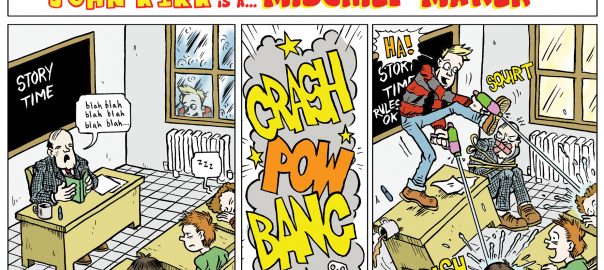
To my great relief the manuscript arrives at the end of February and tonsillitis gives me the opportunity to read it in the second week of March.  Nigel Auchterlounie is a regular contributor to The Beano and as I read I can’t help thinking of a cartoon strip.  You see, whilst Dennis and the Chamber of Mischief is a basically a classic quest/adventure it’s packed with huge ideas which appear and disappear in the turn of a page.  There are lots of characters and the action takes place across time and space.  My first thoughts are that it will be a challenge to turn the book into a storytelling for a library.

When I edit I always work backwards through a book.   In 2014 editing Private Peaceful into a 40 minute storytelling was relatively straightforward because Morpurgo has a habit of describing everything 2 or 3 times.  I would pick one and ditch the others.  The Hundred Mile an Hour Dog was trickier because it’s a situation comedy and each episode has to be fully described for the audience to understand why what’s happening might be funny.  Dennis and the Chamber of Mischief is a whopper of a tale weighing in at almost 250 pages.  It’s comfortably the longest source story I have ever attempted to adapt.

Deep breath.

Working on and off between other commitments my edit lasts three weeks and sees the story reduced from 31500 words to 3500 words.  It’s savage but necessary.  Authors have the luxury of time in their presentation of a tale that I don’t.  Saying this, my editing process doesn’t end when I finally step away from the lap top.  I’ll continue to edit during the life of the project and over time I will naturally adapt and adjust phrasing.  I’ll also reinstate material once it’s clear how long my delivery is going to be.

SPOILER ALERT: In my retelling I have decided to centre on Dennis’ pursuit of the Golden Pea Shooter of Everlasting Fun into the Chamber of Mischief and out again.  Into this I have to set up unfamiliar concepts for the audience including the character of Dennis, Beanotown, the Chamber of Mischief, and the various magical objects the story hangs around.  In order for an audience to understand how we reach the end of the story I have to make my narrative arc as clear as possible.  This means that a lot of clever sub plots are excluded (rather than Dennis tackling 9 challenges in the Chamber of Mischief, my version contains just four).  Whenever I prepare a story I must bear in mind that whilst a book might be aimed at child aged 6+ there will be children aged 4+ and possibly younger who come to watch and listen to me and they don’t have very long concentration spans.  In short: I have to serve my audience and they are different to the audience of the book.

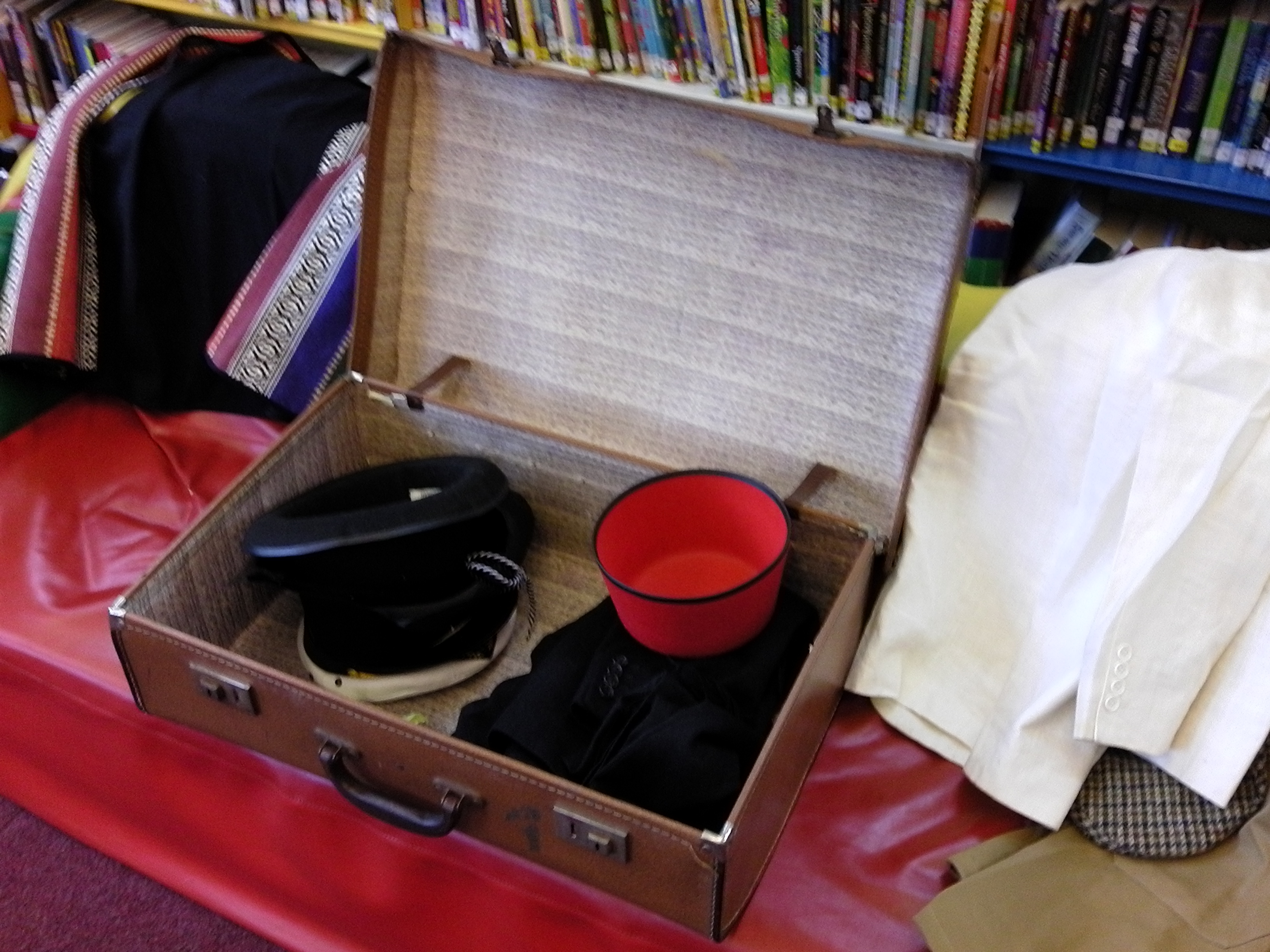
The next major task is thinking about the props, hats and wigs I’ll need in my presentation.  My style of storytelling is to narrate and when a character speaks become the character by wearing something or changing my voice or physicality.  It means what I am doing is incredibly clear to the audience.  Working on Roald Dahl’s The Twits was a gift as it suited my style to a tee because there are very few characters.  A story like A Christmas Carol in which I introduce a multitude of characters in a short period and we don’t ever get to know them is harder for everybody.  Dennis and the Chamber of Mischief has a lot of characters but not just people; SPOILER ALERT: there are dogs (obviously), giant squid, talking paintings and medieval knights.  I used to source my props in London’s numerous costume shops but these days I do it all online.  Trying to find one prop, voice, hat or wig to define a character really gets you thinking about and helps to consolidate the story.

By now it’s Easter.  The diary is almost full and my June deadline is looming.  I have about 6 weeks to learn the whole thing.  My savage editing serves for two purposes; it reduces the text but it also helps me to remember it.  These days this is crucial.  I have loads of dormant words floating around my head from almost a decade of storytelling and with a very young child in the house and other work commitments finding time to cram more in is sometimes terrifies me.  As I say though, the words I took from the book and the words I use in the storytelling will evolve in time but this is about having a framework at the beginning.  This year, with two other storytellers involved in delivering the project a solid framework has never been more important.

All that remains now is for me to tell the story.  There’s just enough days in the week to go through it with Dan McGarry.  I’ll then put it up in front of an audience and as the fun starts the hard work begins.  Dennis and the Chamber of Mischief is set to be presented 86 times and I guarantee that what we start with and finish with will be poles apart.

To this point the process has been very insular; sitting with a lap top in front of the TV, on a train or in hotel rooms.  For the 30-50 minute delivery hours have been spent pouring over the words to the point I think I sometimes dream about Dennis’ adventures.  The next stage will be far more instinctive and far more to do with my communion with a live audience.  Will the story have the momentum I need to take everybody on this wacky adventure?  Time will tell but if it does then all the preparation I’ve done to this point will be time well spent.
My work with EYFS (Early Years and Foundation Stage)

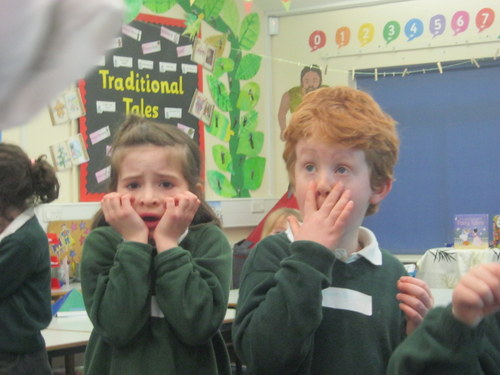
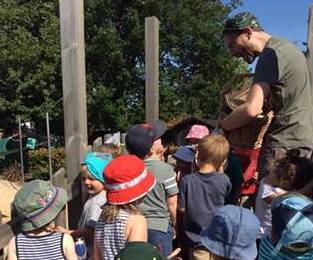
Telling stories to under fives is so very very important.  If we can convince a child early on that stories are magical then perhaps we make them a reader and maybe we change their future.  That isn’t to say it’s easy.  After I quit my day job and decided that I was going to tell stories for a living I was prepared to do pretty much any job that came my way and when local nursery school invited me to do 30 minutes with them every fortnight I jumped at the opportunity.  Now, I have worked with all kinds of different challenging behaviours, children with profound complex needs and even teenagers but these sessions with 0-3 year olds were some of the toughest I have EVER run.  Having been a father to Verity for almost 16 months I laugh about it now but back then I dreaded these sessions because I felt out of my depth and simply didn’t know what to do.  Spin forward to today and working with under fives is my bread and butter.  I work fairly regularly in EYFS (Early Years and Foundation Stage) settings and have even run staff training with nursery workers and sessions with new parents around telling stories.  I have developed a really solid set of traditional folk tales which go down really well in schools and I am making tentative steps into running under fives drop in sessions for libraries too.

So what’s changed in 10 years?  Well, being a Daddy probably helps- fatherhood has taught me many things including patience, understanding and being more adaptable– but mainly its about recognising the different ways that children learn and play.  When doing drop in sessions and nursery sessions I have a set format for delivery so if I am doing a regular set the audience know what to expect.  I will vary the pace of a session by incorporating different activities, games, songs and rhymes as well as stories.  I pack my storytelling with movement and the opportunities for the children to participate through repetition and instead of just using words I’ll use sounds, songs and rhymes to make the narrative more accessible and fun.  My acting career is a distant memory but I still sometimes deliver in role to enhance the experience and bring a different dimension to the sessions.

“Younger children’s attention span is not the same as older children. John knew exactly how to engage very young audience whilst telling the story and most children enjoyed being involved in the story. What impressed me most during story telling was that one baby about 7 months old was so mesmerised by John’s storytelling and her eyes were glued to him the whole time!” (Librarian, Northamptonshire, June 2018)

Once upon a time I was terrified by the thought of telling a story to a room of babies.  My confidence has grown because I have gained experience from working in the environment and learning from talented early years professionals and the children themselves.  There’s one word that sums up telling stories to Early Years and Foundations Stage children: joyful.

The Great Fire of Guilden Morden (Part Two)

John Kirk specialises in drama workshops and theatre for young people.Time to bring you up to speed on The Great Fire of Guilden Morden project.
As you’ll recall from my previous blog on this three month project  last year I was contacted by Guilden Morden Primary School who were looking for a creative partner for a Heritage Lottery funded project.  Working over 12 weeks between May 2014 and July 2014 the school would devise and develop a creative response to The Guilden Morden Fire (22/5/1881).  This creative response would be documented using web based, digital technology.

The project has now finished so it seems appropriate to reflect on what we got up to in my final weeks in Cambridgeshire…

John Kirk is a storyteller and drama facilitator specialising in drama workshops and theatre for young people.Week Six

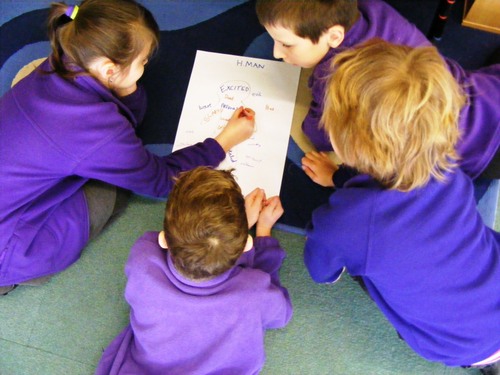
Polishing our story – I worked with the groups to consider the structure and language we might use in our poetry and scenes.  We explored atmosphere and how it might effect the urgency of our words (particularly as our story is about a fire).  We began rehearsing our scenes and thinking about how we could use transitive verbs to help a performer better understand character and events.  Elsewhere we explored the local legend of Jack o’Legs and the area’s connections to agriculture.

Week Seven

Staging a Chorus – The group continued to think about how vocal expression could bring the story to life.  Conscious of the looming deadline to create a piece of community theatre this week I also introduced some basic ideas about Greek Chorus Work.  With the youngest classes we set up a water relay race as we explored the difficulties the Fire Brigade might have faced in 1881.

Week Eight

Rehearsals – With two sessions scheduled this week we staged the main structural elements of our story; the scenes and poem.  It is worth mentioning that most of the ideas for the words and actions came from the children rather than from the teachers or myself.  It was very important that the children felt this was their project and that my role was to challenge and enthuse them.

John Kirk is a storyteller and drama facilitator specialising in drama workshops and theatre for young people.Week Nine

More Rehearsals – Working with each group for short bursts to ensure they didn’t disengage from the story we continued to rehearse the groups.  As we began to bring the different elements of the story together the process became very technical and I confess to confusing myself at times!  Despite this the group took things in their stride.

Week Ten

Show Time – For the first time we brought all 73 performers together and on two sweltering afternoons the children presented their story to their families and community.

The Great Fire of Guilden Morden is documented by the school here but this is a taste of what we came up with…


“It was a charming summer’s day in the year of 1881.

In Guilden Morden, the golden hill in the marsh,

the sun’s warm rays are dancing on the faces of children playing outside.

Birds sit amongst the fresh green leaves of silver birch trees

singing their beautiful songs,

and a gentle breeze carries cares and worries away.

Peace reigns over the village, fields and lanes.

None suspect what is to pass on that terrible Sunday.”


From start to finish this was a special experience.  The staff and all the pupils were wonderful to work with and I will truly miss being a part of the school.  I take away a lot of memories and a folder of thank you messages from the children which I will treasure.  Most of all though I leave this project inspired by the potential of young people and certain that creative practitioners have a future within education so long as schools remain willing to take creative risks, commissioning projects where the outcomes are more difficult to quantify.  So long as there are teachers like those at Guilden Morden Primary School creativity has a very bright future.

The Great Fire of Guilden Morden (Part One)

John Kirk specialises in drama workshops and theatre for young people.Three years ago it was my pleasure to be involved in two projects which were funded by the Creative Partnerships initiative.  The programme saw artists working with schools and exposing pupils and staff to new ideas of working.  In Stoke we worked to explore how we identify with urban spaces through stories and in Lincolnshire we created a story trail for the school and wider community.

Rather than doing a day in a school I was able to present a series of workshops as I took up residency in my partner schools.  The projects were very rewarding and I feel that I learned a lot about my practice from being involved.  I was supported by my partner schools to try out ideas (to take risks) and organise really memorable learning experiences for the children (we did a Q&A in Stoke with some local VIPs as well as a creative walk, whilst in Lincolnshire I organised storytelling experiences around the school to help the children’s imaginations).  Sadly (as is the way with these things) the programme came to an end just as I was discovering it.

Last year I was contacted by Guilden Morden Primary School who were looking for a creative partner for a Heritage Lottery funded project.  Working over 12 weeks between May 2014 and July 2014 the school would devise and develop a creative response to The Guilden Morden Fire (22/5/1881).  This creative response would be documented using web based, digital technology.  Remembering my previous Creative Partnership experiences I jumped at the chance.

At the time of writing we are approaching the midway point of the project.  I have tried to summarise what we’ve done below…

John Kirk is a storyteller and drama facilitator specialising in drama workshops and theatre for young people.Week One

Celebration.  Our first session fell on May Day.  In Cambridgeshire at the time of our story May Day would have been an opportunity for the community to celebrate the coming of Spring.  I want celebration to be central to our final presentation so I introduced a simple group dance to the children.  The dance will be incorporated into the final presentation and offer our work a communal spectacle.

Who are you?  Through simple storytelling games I found out more about the groups and we used objects to stimulate more personal stories.

Week Two

Who am I to you?  The pupils brought objects from home to tell their personal stories.  We then used the objects to build a map of their school community.  By spending two weeks focussed on identity we are better positioned to introduce the heritage aspect of the project (I have a better understanding of who I am but where do I come from?)

Week Three

The Great Fire of Guilden Morden Walkabout.  I lead walks around the village, introducing the children to the story of the fire in role.  Each walk took us on a 40 minute stroll about Guilden Morden stopping at the (assumed) site of the fire, The Independent Chapel, Old School, War Memorial, Church and Vicarage.  At each stop I role played a different character who had a part in the story of the fire.

Week Four

Commemoration.  This session fell on the anniversary of the fire.  To mark the date the school organised a fire drill and I read the newspaper report of the fire to the children in assembly.  Our commemoration was in sharp contrast to the celebration of Week One.

In their own words “The Guiden Morden Fire”.  The groups retold the story of the fire using drama games.  The groups used drama to structure their own version of the story.  These structures will be used as a starting point for building a narrative poem and dramatic scenes.

John Kirk is a storyteller and drama facilitator specialising in drama workshops and theatre for young people.Week Five

Acting Out the Events of 1881.  With the younger classes I appeared as a Victorian Schoolmaster and with the older classes we turned our version of the story into a series of scenes.  In the next week the classes will transcribe these scenes to form the basis of scripts and stories.

Over the next six weeks we have a lot of work still to do but I hope to be able to share news of our success, images and video here over the next few months.  Stayed tuned!