Tag Archives: communication

Telling a story in Aisle Four and creating the environment for storytelling.

The Victorian School MasterI graduated from Rose Bruford College in 2002 and that Christmas I took a job with a small scale touring pantomime company.  I was young and fresh and keen to begin building my career.  Well some would say that at 6ft 4ins I wasn’t the most obvious choice for Rumpelstiltskin but I was still very excited to be involved particularly when I learned that we would be doing a public performance in a supermarket.

Well when we arrived at the venue we realised the story wasn’t to be performed in the store but in the staff canteen to the children of the workers.  The other problem (as it turned out) was that store was open and the canteen in operation.  During a 90 minute show we battled deafening tanoy announcements, staff and parents talking over the story and even workers crossing the performance area.  It was at about this point I realised how hard a life in the arts was potentially going to be.

Nearly 12 years on from this experience I am now more than accustomed to inviting family and friends to watch me present stories in strange places.  I have told stories in pub beer gardens, public squares, parks and even a beach hut.  In my view, the same golden rule for success applies whatever the venue: if you aren’t the most interesting thing in the room then you are doomed.

If the environment isn’t right then it won’t matter about the content or delivery, the presentation will not be as effective as it might otherwise have been.  This isn’t always as straightforward as it may seem.  My work is something between pure storytelling and theatricality.  You might think that in suggesting characters using props, hats and wigs even my most wordy stories would be the most interesting thing in any room.  However, I was once telling Private Peaceful in a library when my young audience were completely distracted as a cat crossed the window ledge behind me!

I accept that there are certain things which are beyond the control of the event organiser (unless its your cat) but there are invariably steps that can be taken to ensure that everybody has the best possible opportunity to enjoy the story.
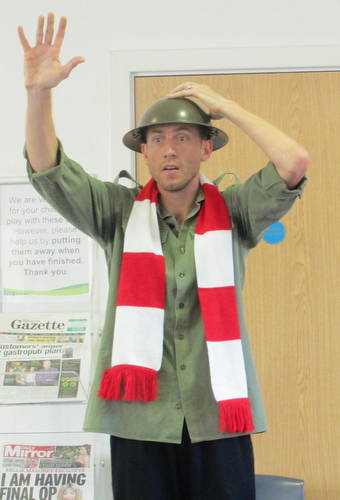
The War GameIs the story suitable and do the group know enough about the subject matter?  Preparing for an event (determining a story’s suitability, talking to a group about the content/background) will maximise engagement and minimise disruptive behaviour.  In telling “The War Game” I have noticed that audience members with some knowledge of The Great War take more from the experience.

Can the group engage comfortably and safely with the presentation?  It’s easy to say “they won’t mind” but in setting up a space the patience of an audience should be considered.  This could mean laying out mats in a public library or ensuring that all the equipment in the school hall is away before we start our session so that there is extra space and no distractions but it can also relate to numbers.  As a performer I don’t mind a large audience but when size compromises or dilutes the quality of the presentation there is a problem.  Sadly, in austere times and as many schools grow to three or even four form entry, I am in regular correspondence with organisations who want to offer experiences to children but are having to make tough decisions based on numbers.

How is the experience going to be valued by those taking part?  Young people with little experience of live presentations will watch adults and how they interact with a presentation.  This means that very young children can sometimes be engrossed by stories because they are taking cues from their parents and elder siblings.  Unfortunately things can also go the other way.  I was once telling Hansel and Gretel to a group.  At the beginning of the session I enlisted a teacher to assist me in handing out sweets and pebbles to the children so that they could help tell the story.  Rather than placing the two items in front of each child the teacher chose to throw them to (or sometimes at) the children.  A higher than usual proportion of that group spent the first few minutes of the story throwing their props because, in my opinion, they hadn’t been shown how to respect that element of the story.    In my experience there is a definite difference in behaviour and attitude when a teacher or parent respects my work and gives a story their full attention (that means not marking books or checking a mobile phone).  Its even better when my stories feeds directly into a project/topic and has a lasting legacy.
Odysseus and Poseidon

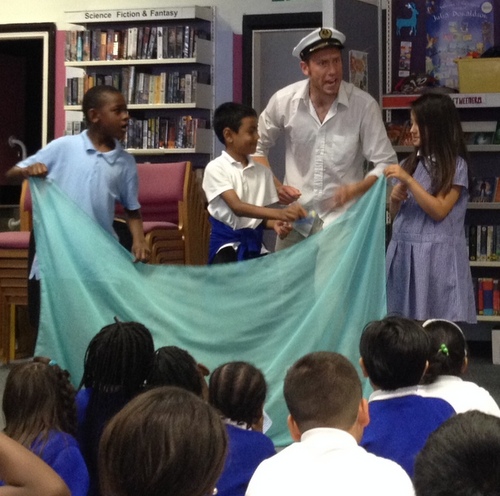
How is the experience going to be valued by the rest of the community?  In some environments everybody must take responsibility for the experience.  In school halls, museums and public libraries my stories have been interrupted by all manner of people who failed to recognise that their activity meant they had become the most interesting thing in the room.  In my view (and this is only my view) we all have a responsibility to children and their literacy and whilst disruptions in a public setting are often unavoidable in some settings they are inexcusable.

I’m sure that I’ll have other supermarket experiences over the course of my storytelling life but my first is indelibly etched on my mind.  For now my work is about collaboration.  It is about effectively communicating with organisers what I do and how I do it ahead of the event and then it is about working in partnership to ensure that every session is memorable for the right reasons.

Non-verbal storytellers

John Kirk is a storyteller and drama facilitator specialising in drama workshops and theatre for young people.

As a storyteller it is not unusual to have people in the audience with a limited understanding of English.  When I presented Private Peaceful I devised a hand out to accompany the session so that learners could follow up the story afterwards.  A hand out is all well and good but what if your audience can’t read?  Well, most of my pieces incorporate a strong visual element so that even if the story is too much for the individual there is something for them to engage with.

I recently visited a school for children with learning difficulties.  I presented Dracula and The Unlucky Mummy to the students (I’d chosen the pieces realising that they are perhaps my most visual and silly) before running a short training session with staff from local schools.  We began the session by articulating what we saw as the challenges in our own working environments to imaginative writing.  It was in this forum that staff spoke about the challenge of working with individuals who for one reason or another, are non-verbal.  In the past I have used this blog to reiterate my belief that we are all storytellers and to discuss Stanislavski’s Subtext but in this piece I’d like to share some ideas about enthusing and empowering non verbal groups with storytelling.  Many of these ideas are inspired by people I have met and worked with over the years and from observing other brilliant professionals at work.  I hope that you will find them as useful as I do.

John Kirk is a storyteller and drama facilitator specialising in drama workshops and theatre for young people.

Encouraging Free Choice  If the objective of the session is to get your young people to be imaginative then you may have to empower them with the idea of a free choice first.  I can express my free choice orally when I tell stories but this isn’t possible for everybody.  One idea for encouraging non verbal free choice is through multiple choice activities in which questions and instructions stimulate the young person to narrative decisions.  Examples of possible instructions might be “pick up the object you think is found in the room”, “move to where you think we should set the story” or “point to the name of the character”.  This can be a slow process but through simple instructions and reinforcing the rules of your activity through repetition you will soon empower young people to tell their own stories.

Storyboarding  Another idea for encouraging free choice in storytelling might be for the young person to draw a cartoon strip story.  Using a simple template of boxes or arrows to indicate the direction of the narrative a story can be structured by the young person.  Such storyboards could then be annotated with assistance.

Using Sound and Movement  Perhaps you aren’t looking at the narrative but are exploring the atmosphere and tone of a story.  This could be done through sounds and working in a group as an “orchestra”.  Offering an idea as a starting point such as “the city” or “the seaside” encourage the group to respond through simple sounds or body percussion.  What does volume or pace say about mood?  This is as much a listening exercise as a sound making exercise and will require your group to work with sensitivity toward the contributions of other people.  Continuing on a musical theme you might encourage the group to express their story, mood or a character through movement or dance.

John Kirk is a storyteller and drama facilitator specialising in drama workshops and theatre for young people.

Using Props and Objects  It may be possible for the participants to use objects to tell their story using objects or props (placing items as the story is told and moving and animating them according to narrative).  Whilst this is a structured activity it would be encouraging an almost child like play.

As a drama workshop facilitator I have used these activities with varying degrees of success when working in Primary and SEN environments and when devising in Secondary and Sixth Form environments.  I think that these ideas appeal to young people because they are easy to access and own and they are fun.  These games encourage a group to risk being wrong without the consequence of failure.  In terms of the non verbal storyteller, used correctly they play to particular strengths rather than underlining weaknesses.

The success of these ideas inevitably depends upon the level of ability within a group and will require patience (your group may not get them the first time) and a variety of accessible stimulations (props and objects which appeal to the different senses, music or imagery).  In exploring and nurturing what an individual can do we hopefully create an environment in which they are able to tell more and more sophisticated and interesting stories.


What’s your Story? A Simple Storytelling Game

John Kirk is a storyteller and drama facilitator specialising in drama workshops and theatre for young people.As human beings have evolved we have developed an introspective (thoughtful) nature.  The ways in which we try to answer the bigger questions in our world is fascinating.  We have turned our minds to the sophistication of technology, we seek truth in theology and spiritual enlightenment but we also tell stories (what are fables and parables if they are not attempts to better understand our own nature and environment?).  Whether you are conscious of it or not, you fill your lives with stories and the ability to exchange stories is a big part of being human.  We fill our lives with narrative and take our turn at playing orator and audience.  Some stories we will tell are significant and some less so but I believe that storytelling is about more than art and communication, storytelling helps to define us.

When I work with a group I do so understanding that even the youngest participant has some notion of a story.  I doubt there is anybody in the world who doesn’t have a story to tell or cannot tell a story.  The work that I do concerns articulating that story better and helping participants to understand the mechanics of their narrative.

To demonstrate this I’d like you, the reader to play a game.  This will hopefully show you that a) everybody has a story to tell and b) everybody can tell a story.  Depending where you are reading this you may want to think about it for a little while, write your answer down or even share your answers over a dinner with friends and family.  My exercise is essentially a parlour game that I often use in workshops with young people and adults as an icebreaker but in this context we are using it to encourage open, honest introspective thinking about identity.  Please read the exercise and rather than saying “I have no idea” say “that’s tricky, let me think about that”.  I hope that you feel able to participate in the game and remember: we’re doing this on the internet – nobody is judging you.

John Kirk specialises in drama workshops and theatre for young people.“Think of one thing that most people know about you and one thing that less people know about you.”

Nobody is saying that telling a story is easy but these stories are about you.  You only share as much as is comfortable.  Don’t worry if the answer you have given seems more like a statement at the moment.  If I were in the room with you and you had given me a very short answer I would probe you with further questions.  Let’s pretend I’ve done that and tell me your stories.

Examples:

One thing most people know about me…

Short answer: I am a football nut.

Story:  I was raised on Manchester United before rejecting them for Wimbledon Football Club.  I was there for the sit ins at Selhurst Park when Wimbledon Football Club became Milton Keynes Dons.  Between 2002 and 2006 I visited the 92 football clubs that make up the football league.  Having moved to North London these days I will only turn Match of the Day on if either Arsenal or Manchester United have played.

One thing less people know about me…

Short answer: I have Burmese heritage.

John Kirk specialises in drama workshops and theatre for young people.Story: My Grandmother was born in Kalaw in the 1920s.  During the Second World War she met my Grandfather and once the war was over she left Burma and moved to the North West of England.  Opposition to the ruling military junta meant that until quite recently visitng Burma was out of the question.  In 2013 my Father, Uncle, Brother and I with our respective partners visited Kalaw and the Convent where my Grandmother was educated.

Storytelling is as much about listening and responding as it is about telling a story.  In each of my stories there are points of intrigue and potential common experiences which might draw further stories from the orator (doing the 92, a trip to Burma) or even draw stories from the audience (a love of sport, migration, family holidays etc).  If that’s the case with you don’t deny your audience a good story or a great conversation.

I hope you enjoy this little game and I hope it proves that we all have a story to tell – happy storytelling!

http://youtu.be/Wk_n2ustc4U