Tag Archives: roald dahl day

Do Mr and Mrs Twit love each other?

After telling children Roald Dahl’s “The Twits” I enjoy posing the following question about the story:

Do Mr and Mrs Twit love each other?

The children are never in doubt; Mr and Mrs Twit do not love each other.  If you push them on this opinion they say things like “because they are nasty to each other” and “because they play tricks on each other”.  I understand the basis of this argument but happen to believe the Twits actually love each other.  Let me explain why..

In many of my most popular storytelling sessions (Roald Dahl’s The Twits, Jeremy Strong’s The Hundred Mile an Hour Dog and Nigel Auchterlounie’s  Dennis and the Chamber of Mischief) I use water pistols to spray the audience.  I don’t mean that I use them to gently flutter a few droplets of water in the vague direction of the audience I mean I use water pistols to quite literally drench the audience.  When outraged children ask me why I do this I point out (and they agree) that they enjoyed getting wet.  You see it’s all about the context of the soaking; if I walked up to a stranger in the street and threw a bucket of water over their head they’d be justifiably irked.  My audiences are rarely upset at getting wet.  This is partly because I’ll have forewarned them that water will be a part of the presentation but mostly because the soaking I dish out makes some degree of sense in the context of the story.

What’s this got to do with Mr and Mrs Twit?

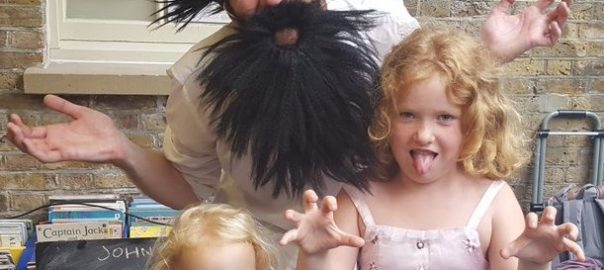
Mr and Mrs Twit are vile, disgusting, revolting people.  Mr Twit has a filthy beard, Mrs Twit has a glass eye and they both have a wicked sense of humour.  In the first part of the story we learn how Mrs Twit put a glass eyeball in Mr Twit’s drink and worms and his spaghetti and that in return Mr Twit put a frog in Mrs Twit’s bed and made his wife believe that she was shrinking.  You could say that these cruel tricks demonstrate that they detest each other.  I say it shows why they are compatible.  Yes, the jokes are extreme but rather than causing the victim to run away they provoke a sort of brinksmanship as Mr and Mrs Twit try to better the previous plot.  You might say that this to do with a desire for revenge or that the Twits are trying to kill each other but I’m not convinced.  Their treatment of the monkeys and the birds show that Mr and Mrs Twit are capable of much darker, much more devious deeds and that if they wanted to kill they’d have done it already as murder is clearly within their power.  Then there’s the fact that despite their revolting trickery they are willing to work together with a common awful purpose at the drop of a hat.  Like my audiences who enjoy getting squirted with a water pistol in the context of a storytelling session I believe the Twits thoroughly enjoying playing tricks on each other.  It may seem bizarre but Mr and Mrs Twit seem prepared to be the butt of the other’s cruelty in the context of their own private game so much so that it’s difficult to say when the mark is overstepped (does Mr Twit go too far when he has his second nasty idea?).  In my view the reason the Twits keep coming back for more is that they don’t just love each other they depend on each other.  I therefore wonder if Mr and Mrs Twit find some perverse satisfaction in the fact they share the same grizzly fate?

When I approached the story I wanted to make the complexity of Mr and Mrs Twit’s twisted relationship as clear as possible.  As well as revelling in the Twit’s tricks, in my retelling composer Joseph Attenborough reflects  their shared joy of being utterly horrible by devising a series of snatches of laughter; Mr Twit, Mrs Twit and finally both the Twits laughing.  It’s the briefest of acknowledgements but it is there and now you know to look out for it hopefully you’ll hear it the next time I tell the tale.

My licence to tell Roald Dahl’s “The Twits” in primary schools, libraries and at events was recently reviewed and extended.  To find out more about this and other projects contact me.
 

The genius of Justin’s House

Since Verity was born what appears on our television has changed dramatically.  Where in the old days we might have found time to watch a drama series these days we watch Cbeebies.

Verity may only be 17 months old but she has her favourite programmes.  Her absolute favourite is In the Night Garden.  From the moment it goes on she is captivated.  She’ll talk to the characters and dance along with Upsy Daisy and Maka Paka.  We recently took her to the stage show and I’ll admit to having wept with pure joy at seeing how much she enjoyed herself.  After the show she got to meet her hero, Iggle Piggle.  She was enraptured.

She is also into Justin’s House.  Justin’s House, for those of you who aren’t seasoned watchers of children’s television is stars Justin Fletcher (aka Mr Tumble).  It’s set in a house in Justin Town where he and his friends, Robert the Robot and the Little Monster, enjoy singing and dancing and have all kinds of fun.

The two shows I have mentioned share a number of features.  Firstly they are uber colourful.  Then there’s the fact the episodes are structured so that if you watched the series you’d become familiar with the routine.  Both programmes have very catchy music with songs being used to introduce characters, deepening the sense of familiarity.  Finally episode plots tend to be very gentle, warm and simple.  They talk about feelings, friendship and fun.  They are definitely not the stuff of Albert Square!

Where Justin’s House is different to In the Night Garden is that Justin Fletcher has devised a slapstick stage show.  Slapstick is visual, physical comedy relying on well-rehearsed routines and sequences for laughs.  It’s easy to dismiss slapstick as an easy or base art form but children really enjoy watching people fall over, bump into each other or getting a pie in the face.  My earliest storytelling sessions were far more theatrical in their nature and my versions of The Unlucky Mummy and Dracula were crammed with slapstick gags which were always very popular with audiences.  Even now I use a lot of water pistols in my work because, in the end, who doesn’t think it’s a little bit funny to see someone get squirted in the ear?

The slapstick in Justin’s House is very slick and perfectly pitched but for me the genius of the show is to put it in front of a live audience.  The audience act like a character, joining in with songs, answering questions and responding to the unfolding story.  The audience’s role is recognised by the director who regularly cuts to the audience so the viewer can see facial expressions.  Justin also acknowledges the audience.  In the song Justin’s House, he sings about the audience saying “you’re funny and sunny, put a smile on my face, you’re brilliant, you really are great!”.  He’s right to be grateful because without the audience the whole programme would have a very different rhythm and feel quite flat or awkward.

So what can a storyteller learn from Justin Fletcher?

Be colourful – when selecting props and visual aids make sure they are bright and colourful.  I use a lot of wigs, hats and props in my storytellings and use voices and physical motifs to enhance my stories.

Have a structure – children find security in familiarity whether it be a daily routine or a storytelling.  If you are running regular sessions a format will help your group become more comfortable and more willing participants.  When I run a session as a one off I’ll explain the rules of the session before I start in order to hype them up and manage expectations; so sometimes when I do global tale sessions the children get to vote on the stories they’ll hear or if I want volunteers they’ll understand how they are going to be selected.

Use music and song – consider enhancing your set with sound.  If you can, find ways of getting the children involved in creating the sound (maybe a sing-a-long).  I don’t play any instrument to a particular standard but will incorporate recorded music, live sound effects and singing where it’s appropriate.  Sometimes creating a sound effect can be just as intriguing for an audience the story!

Consider your content – I do a lot of work for 6+ year olds.  Stories like Dennis and the Chamber of Mischief or The Hundred Mile an Hour Dog invariably include a lot of participation and a water pistol (see above).  My sessions for under-fives are much more gentle.

Get on with and enrapture your audience – in every storytelling session rapport and communion with the audience is crucial.  If you can create a lively positive environment then hopefully everybody will have a good time!  It’s easier to work with a crowd than against them.

Undoubtedly Justin Fletcher is an excellent professional who has developed very strong formats and material and clearly understands how to entertain children.  You can argue the rights and wrongs of watching television but it’d be an error to write children’s television off for it’s content and delivery – these are well made, clever productions that anybody who might like to work with children can learn from watching.  Besides if Iggle Piggle and Justin Fletcher offer Verity some light hearted fun and it makes her happy then that makes me happy too.

A “Twit” update

Just a quick update.

A couple of months ago I posted this – A storyteller in search of a story in which I explained that I had lost the right to tell The Twits and that October would see Mr Twit’s last outing.  Well that’s no longer true.  You see Mr Twit has been reprieved by the Roald Dahl Estate and I am taking bookings for the next academic year.  This is quite obviously fantastic and quite unexpected news.  Over the coming months I will still be shaking up my repertoire and if you are a published author, writer’s agent or international publishing house I am still very much in the market for my next challenge but for now the urgency to do so isn’t quite so great.  Thanks to everybody who sent messages of support, they were all read and appreciated.

Now back to Dennis and the Chamber of Mischief…