All posts by johnkirkstoryteller

About johnkirkstoryteller

John Kirk - father, teacher, compere, poet, workshop leader, storyteller.

Five reasons I’d rather you didn’t take photos…

We live in the 21st Century.  It’s great to be surrounded by technology that supports and sustains us but sometimes that technology can be a hindrance.  I, like most people have a mobile phone.  Its great that I can be connected to a wider world but I find the mobile phone camera a real annoyance particularly when I am working in public settings.  I tried to work out whether my problem with phone cameras was irrational so I decided to make a list of the reasons I’d rather people didn’t take photos during my stories.

1. I would like you concentrate on my story.  I have used this blog to talk about concentration before.  Taking a photo, to my mind, means that you aren’t concentrating on the story.  You are distracted and will potentially distract others (including me – I’ll come onto that).

2. I would like you to show others how to watch a story.  Young people with very little experience of live presentations will watch how other people engage with material.  If you are old enough to bring a phone to a presentation then you are old enough to realise that you are a role model for how to behave.  If you watch then the chances are that they will too.  If you chat or play with your phone the chances are that they will see this as a signal not to pay attention.

3. I didn’t write the story for a small screen.  My work is often high energy and has maximum impact live.  Recordings of any sort (particularly by a cameraman with no previous knowledge of my work) does not do it justice and will potential spoil the future experience for somebody else.

4. I would never come into your work place and take photos of you sitting at your desk.  At the beginning of public presentations I make it quite clear as to whether you can or can’t take photos.  There is usually a good reason for restricting photography (performance rights and child protection being two very reasonable concerns in public settings).  I am well aware that you might want to take pictures of your children and if you ask I’ll pose for photos once the story has finished.  It is disappointing and frankly ignorant when people continue to record my work.

5. It’s disruptive.  My style of storytelling relies on flow and momentum.  Stopping is frustrating and can ruin the entire session.  I do a lot of work in public environments and I think that some people therefore assume that my work is somehow worth less or that they can snap away to their heart’s content.  I will stop if I feel that somebody is taking an excessive number of photos or has filmed enough of my story to present it themselves.  Remember: my stories are my living and whilst I try not to be overly precious I am protective of them.

I suppose these five points can be summed up in one word: control.  It is very frustrating to any kind of artist to think a sub standard version of their work might be distributed without consent and of the potential financial implications of losing control of that work.

There’s a simple way around my ire though; play by the rules and keep your camera in your bag unless you have my permission.  Thanks!

NB: I understand that in early years centres, schools and colleges staff may want to take a few pictures – I’m not an ogre, I won’t have a problem if you check and we can discuss it at the beginning.

I Need a Hero!

John Kirk is a storyteller and drama facilitator specialising in drama workshops and theatre for young people.“Where have all the good men gone?” asks Bonnie Tyler in her song, “I Need a Hero”.  Good question Bonnie.  See, the title of her track isn’t just catchy it’s true.  We all need heroes and stories would be poorer without them.  I have written before about fairy tale villains and the modern anti hero’s role in stories but where would they be without a good old fashioned hero to foil them?  The tug of war between good and evil and right and wrong has manifested itself in countless ways through time.  Be it a Knight in shining armour sent to battle a dragon or a humble servant/beggar who’ll save the Kingdom and marry a Princess (the premise of many a pantomime) we need a hero.  What are their qualities and their relationships with their followers and loved ones and what can we learn from their adventures?

The hero.  The warrior, the conqueror, the vanquisher, the heartthrob.  Archetypally the hero is male although not always.  For every Aladdin there is a Scheherazade who demonstrates the qualities of heroism.  The hero is generally young or youthful.  The hero is bold; strong both in body and mind and is respected widely for their strength.    Many heroes represent change and vibrant progressiveness which will shake up a stagnating world.

I have recently been exploring epic poetry and for the purpose of this blog we’ll consider Odysseus, King of Ithaca and the warrior Beowulf.  Both men are legendary figures, first appearing many thousands of years ago with their exploits translated and reinterpreted over time since.  Odysseus the Greek and Beowulf the Scandinavian come from very different traditions but they are both heroes.  Both are bold warriors and leaders of men who have not just defeated mortal armies but monsters too (Odysseus blinding Polyphemus the Cyclops and Beowulf slaying the beast Grendel and his Mother).  They have demonstrated great intelligence and cunning through their various adventures but they are not without falls.  It is Odysseus’ arrogance which leads Poseidon to seek vengeance against his entire crew.  It might be argued that Beowulf dies because he is too proud to ask his younger warriors to fight with him.

John Kirk is a storyteller and drama facilitator specialising in drama workshops and theatre for young people.What of their followers?  Despite gifts and praise, when Beowulf’s followers are faced with a Dragon fear gets the better of them.  At many stages of The Odyssey, Odysseus’ crew verge on mutiny and in finally disobeying his will, they doom themselves.  That I suppose is the point.  The fallibility of their followers is in sharp contrast to the quick wits and mental toughness displayed by the hero.  Our heroes inspire ordinary men to be better than themselves and rise above their weaknesses (in 1001 Nights, the heroine, Scheherazade inspires King Shahryar with her skill as storyteller).

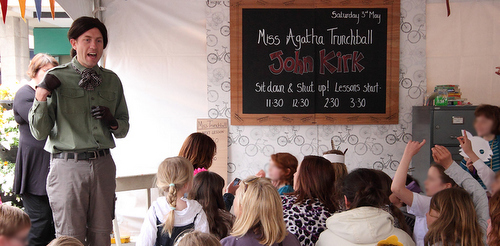
As we remember The Great War I am struck by the relationship between Hero and follower, their relationship with conflict and sacrifice and the parallels with modern conflict and soldiering.  Odysseus is reluctant to go to Troy but his contribution once there is invaluable whilst Beowulf offers his men to aid another Kingdom.  How many brave and loyal men died at Troy, following their leader’s orders, so that King Menelaus could retrieve Helen?  How many brave and loyal men were prepared to lay down their lives because their leader said so, to fight somebody else’s dragon.  Stories and their meanings can be disputed but I think that this is an interesting perspective that shouldn’t be overlooked.

Without meaning to continue the Great War analogy too far, for the hero there is a Home Front.  It is from here that a hero will often find purpose for it is here that they know love.  Odysseus spends time with Circe and Calypso but has a deep and faithful bond with Penelope who steadfastly waits for his return.  After his success, Beowulf is received by Hygelac, King of the Geats and his people with warmth, love and adoration.   It is in the reconciliation of love that we see the hero’s actions have been for a selfless cause.  The hero is rewarded but really everybody’s a winner (Odysseus reclaims his Kingdom and family, Beowulf strengthens the bond with another country and consolidates his position and again, our heroine Scheherazade spares the people of her city any further misery by changing the heart of King Shahryar).  Our hero must understand love and it’s influence on their actions.  A strong moral compass is important to a hero because if they are seen to act out of greed or for individual gain they would be viewed quite differently (Robin Hood is a hero for redistributing his loot not for keeping it!).

It isn’t just love and new found riches that our hero will enjoy.  It isn’t uncommon for them to live long and prosperous lives and sometimes to even achieve further greatness.  Now what do they call that?  Oh yes… “They all lived happily ever after!”

Non-verbal storytellers

John Kirk is a storyteller and drama facilitator specialising in drama workshops and theatre for young people.

As a storyteller it is not unusual to have people in the audience with a limited understanding of English.  When I presented Private Peaceful I devised a hand out to accompany the session so that learners could follow up the story afterwards.  A hand out is all well and good but what if your audience can’t read?  Well, most of my pieces incorporate a strong visual element so that even if the story is too much for the individual there is something for them to engage with.

I recently visited a school for children with learning difficulties.  I presented Dracula and The Unlucky Mummy to the students (I’d chosen the pieces realising that they are perhaps my most visual and silly) before running a short training session with staff from local schools.  We began the session by articulating what we saw as the challenges in our own working environments to imaginative writing.  It was in this forum that staff spoke about the challenge of working with individuals who for one reason or another, are non-verbal.  In the past I have used this blog to reiterate my belief that we are all storytellers and to discuss Stanislavski’s Subtext but in this piece I’d like to share some ideas about enthusing and empowering non verbal groups with storytelling.  Many of these ideas are inspired by people I have met and worked with over the years and from observing other brilliant professionals at work.  I hope that you will find them as useful as I do.

John Kirk is a storyteller and drama facilitator specialising in drama workshops and theatre for young people.

Encouraging Free Choice  If the objective of the session is to get your young people to be imaginative then you may have to empower them with the idea of a free choice first.  I can express my free choice orally when I tell stories but this isn’t possible for everybody.  One idea for encouraging non verbal free choice is through multiple choice activities in which questions and instructions stimulate the young person to narrative decisions.  Examples of possible instructions might be “pick up the object you think is found in the room”, “move to where you think we should set the story” or “point to the name of the character”.  This can be a slow process but through simple instructions and reinforcing the rules of your activity through repetition you will soon empower young people to tell their own stories.

Storyboarding  Another idea for encouraging free choice in storytelling might be for the young person to draw a cartoon strip story.  Using a simple template of boxes or arrows to indicate the direction of the narrative a story can be structured by the young person.  Such storyboards could then be annotated with assistance.

Using Sound and Movement  Perhaps you aren’t looking at the narrative but are exploring the atmosphere and tone of a story.  This could be done through sounds and working in a group as an “orchestra”.  Offering an idea as a starting point such as “the city” or “the seaside” encourage the group to respond through simple sounds or body percussion.  What does volume or pace say about mood?  This is as much a listening exercise as a sound making exercise and will require your group to work with sensitivity toward the contributions of other people.  Continuing on a musical theme you might encourage the group to express their story, mood or a character through movement or dance.

John Kirk is a storyteller and drama facilitator specialising in drama workshops and theatre for young people.

Using Props and Objects  It may be possible for the participants to use objects to tell their story using objects or props (placing items as the story is told and moving and animating them according to narrative).  Whilst this is a structured activity it would be encouraging an almost child like play.

As a drama workshop facilitator I have used these activities with varying degrees of success when working in Primary and SEN environments and when devising in Secondary and Sixth Form environments.  I think that these ideas appeal to young people because they are easy to access and own and they are fun.  These games encourage a group to risk being wrong without the consequence of failure.  In terms of the non verbal storyteller, used correctly they play to particular strengths rather than underlining weaknesses.

The success of these ideas inevitably depends upon the level of ability within a group and will require patience (your group may not get them the first time) and a variety of accessible stimulations (props and objects which appeal to the different senses, music or imagery).  In exploring and nurturing what an individual can do we hopefully create an environment in which they are able to tell more and more sophisticated and interesting stories.


Wave your Flag

John Kirk is a storyteller and drama facilitator specialising in drama workshops and theatre for young people.“Did you see Dolly?”  That is usually the first question I am asked when I admit that I went to the Glastonbury Festival 2014.  My audience is then disappointed to learn that I went to watch Michael Rosen instead of the first lady of Country Music.

What I did see at Glastonbury were flags.  Hundreds of flags.  These flags came in all shapes and sizes, carrying the colours of foreign lands and regional territories, the emblems of sports teams and companies and the messages of the people (“Will you Play at our Wedding Dolly?”).  The flag bearer and their tribe are usually fairly ordinary, muddy people.  You won’t necessarily find a costume or a philosophy at the other end of a flagpole and therefore the flag is not necessarily a symbol of counter culture.  A flag will help you find a tent or a friend.  It might get you on television and will generally serve as a safe way to help you stand out in a crowd of 200,000 people.

John Kirk is a storyteller and drama facilitator specialising in drama workshops and theatre for young people.Another arena where people fall behind flags are sport’s events.  This summer we have had a plethora of international competitions, opening and closing ceremonies, with all their pomp and circumstance.  Integral to these pageants have been the anthems and flags and the manner in which these standards have set the tone.  Who can forget the raw passion of Brazilian fans, bedecked in their bright yellow shirts as they sang their anthem a cappella.  Compare this to in 2008, when Boris Johnson got the Union Flag caught in his belt during the Olympic Closing Ceremony.  What did these moments say about two nations?

The ideas of what a flag might mean in relation to personal and national identity is very interesting particularly in the year that Scotland decides whether to remain part of the union with England.  Of course there are many important considerations but if the Scots voted with heart rather than head then how a person feels might lead Scotland to the Saltire.

John Kirk is a storyteller and drama facilitator specialising in drama workshops and theatre for young people.

In my capacity as a storyteller and drama facilitator I encourage self expression and the discovery of identity.  Through heritage projects (Hackney Museum and the Guilden Morden Fire) I help young people to discover their local history and to consider their legacy whilst promoting tolerance and diversity.  In drama workshops I initiate games and activities in which participants explore ideas and issues and challenge the way in which groups articulate themselves and their opinions through vocal and physical technique.  Many of my successes are defined as soft outcomes but often it won’t feel that way to the individual.  The ability to speak confidently in a group and have your opinion listened to can be life changing for some people.

Like the anthem or the flag much of my work can be linked to pride, confidence and self esteem and expressing identity whilst understanding place within a wider community.  My view is that unlike the Glastonbury crowd or the Commonwealth athletes, most people’s flags will be purely figurative.  You don’t need to march behind a banner to be you but if you’re going to wave a flag at least wave it properly!

The Minstrel and the Firebird

In the Dark Days there lived a Minstrel.  The Minstrel would play for the people of the town to earn enough money for his crust of bread.  In times gone by the Minstrel had entertained the King but now his Flute was battered and he had no money to mend the strings of his Mandolin.  Sometimes it seemed to him that he was completely alone in the world.

One afternoon the Minstrel was sat in the town square with his crust of bread when his attention was drawn to a group of boys.  They had cornered something, some kind of animal, and were daring each other to kill it.  The Minstrel chased the boys away and there cowering in the corner of the square in the filth and dirt was a soot black bird.

The Minstrel could see that the bird was hurt and too weak to fly.  Rather than leave it to die, he gently lifted it up and placed it into the pocket of his tunic.  Returning to his seat in the square he offered the bird his crust of bread.  The bird began to glow; yellows and reds and oranges.  The bird was no ordinary creature; it was a Firebird, that rarest and most beautiful of creatures, said to have been forged at the dawn of time in the very heart of the Sun.  It glowed out of love for the Minstrel.

That evening the Minstrel took the Firebird back to his lodgings where he made it a nest from some old rags.  The nest was very simple but as the Minstrel showed his compassion the Firebird seemed stronger and brighter.

The next day, once the Minstrel had fed the Firebird they went into the square.  The Firebird proved to be very good for business and a crowd gathered to hear the Minstrel play.  That night the Minstrel spent the copper coins he had earned on a great feast which he shared with the Firebird.  The following day the crowd was bigger and that night the Minstrel felt it wise to use some of his copper coins to buy a metal cage, to protect the injured Firebird.

So this went on.  Each day the Minstrel and the Firebird would go to the square where they were met by bigger and bigger crowds and each night they would feast.  The Minstrel bought a new Flute and strings for his Mandolin and it wasn’t long before he was invited to entertain the King.  The Firebird was now strong enough to fly but the Minstrel wasn’t ready to let her go.  The Firebird, that rarest and most beautiful of creatures, sat in her metal cage.  Still she glowed but not as brightly as before.

The night before the royal performance the Minstrel woke to a tapping noise.  He went to where the Firebird’s cage stood by the window.  There was another Firebird.  The two rare and beautiful creatures were dancing silently in the moonlight.  As the Minstrel approached he could see that the caged bird was flaming and glowing more magnificently than ever before.  The dance continued until finally her friend flew away; a shooting star in the night sky.  The Minstrel could see that the Firebird was crying.  The Firebird, that rarest and most beautiful of creatures was sad at her imprisonment.

The Minstrel knew what he had to do.  He threw open the window and lifted the Firebird from the cage.  Although the Firebird was burning brightly she felt cool to the Minstrel’s touch.  The Minstrel let her go.  The Firebird flew out into the sky, chasing her friend, high above the trees and mountains, high up into the air until her brightness brought on the dawn.  As the Firebird flew further and further away, the Minstrel despaired – how could he entertain the King without his friend?

The Minstrel needn’t have worried.  The next morning the Minstrel walked out of the Royal Palace.  The King had heard of the Minstrel’s popularity in the square and had very much enjoyed his music even asking him to return for another performance.  The Minstrel smiled.  He would miss the Firebird but he knew she was happy.  Despite letting the Firebird go the Minstrel was no longer lonely and as he looked up at the warm, morning sun, he was certain that all of his day’s would be that little bit brighter.

The Great Fire of Guilden Morden (Part Two)

John Kirk specialises in drama workshops and theatre for young people.Time to bring you up to speed on The Great Fire of Guilden Morden project.
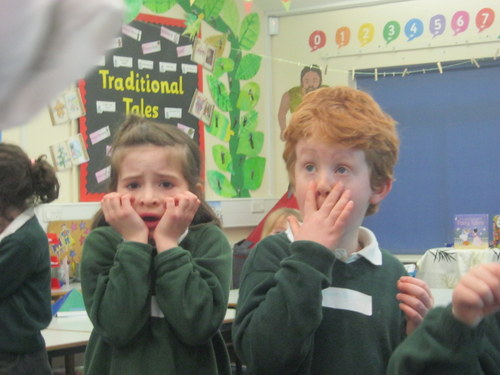
As you’ll recall from my previous blog on this three month project  last year I was contacted by Guilden Morden Primary School who were looking for a creative partner for a Heritage Lottery funded project.  Working over 12 weeks between May 2014 and July 2014 the school would devise and develop a creative response to The Guilden Morden Fire (22/5/1881).  This creative response would be documented using web based, digital technology.

The project has now finished so it seems appropriate to reflect on what we got up to in my final weeks in Cambridgeshire…

John Kirk is a storyteller and drama facilitator specialising in drama workshops and theatre for young people.Week Six

Polishing our story – I worked with the groups to consider the structure and language we might use in our poetry and scenes.  We explored atmosphere and how it might effect the urgency of our words (particularly as our story is about a fire).  We began rehearsing our scenes and thinking about how we could use transitive verbs to help a performer better understand character and events.  Elsewhere we explored the local legend of Jack o’Legs and the area’s connections to agriculture.

Week Seven

Staging a Chorus – The group continued to think about how vocal expression could bring the story to life.  Conscious of the looming deadline to create a piece of community theatre this week I also introduced some basic ideas about Greek Chorus Work.  With the youngest classes we set up a water relay race as we explored the difficulties the Fire Brigade might have faced in 1881.

Week Eight

Rehearsals – With two sessions scheduled this week we staged the main structural elements of our story; the scenes and poem.  It is worth mentioning that most of the ideas for the words and actions came from the children rather than from the teachers or myself.  It was very important that the children felt this was their project and that my role was to challenge and enthuse them.

John Kirk is a storyteller and drama facilitator specialising in drama workshops and theatre for young people.Week Nine

More Rehearsals – Working with each group for short bursts to ensure they didn’t disengage from the story we continued to rehearse the groups.  As we began to bring the different elements of the story together the process became very technical and I confess to confusing myself at times!  Despite this the group took things in their stride.

Week Ten

Show Time – For the first time we brought all 73 performers together and on two sweltering afternoons the children presented their story to their families and community.

The Great Fire of Guilden Morden is documented by the school here but this is a taste of what we came up with…


“It was a charming summer’s day in the year of 1881.

In Guilden Morden, the golden hill in the marsh,

the sun’s warm rays are dancing on the faces of children playing outside.

Birds sit amongst the fresh green leaves of silver birch trees

singing their beautiful songs,

and a gentle breeze carries cares and worries away.

Peace reigns over the village, fields and lanes.

None suspect what is to pass on that terrible Sunday.”


From start to finish this was a special experience.  The staff and all the pupils were wonderful to work with and I will truly miss being a part of the school.  I take away a lot of memories and a folder of thank you messages from the children which I will treasure.  Most of all though I leave this project inspired by the potential of young people and certain that creative practitioners have a future within education so long as schools remain willing to take creative risks, commissioning projects where the outcomes are more difficult to quantify.  So long as there are teachers like those at Guilden Morden Primary School creativity has a very bright future.

April to June: What they said..

John Kirk is a storyteller and drama facilitator specialising in drama workshops and theatre for young people.

This year I have seen the amount of work I do swell.  More than ever before I am being asked to travel across the country to work with young people and adults on all manner of projects.  As the school year ends I thought I would share a few of the comments from the past three months.

In March Private Peaceful was perhaps the largest single project I have ever undertaken and the feedback from it was phenomenal but rather than share what you can see on a dedicated page I have picked out testimonials from other workshops that I offer.

“Children from all ages and classes were engaged and buzzing from their work with you.”

Literacy Coordinator, Watling Lower School, Dunstable (Jack and the Beanstalk Workshop and Storytelling Day, May 2014)

John Kirk is a storyteller and drama facilitator specialising in drama workshops and theatre for young people.“The staff said you were the best story teller they had ever experienced.”

Inclusive Coordinator, Sauncey Wood Primary School, Harpenden (The Unlucky Mummy Myths and Legends Day, May 2014)

and perhaps my favourite…

“‘I really get it now. Shakespeare was my worst thing before but now I understand that it’s meant to be fun and dramatic.'”

Year Eight, Shenfield High School, Shenfield (Shakespeare’s The Tempest Workshop Sessions, May 2014)

John Kirk is a storyteller and drama facilitator specialising in drama workshops and theatre for young people.

I’d be lying if I said that everybody adored my style of working and that there haven’t been difficult days along the way but the comments I choose to share here are my mandate for carrying on working into 2014-15.  They demonstrate my value and the difference my storytelling and workshop sessions make to young people and educational professionals.

I am incredibly lucky to have worked with some fantastic people during the current academic year (City Read London, Shrewsbury Children’s Bookfest, Guilden Morden Primary School and Hackney Museum) and much of my success is because of the wonderful, supportive people who give me such wonderful opportunities.

The Summer Reading Challenge 2014 has already kicked off what’s looking like a very exciting six months.  Who knows?  Maybe I’ll be visiting you.

See also feedback from Jan-March

Gods and Monsters: Approaching Homer’s Odyssey

John Kirk specialises in drama workshops and theatre for young people.A year ago I devised Dracula to coincide with The Summer Reading Challenge (SRC) 2013.  The piece was hugely successful and it has been my pleasure to present it across the rest of the country at schools and events since.  Time waits for no man and a year later I am about to embark upon an even bigger tour with an even bigger challenge: Homer’s Odyssey.

I had originally thought to give SRC 2014 a miss – Private Peaceful was a very demanding and very consuming project and I thought that perhaps I needed some time to reflect.  In February I was booked by Hammersmith and Fulham Libraries for four days of storytelling.  I knew that the obvious choice considering the theme this year is Mythical Mazes, would be Theseus and the Minotaur but I tell this already as part of my traditional storytelling offer to schools.  I briefly considered “The Secret Garden” as an alternative slant on the theme before settling on Homer.

There are many good reasons for children to hear The Odyssey.  It may be 3000 years old but its a really famous and influential story packed with Gods and Monsters.  Be it the Coen Brothers’ Oh Brother!  Where Art Thou? or the test of the Glass Slipper to find true love in Cinderella, shades of The Odyssey are everywhere.  The original is very skilfully written and as the plotlines merge it is clearly much more than an adventure story.  There is a strong message through the narrative about the foolishness of men and the wisdom and fortitude of women.  I have used this blog to talk about the role of strong women in fairy tales before and whilst Odysseus truly is a man of exploits and trials (many of which are brought about by ill judged decisions) loyal Penelope is admirably steadfast and dignified as she waits for his return.

John Kirk is a storyteller and drama facilitator specialising in drama workshops and theatre for young people.In recent months I have been doing more and more work around narrative poems.  I have explored Alfred Noyes’ Highwayman, Tennyson and even used narrative poetry as a device for telling the story of The Great Fire of Guilden Morden.  I have been keen to retain the sense of a narrative poem, its language and imagery, in my reinterpretation.  I say reinterpretation because mine will be an adaptation of Homer.  There is no way I could remember twelve and a half thousand lines of poetry but I hope that I offer a flavour of the journey as we follow Odysseus home in just 40 minutes.  My story must also have a sense of progression and therefore cannot afford to linger.  My other big challenge is making the piece accessible to very young audiences.  I want the experience to be fun but its important that the tone is right and any jokes mustn’t cloud the narrative.

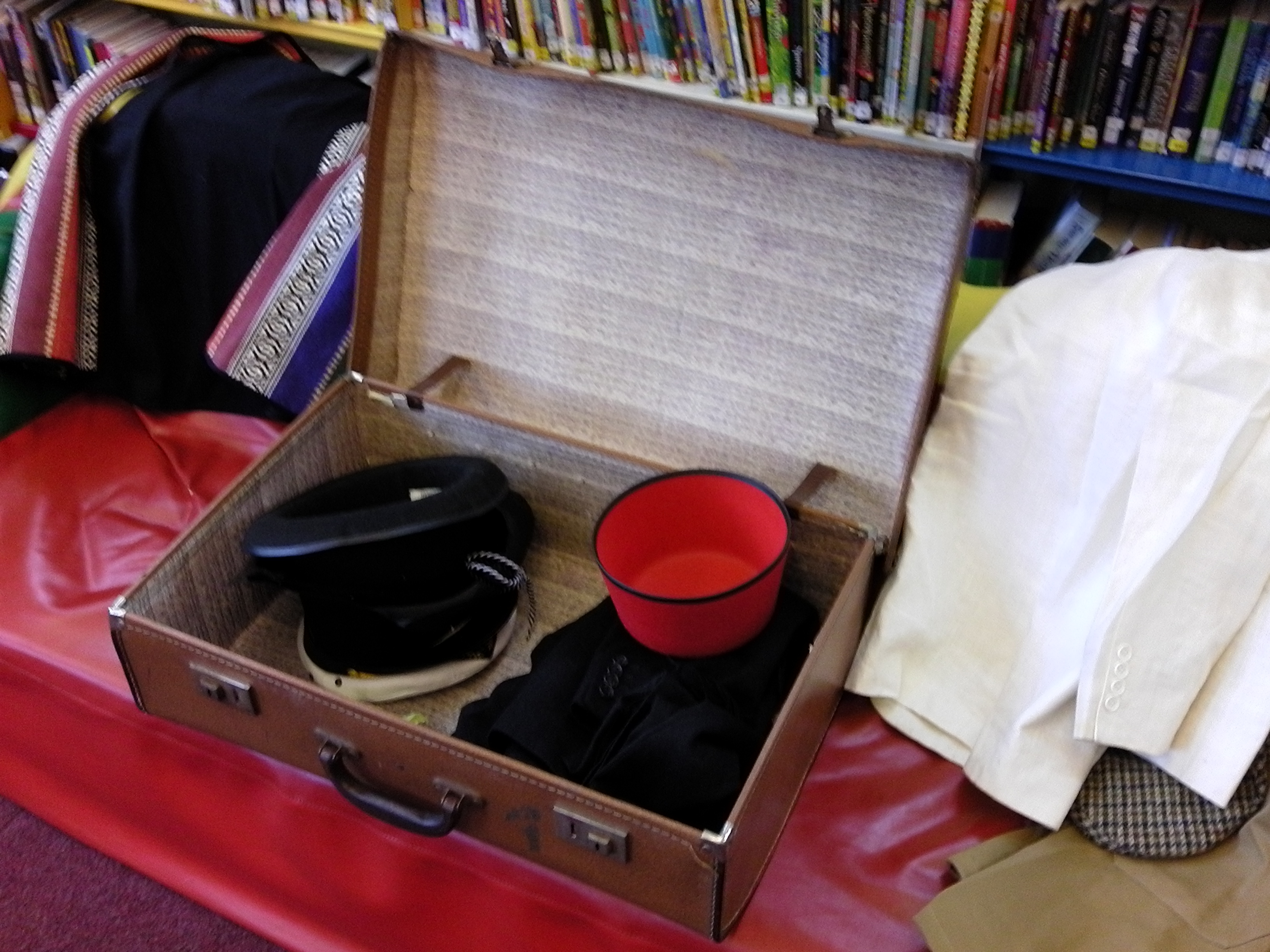
John Kirk is a storyteller and drama facilitator specialising in drama workshops and theatre for young people.The result is a series of short stories which in the future I will be able to tell independently or present as a show following Odysseus from Troy back to Penelope.  I’ll be doing my usual array of voices, physical attitudes and helping the audience to identify Gods from the Monsters with suggestions of costume and some more visual setpieces.  (I have already redecorated my Kitchen with tomato juice in a failed attempt to produce a suitably gory effect for the blinding of Polyphemus).

If the preparation is an indicator of the summer to come then it’s going to be epic!

Dates from 9th July 2014 in London Libraries.  Follow link and check local listings for details of presentations.

Interpreting The Great War

John Kirk is a storyteller and drama facilitator specialising in drama workshops and theatre for young people.

In the course of telling “Private Peaceful” I ran question and answer sessions in order to contextualise the story, the presentation and The Great War.  Questions ranged from “How do you remember all the words?” to “Why do the innocent always have to die?”.  In Lambeth a teacher asked a very interesting and current question which went along these lines: many modern authors take the standpoint that The Great War is wrong and therefore is it appropriate to approach the conflict with this literature?  The session was some weeks ago but I have been pondering my answer ever since.

As Britain prepares to commemorate the beginning of The Great War, how it is interpreted has become a controversial subject.  Historians and politicians have attacked books, film, television and stage productions for painting The Great War as simply a tragic waste of life and reinforcing the idea of lions (the regular soldier) lead by donkeys (the officer classes).  My favourite subject at school was History and this year, as well as Private Peaceful, I am currently working with Hackney Museum to present a series of workshops considering Hackney’s part in The Great War, so I thought I might use my blog to reflect upon the debate.

In 1914 Britain goes to war and thousands of men volunteer to join the fight.  These men volunteer because they believe they are doing their patriotic duty by defending William Blake’s “green and pleasant land” (Jerusalem) from a very real threat of invasion.  Men from across the country rally “For God, Harry, England and St George!” (Shakespeare, Henry V) convinced it will all be over by Christmas.  Of the six million who go to fight 700,000 will be killed.

Of the men who went to fight the likes of Wilfred Owen reflect more bleakly on this patriotic fervour:

“If you could hear, at every jolt, the blood
Come gargling from the froth-corrupted lungs,
Obscene as cancer, bitter as the cud
Of vile, incurable sores on innocent tongues,
My friend, you would not tell with such high zest
To children ardent for some desperate glory,
The old Lie; Dulce et Decorum est
Pro patria mori.” (Wilfred Owen)

John Kirk is a storyteller and drama facilitator specialising in drama workshops and theatre for young people.

Compare this stark description with the poetry of Rupert Brooke concerning the duty and sacrifice of the English and you quickly see why the Government of the time preferred his take on events:

“If I should die, think only this of me:
That there’s some corner of a foreign field
That is forever England.” (Rupert Brooke)

In the years after the war, many soldiers offered up their artistic thoughts on the conflict(notably, Journey’s End and All Quiet on the Western Front).  Whilst these are artistic interpretations of events this generation wrote from personal experience.

The recent controversies seem to surround works like Oh! What a Lovely War and Blackadder.  Those involved in their production had little or nothing to do with The Great War and yet offer their audience an opinion on the worth of the conflict.  Michael Morpurgo writes about The Great War, describing the conditions in the trenches with a palatable harshness which draws in a younger audience and yet he and others are attacked by politicians and historians for insome way, distorting the events.

John Kirk is a storyteller and drama facilitator specialising in drama workshops and theatre for young people.

Surely though, this is the role of art.  Surely, art should challenge our ideas and make us re evaluate our world.  Oh!  What a Lovely War juxtaposes songs from the period with striking statistics about The Great War to stunning effect whilst the final episode of Blackadder Goes Forth is in my opinion some of the most poignant television I have ever watched.

As a nation we don’t know that much about The Great War.  By this I mean that many of us went through our whole school careers without learning about it at all.  I only began to study it when I took History as a GCSE subject when I was in Year Ten.  You might perhaps argue that for many, it has been left to artists to fill in the gaps.

There are some excellent public chronicles of The Great War but very few people have ever made a mainstream (book, television, stage, film), artistic defence of First World War leaders and their actions besides pointing out their errors and lampooning them.  Perhaps I’m wrong but it would seem that the leaders themselves remained almost silent on the matter (or perhaps their point of view has been drowned out).

It is right that we address how much is known about The Great War and there are risks of confusing art with fact.  I believe that modern interpretations of how The Great War was fought and its consequences do have a place within the classroom if only to demonstrate how our thinking has changed over the last century.  Rather than criticising their use maybe the debate now needs to be shifted to how these interpretations are counter balanced so that the alternate view, that war in 1914 was just and right, registers with modern students and the wider public.

The Great Fire of Guilden Morden (Part One)

John Kirk specialises in drama workshops and theatre for young people.Three years ago it was my pleasure to be involved in two projects which were funded by the Creative Partnerships initiative.  The programme saw artists working with schools and exposing pupils and staff to new ideas of working.  In Stoke we worked to explore how we identify with urban spaces through stories and in Lincolnshire we created a story trail for the school and wider community.

Rather than doing a day in a school I was able to present a series of workshops as I took up residency in my partner schools.  The projects were very rewarding and I feel that I learned a lot about my practice from being involved.  I was supported by my partner schools to try out ideas (to take risks) and organise really memorable learning experiences for the children (we did a Q&A in Stoke with some local VIPs as well as a creative walk, whilst in Lincolnshire I organised storytelling experiences around the school to help the children’s imaginations).  Sadly (as is the way with these things) the programme came to an end just as I was discovering it.

Last year I was contacted by Guilden Morden Primary School who were looking for a creative partner for a Heritage Lottery funded project.  Working over 12 weeks between May 2014 and July 2014 the school would devise and develop a creative response to The Guilden Morden Fire (22/5/1881).  This creative response would be documented using web based, digital technology.  Remembering my previous Creative Partnership experiences I jumped at the chance.

At the time of writing we are approaching the midway point of the project.  I have tried to summarise what we’ve done below…

John Kirk is a storyteller and drama facilitator specialising in drama workshops and theatre for young people.Week One

Celebration.  Our first session fell on May Day.  In Cambridgeshire at the time of our story May Day would have been an opportunity for the community to celebrate the coming of Spring.  I want celebration to be central to our final presentation so I introduced a simple group dance to the children.  The dance will be incorporated into the final presentation and offer our work a communal spectacle.

Who are you?  Through simple storytelling games I found out more about the groups and we used objects to stimulate more personal stories.

Week Two

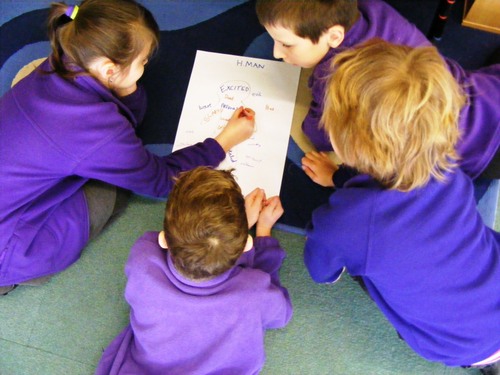
Who am I to you?  The pupils brought objects from home to tell their personal stories.  We then used the objects to build a map of their school community.  By spending two weeks focussed on identity we are better positioned to introduce the heritage aspect of the project (I have a better understanding of who I am but where do I come from?)

Week Three

The Great Fire of Guilden Morden Walkabout.  I lead walks around the village, introducing the children to the story of the fire in role.  Each walk took us on a 40 minute stroll about Guilden Morden stopping at the (assumed) site of the fire, The Independent Chapel, Old School, War Memorial, Church and Vicarage.  At each stop I role played a different character who had a part in the story of the fire.

Week Four

Commemoration.  This session fell on the anniversary of the fire.  To mark the date the school organised a fire drill and I read the newspaper report of the fire to the children in assembly.  Our commemoration was in sharp contrast to the celebration of Week One.

In their own words “The Guiden Morden Fire”.  The groups retold the story of the fire using drama games.  The groups used drama to structure their own version of the story.  These structures will be used as a starting point for building a narrative poem and dramatic scenes.

John Kirk is a storyteller and drama facilitator specialising in drama workshops and theatre for young people.Week Five

Acting Out the Events of 1881.  With the younger classes I appeared as a Victorian Schoolmaster and with the older classes we turned our version of the story into a series of scenes.  In the next week the classes will transcribe these scenes to form the basis of scripts and stories.

Over the next six weeks we have a lot of work still to do but I hope to be able to share news of our success, images and video here over the next few months.  Stayed tuned!