All posts by johnkirkstoryteller

About johnkirkstoryteller

John Kirk - father, teacher, compere, poet, workshop leader, storyteller.

A Guide to Guidance: how can you be sure a story is suitable?

John Kirk is a storyteller and drama facilitator specialising in drama workshops and theatre for young people.Whenever I take a booking or ask for feedback on my work, suitability is mentioned.  For each of my stories I have suggested the age or level the audience should be at in order to watch it.  You did read that correctly, I said suggested.

Most recently I have been presenting “Private Peaceful” as part of the Cityread 2014.  My brief was to work with young readers in public spaces (lots of libraries!).  Michael Morpurgo’s story is quite rightly, not pitched at younger young readers but I know from experience of working in public spaces to expect very young audiences.  I therefore devised a piece which could be accessible to an audience of young people aged 7 plus.  This was challenging as I did not want to compromise the language or the tone of the original in my work.  In my interpretation I remove elements of the story which are too disturbing for a young audience or too difficult to do justice in a 40 minute presentation (the shooting of Bertha, Molly and the baby).  Similarly, I say that my version of “A Christmas Carol” can be enjoyed by audiences of young people aged 4 plus.  I don’t deviate from Dickens’ story or his language and in places my ghost story can be scary but I include elements of slapstick, pantomime and colourful, comic characters to entertain the very youngest audience members.

John Kirk is a storyteller and drama facilitator specialising in drama workshops and theatre for young people.The truth is that when I say a piece is suitable for a particular age or level I am making a broad statement.  If I am liaising with a school directly it is much easier to advise them on a story to choose for their children.  Here my statement on suitability is definitely “this story is suitable for a person of the stated age or level”.  When I work In public environments I have less control over who will be watching.  I can put a statement of suitability on my literature or speak to the audience briefly before the presentation begins but my statement is more ambiguous, “a person of this age or level can access this story in some way”.

Perhaps it shouldn’t be like this but in the end I don’t know the audience who will watch my work.  When I work in schools, a child who is particularly sensitive will respond to my work differently compared to one who is bomb proof.  During the school holidays a parent will not be able to leave one child in order to monitor their sibling so I often present stories I deem inappropriate to very young children.  Saying this, I have had two year olds howling with laughter at Dracula because of my presentation style and teenagers who have disrupted my stories because they weren’t prepared to engage with my work.

John Kirk is a storyteller and drama facilitator specialising in drama workshops and theatre for young people.There are risks when booking or attending stories for children but many pitfalls can be avoided with insight into the work.  Just because it says its suitable for a seven year old doesn’t mean its not Michael Morpurgo.  Just because it says its suitable for four year olds doesn’t mean that its not Charles Dickens.  A statement of suitability is to say you can rather than you should watch.  It is for adults to exercise their discretion in choosing an appropriate story for their audience.

“Saluting” my CityRead 2014…

Here is the story of my CityRead2014 in pictures.  The saluting came about when the group piled into the photograph at New X Learning.  It became a trend that would be repeated across London.

I started in Lewisham…

John Kirk is a storyteller and drama facilitator specialising in drama workshops and theatre for young people.

and was next in Wandsworth.

John Kirk is a storyteller and drama facilitator specialising in drama workshops and theatre for young people.

April rolled in with presentations in Barking and Dagenham…

John Kirk is a storyteller and drama facilitator specialising in drama workshops and theatre for young people.

and Islington.

John Kirk is a storyteller and drama facilitator specialising in drama workshops and theatre for young people.

As the Easter Holidays began the dates came thick and fast with presentations in The City of London…

John Kirk is a storyteller and drama facilitator specialising in drama workshops and theatre for young people.

Waltham Forest…

John Kirk is a storyteller and drama facilitator specialising in drama workshops and theatre for young people.

and Ealing.

John Kirk is a storyteller and drama facilitator specialising in drama workshops and theatre for young people.

I did nine presentations in Croydon…

John Kirk is a storyteller and drama facilitator specialising in drama workshops and theatre for young people.

eight in Haringey…

John Kirk is a storyteller and drama facilitator specialising in drama workshops and theatre for young people.

with days in Merton…

John Kirk is a storyteller and drama facilitator specialising in drama workshops and theatre for young people.

and Camden too – Phew!

John Kirk is a storyteller and drama facilitator specialising in drama workshops and theatre for young people.

When the schools went back we pressed on with huge crowds in Lambeth…

John Kirk is a storyteller and drama facilitator specialising in drama workshops and theatre for young people.

Redbridge…

John Kirk is a storyteller and drama facilitator specialising in drama workshops and theatre for young people.

and Brent.

John Kirk is a storyteller and drama facilitator specialising in drama workshops and theatre for young people.

Not forgetting Hackney…

John Kirk is a storyteller and drama facilitator specialising in drama workshops and theatre for young people.

Westminster…

John Kirk is a storyteller and drama facilitator specialising in drama workshops and theatre for young people.

Kensington and Chelsea …

John Kirk is a storyteller and drama facilitator specialising in drama workshops and theatre for young people.

and Hammersmith and Fulham.

John Kirk is a storyteller and drama facilitator specialising in drama workshops and theatre for young people.

As April ended I went to Bexley …

John Kirk is a storyteller and drama facilitator specialising in drama workshops and theatre for young people.

and Bromley to work with secondary school groups.

John Kirk is a storyteller and drama facilitator specialising in drama workshops and theatre for young people.

My CityRead 2014 finished with May visits to Richmond Upon Thames…

John Kirk is a storyteller and drama facilitator specialising in drama workshops and theatre for young people.

… and Kingston Upon Thames.

John Kirk is a storyteller and drama facilitator specialising in drama workshops and theatre for young people.

65 presentations in 27 days across 23 different London authorities to 2300 people.

My CityRead 2014 was incredible.

Resilience and Creativity

John Kirk is a storyteller and drama facilitator specialising in drama workshops and theatre for young people.‏Human beings are incredibly resilient creatures.  So too are creative people.  When I work with BTEC and A Level students I share my observation that often the difference between being great and being successful is resilience and that resilience isn’t easily taught.  I think that this is best summed up in the following tweet.

@boltcity Creative process: 1) This is going to be awesome 2) This is hard 3) This is terrible 4) I’m terrible 5) Hey, not bad 6) That was awesome

The sentiment of this tweet could apply to anybody undertaking a creative journey so I’m not going to dwell on the hardships of professional arts practice.  The difficulties of making a living in the arts are well documented and in some quarters gain limited sympathy.  It might be argued that being an artist is a choice and that any need for resilience to cope with rejection is self inflicted.

Resilience rears its head in many ways when you talk about creativity.  For instance there are artists who continue to express themselves in the face of restriction and sometimes oppression (eg. Ai Weiwei, Pussy Riot, The Belarus Free Theatre and The Moustache Brothers).  Perhaps some of those I have listed might be viewed by some as troublemakers but their refusal to be silenced demonstrates their own resilience and in turn offers strength to their audiences.  It is this resilience that is offered to the participants and audiences of creativity which I wish to highlight here.

At the beginning of 2014 Britain was hit by some of the worst storms in living memory.  I got first hand experience of lashing rain and wild winds when I visited the South West in February.  I was there to lead Stories of the World and Brecht workshops.  At one point during the workshop the Fire Door blew through and dumped the overflowing gutter into the studio where we were working!  Despite their town being sodden and local roads being impassable all the students who could attend did so.  Despite miserable conditions outside, inside the groups laughed and joked about the weather and participated excellently in the workshop.  Why?  Well this could have been for any reason really; interest in the subject being presented, an awareness of impending assessment or just a desire to carry on as normal.

John Kirk is a storyteller and drama facilitator specialising in drama workshops and theatre for young people.Some would say that the flooding was a once in a lifetime weather event and that this is just an example of a very British storm in a tea cup (excuse the pun).  What if the storm is a metaphor?  How much resilience must it take for a family to carry on at moments of crisis (long term illness, family breakdown or bereavement) and what does the ability to feel normal mean to them?

The world can be a hard place but its through creativity many of us find our resilience.  Creativity can be many things to many people: escapism, hope or just routine.

What of creativity itself?  Can creativity survive the uncertainty of funding cuts, policy changes, fashions and tastes?  Of course it can.

Mammoths to Medals (Revisited)

John Kirk specialises in drama workshops and theatre for young people.In 2013 I moved from the London borough of Hackney to the London Borough of Waltham Forest.  I may have only moved seven short miles but after six happy years in one of the most vibrant boroughs in Britain it was a massive wrench.  Whilst living in Hackney I had some of the most creatively fulfilling years of my life as I built strong working relationships with organisations including The Hackney Museum.  Hackney Museum, based in Hackney Central Library is an amazing community resource staffed by knowledgeable and creative people with a passion for sharing local history.  I may be biased but I think its one of the best museums in the country.

Working in heritage environments is something I really enjoy.  My earliest solo storytelling pieces were based around British history (including a Victorian Classroom session for The Bruce Castle Museum) and this summer I will be helping to lead a creative exploration of the Guilden Morden fire.

Anyway, as I sat watching Lizzy Yarnold, Jade Etherington and Team GB at the Sochi Winter and Paralympic Games I couldn’t help but think back to my time working with Hackney Museum.  It was in the build up to Summer Olympic and Paralympics (London 2012) that I collaborated with Hackney Museum on Mammoths to Medals,a presentation which sought to tell the incredible story of Hackney’s history as part of the Museum’s Mapping the Change project.  In just 30 minutes we explored 200,000 years of Hackney’s history highlighting the contributions of those people who have called Hackney their home; Anglo Saxon Farmers, Tudor Society, Victorian Industrialists and migrants from across the globe.

In the life of the project I have presented the piece on many occasions at Hackney Museum and in Hackney Primary Schools.  Incorporating games and learning activities into a chronological narrative the piece offer facts about Hackney and but also it questions how we will be remembered.

John Kirk is a storyteller and drama facilitator specialising in drama workshops and theatre for young people.A lot has changed in the two years since we made the piece was documented at Kingsmead Primary School.  Hackney’s demographic and landscape have been slowly morphing for 200,000 years but concerns about how communities will withstand the gentrification of East London mean our legacy is once again scrutinised.

When we look at Hackney’s story it shows us that change doesn’t have to be a bad thing.  It points to how different traditions, cultures and values have shaped an area into a place people want to live and work.   I am incredibly proud of being a part of Hackney’s history and of this piece.  I hope that through watching Mammoths to Medals young people recognise how they can shape their community.

Thankfully I haven’t lost touch with Hackney Museum and hope to be back to run sessions as the country prepares to commemorate The Great War.  For the moment though I am very settled in Waltham Forest and I’m looking forward to the future.

What’s your Story? A Simple Storytelling Game

John Kirk is a storyteller and drama facilitator specialising in drama workshops and theatre for young people.As human beings have evolved we have developed an introspective (thoughtful) nature.  The ways in which we try to answer the bigger questions in our world is fascinating.  We have turned our minds to the sophistication of technology, we seek truth in theology and spiritual enlightenment but we also tell stories (what are fables and parables if they are not attempts to better understand our own nature and environment?).  Whether you are conscious of it or not, you fill your lives with stories and the ability to exchange stories is a big part of being human.  We fill our lives with narrative and take our turn at playing orator and audience.  Some stories we will tell are significant and some less so but I believe that storytelling is about more than art and communication, storytelling helps to define us.

When I work with a group I do so understanding that even the youngest participant has some notion of a story.  I doubt there is anybody in the world who doesn’t have a story to tell or cannot tell a story.  The work that I do concerns articulating that story better and helping participants to understand the mechanics of their narrative.

To demonstrate this I’d like you, the reader to play a game.  This will hopefully show you that a) everybody has a story to tell and b) everybody can tell a story.  Depending where you are reading this you may want to think about it for a little while, write your answer down or even share your answers over a dinner with friends and family.  My exercise is essentially a parlour game that I often use in workshops with young people and adults as an icebreaker but in this context we are using it to encourage open, honest introspective thinking about identity.  Please read the exercise and rather than saying “I have no idea” say “that’s tricky, let me think about that”.  I hope that you feel able to participate in the game and remember: we’re doing this on the internet – nobody is judging you.

John Kirk specialises in drama workshops and theatre for young people.“Think of one thing that most people know about you and one thing that less people know about you.”

Nobody is saying that telling a story is easy but these stories are about you.  You only share as much as is comfortable.  Don’t worry if the answer you have given seems more like a statement at the moment.  If I were in the room with you and you had given me a very short answer I would probe you with further questions.  Let’s pretend I’ve done that and tell me your stories.

Examples:

One thing most people know about me…

Short answer: I am a football nut.

Story:  I was raised on Manchester United before rejecting them for Wimbledon Football Club.  I was there for the sit ins at Selhurst Park when Wimbledon Football Club became Milton Keynes Dons.  Between 2002 and 2006 I visited the 92 football clubs that make up the football league.  Having moved to North London these days I will only turn Match of the Day on if either Arsenal or Manchester United have played.

One thing less people know about me…

Short answer: I have Burmese heritage.

John Kirk specialises in drama workshops and theatre for young people.Story: My Grandmother was born in Kalaw in the 1920s.  During the Second World War she met my Grandfather and once the war was over she left Burma and moved to the North West of England.  Opposition to the ruling military junta meant that until quite recently visitng Burma was out of the question.  In 2013 my Father, Uncle, Brother and I with our respective partners visited Kalaw and the Convent where my Grandmother was educated.

Storytelling is as much about listening and responding as it is about telling a story.  In each of my stories there are points of intrigue and potential common experiences which might draw further stories from the orator (doing the 92, a trip to Burma) or even draw stories from the audience (a love of sport, migration, family holidays etc).  If that’s the case with you don’t deny your audience a good story or a great conversation.

I hope you enjoy this little game and I hope it proves that we all have a story to tell – happy storytelling!

http://youtu.be/Wk_n2ustc4U

A Story? Really? A blog about managing innocence in storytelling

John Kirk is a storyteller and drama facilitator specialising in drama workshops and theatre for young people.As a storyteller I rely upon two presentation models: narrating events and being the character.  My relationship with the audience will change depending how I present the story.  If I am narrating events I inform the audience of our relationship.  I allow them to understand that the story and its events are a fiction and that they are watching a presentation.  I do this by introducing myself, talking about the story and clearly demonstrating different characters.  When I become a character my audience must do much more of the work themselves.

“So what?”, I hear you cry.  Well, when I present a session as a Victorian School Teacher the participants are briefly starring in a drama devised to expose them to the way education might have been in the 19th Century.  If the participants don’t respect the threat of caning then the session is less effective.  Equally, when I present a Detective investigating a crime the participants must be convinced that the scenario is credible.  A lack of investment in the world of the story can be a session’s undoing.

John Kirk specialises in drama workshops and theatre for young people.Cynicism can bedevil creativity as we grow up and the examples above relate to characters and sessions devised for pre-teens but what about when we are very young?  What are the dangers of investing too heavily in stories?  Can there be any harm in believing that you just met the Gruffalo?  I suppose that very much depends on the experience.  For a young child, meeting a creature with terrible tusks, terrible claws and terrible teeth in terrible jaws etc. will either be the best or worst day of their life.

Clearly telling a very young participant that what is happening (or about to happen) isn’t real can impact their experience.  You could go as far as to say that intentionally breaking the illusion robs them of an innocent experience.  There is unquestionable security in the truth and I think it is the storyteller’s responsibility to offer that security through the narrative by ensuring audiences see that the wicked get there just desserts.  If the participant absolutely believes is this more memorable or just confusing?  Is Miss Trunchbull scary if you know its an act or is the Mad Hatter as wonderful if you know its in some way false?  How a situation is managed will hinge on lots of factors including the sensitivity of the participant and the circumstances and legacy of the meeting.

From my point of view it isn’t easy to maintain the reality of being a character rather than a person for an extended period of time.  It can involve a lot of planning with a school or organisation ahead of the day.  Trying to think like a character at all times and allowing everybody to believe you are a character can be exhausting (once I spent an entire day in a Headteacher’s study in role pretending to work at her desk!).  I have however found that the legacy of this approach is huge and the feedback on such sessions is generally very positive.

John Kirk specialises in drama workshops and theatre for young people.“When you came in to work with the children during world book week, they were completely gripped!  The story narrative you came up with to engage the children was phenomenal, the children completely believed the 3 Little Pigs had been eaten!  You stayed in role all day and as a result the children played along too, the quality of writing and language we got from them was fantastic.   I have no doubt in my mind that we would use you again… as we are still talking about it a year later!!” (Teacher, St Wulstans and St Edmunds Primary School, Fleetwood)

I suppose that to some extent the purpose of the story will determine whether the participants are allowed to believe in the character.  After presenting the Victorian Classroom I will appear to participants as myself and discuss their experiences.  This is partly to assure groups that the monstrous school master is imaginary but also so that the group can articulate how my lesson and their lessons compare.

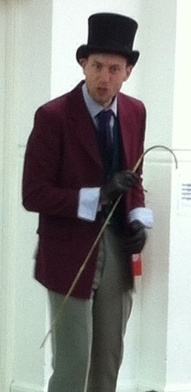
John Kirk is a storyteller and drama facilitator specialising in drama workshops and theatre for young people.The real world can be a hard place and sometimes we grow up too fast.  Its a sad day when a child becomes inhibited by doubt.  I was recently at a school and a little girl took me to one side and asked whether I really was Willy Wonka.  I told her that in life we can choose to believe or we can choose not to believe but that decision was ultimately hers.  She skipped away satisfied with my answer, having just chatted with the world’s greatest chocolate maker!

There are times when I wish I was a little more innocent.  As an adult and a storyteller I have an important role to play in maintaining the innocence of my youngest audiences for as long as possible.

St George and the Dragon: The Golden Legend

John Kirk is a storyteller and drama facilitator specialising in drama workshops and theatre for young people.I was recently asked to recall the stories that I told.  As I compiled my list it occurred to me that my repertoire includes stories about our world from all around the world. A striking example of this is The Legend of St George and the Dragon.

The Legend of St George and the Dragon is well known in England because he is the nation’s patron saint and although it seems, on the surface, a straight forward battle between man and beast (albeit mythical monster) this is a story which is appreciated around the world.

It is said that the story was first brought to England from the Holy Land  by Knights returning from the Crusades.  The story goes that St George comes to the town of Silene in Libya.  Learning that the town is troubled by a terrible Dragon, George seeks the beast out and kills it.  He is hailed as hero by the people.  It’s easy to see how the central idea of bravery, honour and valour conquering a terrible enemy would have resonated with the returning soldiers and fascinated the population at the time.

The idea of George as a Knight fighting with a Dragon, sometimes referred to as “The Golden Legend”, is a romantic view of the Saint’s life.   Saint George was a Roman Soldier, who was born in Turkey 2000 years ago and died for refusing to renounce his Christian faith.  In death St George is respected by Christians and Muslims alike.  As well as England, St George is patron of the World Scouting Movement and other countries including Georgia, Greece, India, Russia and Egypt.  The list of countries and cities who have chosen George as their patron saint is much longer than this but I feel this selection demonstrates his truly global appeal.

John Kirk is a storyteller and drama facilitator specialising in drama workshops and theatre for young people.George and the Dragon is a legend: a traditional story sometimes popularly regarded as historical but not authenticated (www.oxforddictionaries.com).  Both Knight and Dragon can be viewed as metaphors (the saint’s battle with religious persecution).  In some versions of the story George captures the Dragon and only agrees to killing it if the people of the town convert to Christianity.

At the beginning of this blog I said that St George and the Dragon demonstrates how the stories I tell are about our world from all around the world.  Now, I’m not suggesting that everyone who chooses George as their patron did so because of “The Golden Legend” but I would say that you don’t have to be religious to buy into the metaphor.  Everyday all around the world people face hardships and difficulties.  They aren’t knights and don’t have swords or shields but they do share the resolve and courage that George had in facing his Dragon.

Doing the right thing isn’t always easy – it’s a simple yet enduring message.

The Merits of a Narrative Poem

John Kirk specialises in drama workshops and theatre for young people.When I was younger I didn’t think that I liked poetry.  Outside Shakespeare I rarely read verse for pleasure.  Last year though, I was introduced to Alfred Noyes’ “The Highwayman” and it changed my view of poetry completely.  Since then I have been reading other narrative poems including the “The Ballad of the Fleet” (Tennyson) and “The Walrus and the Carpenter” (Carroll) and incorporating them into my work.

A narrative poem tells us a story but it is set out in stanzas with the rhythms and rhyming patterns familiar in other types of poem.  It will contain a skilfully woven story packed with wonderful imagery and metaphors which compels its audience.

In my opinion the narrative poem offers so much that I have even used them in pieces for Birthday Parties!  Here are what I see as the merits of working with narrative poetry.

The narrative poem is perhaps one of the most ancient form of storytelling (The Iliad and Beowulf are both story poems).  As a Drama Facilitator I believe they are a fantastic way of introducing complex text to young audiences which demonstrates the breadth and depth of our literary heritage beyond Shakespeare.

It offers a whole story.  A chapter of a book or a scene from a play wouldn’t offer the beginning middle and end in this way.  If I want to guarantee that a group have heard the material a narrative poem is a concise way of quickly offering an entire story.

The narrative poem will capture the imaginations of boys and girls as it often recalls and romanticises some kind of adventure.

John Kirk is a storyteller and drama facilitator specialising in drama workshops and theatre for young people.Investigating narrative poetry through drama is a lot of fun and once a group has a story they are better positioned to explore the author’s imagery and language choices.  The poems I am talking about were mostly written in the 19th and 20th Century and whilst the language is certainly complex it is not impenetrable.  Accessing it allows young  participants to make their own judgements about themes, events and characters (perhaps physically characterising or hot seating characters about their decisions in the story or making up scenes based upon their deductions).

I have also found that exploring a narrative poem can become a catalyst for exploring rhythm, rhyme and meter and getting groups to write in poetry.

_ _ _ _

“The wind was a rushing train, dodging every tree

The moon was a shiny banana ripe and ready for me.

The road was a lonely wanderer, under an ongoing spell

and Mr Highwayman came riding, riding, riding

Josh Highwayman came riding, up to the Grand Hotel.”

_ _ _ _

“The snow was a breeze of coldness coating the leafy bush,

The sun was a ball of fire, gleaming upon rushing waves

The field was a soft green carpet, over the earthy road

And the Highwayman came skating, skating, skating

The Highwayman came skating up to the big mansion’s door.”

_ _ _ _

As well as getting excited about narrative poetry I have discovered narrative songs.  My taste in story song is eclectic ranging from Benny Hill (The Fastest Milkman in the West) to Charles Daniels (The Devil Went Down to Georgia) and Chris Wood (Hollow Point).  You could easily laugh some narrative songs off as being novelties but constructing an effective narrative within a poem or a song is a great skill.  Tennyson and Noyes might not be matched for their poetry’s beautiful imagery  but Hollow Point particularly is (in my view) a powerful piece of modern verse based storytelling.

Up to now narrative poems have formed the basis of workshops or featured within other work that I have presented but this summer to coincide with The Summer Reading Challenge 2014 I am taking my new found love of the narrative poem to a whole new level as I reinterpret Homer’s “Odyssey” for a young audience.
My final reinterpretation is unlikely to be a narrative poem but one thing is certain – it’s going to be epic!

Special thanks to the children of South Malling Primary School for sharing their “modern” takes on “The Highwayman”.

Qualifying my contribution to children’s learning

John Kirk is a storyteller and drama facilitator specialising in drama workshops and theatre for young people.This week I am using my blog to qualify my impact on learning by sharing some of the testimony I have received in the past 3 months.

“The day was absolutely fantastic and the feedback from children and parents was brilliant. It was lovely to see the children echoing the language you used when writing stories the next day. They all thoroughly enjoyed the day so thank you!!”  Teacher, Wychwood Primary School, Shipton Under Wychwood (Traditional Storytelling and Presentation Day, January 2014)

“I can honestly say that this was one of our most successful days!
John totally engaged the children and especially a group of boys who usually show very little interest in drama, storytelling or writing! The next day the children were still talking about John’s visit and the tips he had given them for story writing. I call that money well spent!” Headteacher, Gillibrand Primary School, Chorley (Classic Storytelling and Workshop Day, February 2014)

“Again, a fabulous day much enjoyed and talked about by the children all week… They have also been inspired to write their own poems and stories – ” Teacher, South Malling Primary School, Lewes (Alfred Noyes’ “The Highwayman“, February 2014)

John Kirk is a storyteller and drama facilitator specialising in drama workshops and theatre for young people.Each of these teachers work in very different social, economic and geographic settings and yet their feedback demonstrates that my stories and workshops manage to transcend such obstacles, appealing to young people nationwide.  They also point to a lasting impact and legacy.

Positive and constructive feedback is always appreciated but I’d like to finish this piece by sharing a lovely comment I received from a school in Liverpool.  Leaving London at 5.30am I made it to Anfield for a 10.45am start.  I led a story and workshop session and was back in the big smoke by 7.45pm.  The children were wonderful to work with but getting this comment from their teacher made an epic trip to Merseyside more than worthwhile.

“The children got a lot out of the workshop! Thank you.”  Teacher, Whitefield Primary School, Liverpool

Related blogs

Fairy Tale Stepmothers do ave’em! – my thoughts on female Fairy tale villains

See also A Tale of Two Newspapers – a piece about performing in Chorley (my home town)

See also “The Highwayman” from an Ostler’s point of view – my thoughts on rewriting Alfred Noyes’ “The Highwayman”

See also Why Mickey Flanagan isn’t joking – my thoughts on quality

“It was so much better than German!”

John Kirk specialises in drama workshops and theatre for young people.At the beginning of January I was in Essex to help inspire a group of young writers.  I wanted to present a workshop in which the participants didn’t feel they were really doing any work.  As absurd as this may sound – I ran a creative writing workshop without doing any writing!

As a trained actor my strength is in the spoken word and its delivery.  Through games and activities I helped the group explore short stories and the work of Edgar Allan Poe.  Here are some of the games we played:

Exploring quality of their content and how we can manipulate atmosphere.

Person A sets up a simple mime.  Person B questions it.  Person A tells a lie about their action and that lie becomes Person B’s truth.  The quality of A’s lie will effect the quality of B’s mime (I’m eating a spicy chilli is far easier to demonstrate than I’m eating).  The game then develops as Person B informs Person A what they are doing.  Whatever B says A accepts as truth.  It is in B’s power to manipulate the scene (A is sitting on a chair watching television and B begins an interrogation).

John Kirk is a storyteller and drama facilitator specialising in drama workshops and theatre for young people.Building short stories

A small group is challenged to tell a story.  Each person in the group is responsible for a section of that story which must have a clear beginning, middle and end.  A character, a location and object are offered as a starter to the group).  As the group build their story ideas about tense (how does “I” rather than “he” effect a story?), sentence structure and vocabulary are introduced before the story is presented to the rest of the group.

Eventually my success will be qualified by how the participants take the ideas they explored on their feet into their written work.  For now though my success is qualified by their words…

“It was better than any day at school… Changed my view of storytelling.”

“Today was really good!  It was so much better than German!  I learnt a lot about building tension and suspense and I have learnt how to use it in my own work.”

“This experience was such a great learning curve for anyone invited and I will take skills with me.”

I really enjoyed today… everyone got involved with acting and storytelling.  It was lots of fun!”

“Thank you to John Kirk for a great experience toady, we learnt a lot of new things and had a really enjoyable morning.”


John Kirk is a storyteller and drama facilitator specialising in drama workshops and theatre for young people.
A letter from a student after a secondary school workshop exploring short stories and Edgar Allan Poe.
John Kirk is a storyteller and drama facilitator specialising in drama workshops and theatre for young people.
A display of Tweets after a Secondary School Workshop exploring short stories and Edgar Allan Poe.