Category Archives: Ideas

Can I tell you a story? Advertising storytelling sessions

I love my job.  I love it because everyday is different and I get to meet literally hundreds of interesting people and visit loads of new and interesting places.  I love it because I work with teachers and library staff to create memorable experiences for young people and in doing so challenge myself and those around me to engage creatively.  I love it because of the responses I get from the children and young people I come into contact with.  I love the moment I hit the brief or when an entire room is really (and I mean truly) listening to, participating in or simply enjoying a story or just the little moments along the way; a thank you or just a smile.  I love my job.  I’m not very good at advertising that fact.

In the main storytelling is a pretty solitary business.  We are like snow leopards, rarely meeting other storytellers unless its at some kind of an event.  What other storytellers contact me most regularly about is work and how to get it.  Whilst I don’t have a magic formula here’s my tuppence worth…

Many years ago I was taught the following mantra about classroom management which goes like this: get them in, get on with them, get on with it.  Here I have adapted the mantra for those looking to sell storytelling projects to potential clients.

Get them in – imagine this as the starting point, the hook, the pitch – call it what you will, the objective is buy in and if you master selling yourself you’ll work.

Get on with them – once you’re in its important to have rapport not just with the group you are working with also with staff.

Get on with it – this is your pay off.  Be it fine art or morris dancing,  if you do whatever it is you do really well you’ve given yourself the best chance of a repeat booking or recommendation.

So how can we promote and achieve buy in to what we are doing?

Leaflets and cold calling

I don’t like leafleting or cold calling.  I think its time consuming and ineffective and I’ll tell you why….  Have you ever consider what it must be like to be a takeaway leaflet?  There you are all fresh from the printers crammed with promises of all the latest tasty deals.  What happens to you?  you are stuffed through someone’s door and promptly put in a recycling bin.  Why does this happen?  because the recipient doesn’t want any Chinese food.

Unsolicited leaflet advertising will only be so effective unless you can afford to bombard what you are doing into the intended target’s consciousness (sending multiple leaflets with the same or similar messages) or you can guarantee your recipient is going to be interested.  To ensure that you’ll need to speak to the right person.  Cold calling schools means speaking to school secretaries; the gatekeepers beyond whom maybe work.  You can save time and pay an agency to provide you with this kind of contact information without having to talk to school secretaries but what if they still don’t want what you are selling?

Making a website

The advantage as I see it of a website is that you are in control of its content and therefore your message.  As a storyteller I am able to display photographs to give site visitors a sense of colour and fun, testimonials that give my work credibility and I can outline projects and answer questions so that potential clients are able to make informed decisions about booking.  This is passive marketing.  I am adopting a policy of “If you can’t find the work, let the work find you”.

The problem is the amount of traffic my website receives.  You spend time developing what you think is a flashy looking website but keyword searches consistently take potential traffic elsewhere.  Search engine optimisation (SEO) is big business and you can pay web designers to boost your web search rankings but there are things even storytellers can do to become a top search result.

Paid listings – advertising will provide you with prominent links to your website and increase your traffic (search engine advertising, specialist advertising).  The problem is if your advertise too broadly some of your newfound traffic may just be lost (using keywords, “children story”, someone looking for a book rather than a storyteller might click on your advertising link).

Free listings – putting your listing into free advertising spaces may yield success.  The following is an example of a free link to my website which was created by another storyteller relating to storytellers working in London.

https://londondreamtime.com/find-a-storyteller-in-london-a-list-of-storytellers/

Keywords and content – if you hit upon a unique phrase or keyword traffic will be directed from a search engine to your website.  Equally filling your site with unique and interesting content may lead to more traffic (I get traffic to my website because of blogs and videos about Tim the Ostler.  Unfortunately these people tend to be studying Alfred Noyes poetry rather than looking for a workshop).

Active social media – An active social media presence will mean people are regularly reminded of the work that you do.  Likes, shares, retweets and follows all help to get the word out there (so when you’ve finished reading this, do me a favour and subscribe to my Youtube channel!).  Some people link their social media to their website content making this process less time consuming.

This leads me to what I believe to be the most powerful form of advertising…

Word of mouth recommendations

A person who watched what you do and how you do it makes a recommendation explaining what made you special and so a chain begins.  Word of mouth recommendations are like gold dust and fortunately in spite of the fact that at times I can be a tongue tied bumbler I’ve received a few over the years.

Reading back over what I’ve written it sounds like marketing a story successfully you’d have about as much chance as a salmon heading up a bear infested river but that’s not at all true.  Some of the best storytellers I ever met don’t have websites or even bother with marketing.  So what am I saying about selling stories?  That there’s no point?  Leaflets and websites are merely a glossy platform for promoting your creative ideas.  To achieve the buy in the interactions with potential clients should be as unique as the story that might be told.  Its about opening a dialogue about creativity; offering imaginative formats and fantastic content all mixed up with a healthy dose of enthusiasm and honesty as in the end no one’s booking a manicured sound byte.  If we place the emphasis on enjoying the experience of working with storytellers the rest will follow because the unique selling point of John Kirk – Storyteller is John Kirk.

 

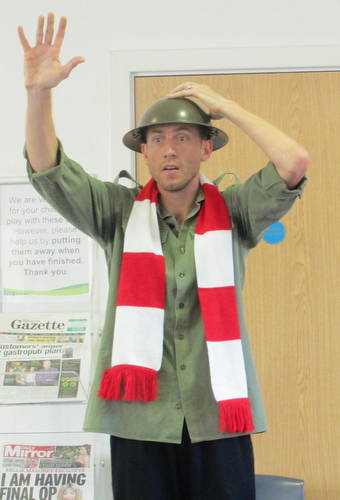
I’ve a hat for that…

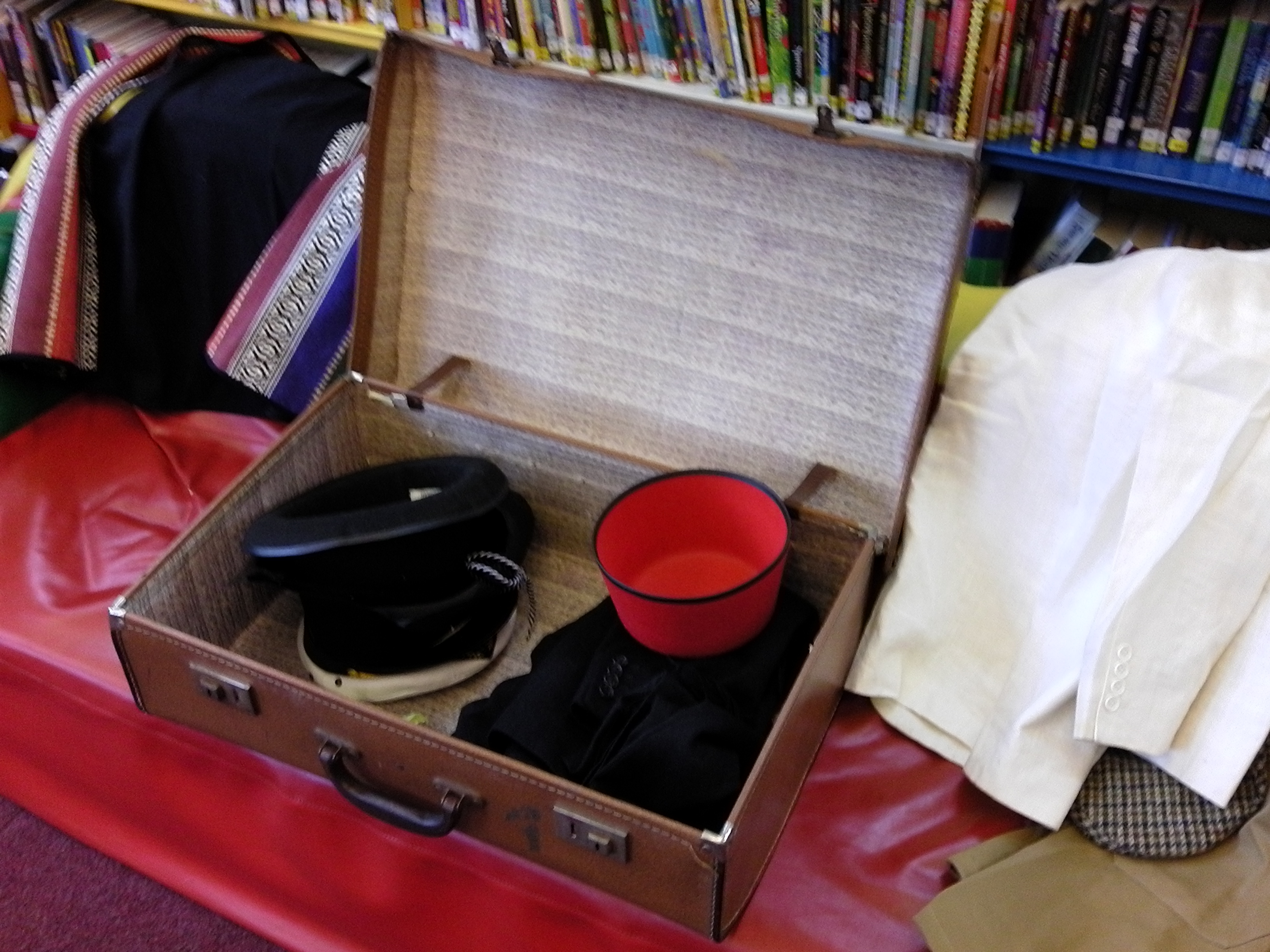
STORYTELLING 1This morning I wanted to write something meaningful about the state of the nation ahead of the election.  I wanted people to understand what choosing cuts to public services means to arts practitioners like me, who are funded pretty much entirely by schools and local authorities.  In the end I couldn’t find the right words so instead I wrote a poem about my many different hats.

 

For the ‘I-don’t-get-its’

For ‘it-doesn’t-make-sense’

For ‘schools-dead-boring’

and sometimes parents.

For learning about stories

For learning about the past

For learning you’ve a future

if you give yourself a chance.

For moments you’ll remember

For memories you will make

For adding joy and inspiration

for someone else’s sake.

For a light bulb or a penny

For a different point of view

For an experience or something fun

I’ve a hat for that, have you?

Who’s in the audience?

The War GameI have spoken about concentration and the fact that my work can be an audience training ground before, but I’d like to take a moment to consider some of the different characters you might find in an audience.  I am neither a scientist or a psychologist but based on my experience the following six characters are amongst those that make up audiences of young people.

(A) participates boisterously.  (A) will talk about the presentation during the presentation, calling out and is always a willing volunteer.

(B) participates enthusiastically.  Like (A), (B) is a willing volunteer but will reserve their verbal participation for when it is encouraged.

(C) participates attentively.  (C) listens hard but is more reserved than (A) or (B).  (C) is more likely to share their thoughts and feelings privately.

(D) participates distractedly.  (D) is a willing volunteer but is as likely to watch other audience members as the presentation.  Dominant audience types are tricky for (D).

(E) participates dangerously.  (E) is like (A) but their chat is off topic and can be destructive or aggressive.  They are different to (F) because they are prepared to be convinced by the presentation.

(F) participates inappropriately.  For one reason or another (F) cannot engage with the presentation.  Where this is a choice rather than circumstances (F) is more challenging.  (F) can manifest actively or passively and may leave the presentation (this ejection may be their choice or sadly somebody else’s).

Launching RBKC Homework Club

We may not see these characters as clearly in older audiences because of social and economic factors but they might help to explain the behaviour of adults during presentations for young people.

We could analyse these character traits further but suffice to say audiences are unique and rightly or wrongly, my expectation of an audience will vary according to the environment, the occasion and the content of the story.  In my experience (B) and (C) make up the largest parts of an average audience of children and thankfully I rarely see (E) or (F) but part of my role is to prepare and respond to different crowds.  For some, sitting through the entire story will be an achievement where for others articulating why they liked, disliked or preferred another story will define appropriate participation.

Whilst the make up of the audience will influence the presentation it doesn’t change my job; to share a story.  Now here’s my question to you, what type of audience member are you?

Telling a story in Aisle Four and creating the environment for storytelling.

The Victorian School MasterI graduated from Rose Bruford College in 2002 and that Christmas I took a job with a small scale touring pantomime company.  I was young and fresh and keen to begin building my career.  Well some would say that at 6ft 4ins I wasn’t the most obvious choice for Rumpelstiltskin but I was still very excited to be involved particularly when I learned that we would be doing a public performance in a supermarket.

Well when we arrived at the venue we realised the story wasn’t to be performed in the store but in the staff canteen to the children of the workers.  The other problem (as it turned out) was that store was open and the canteen in operation.  During a 90 minute show we battled deafening tanoy announcements, staff and parents talking over the story and even workers crossing the performance area.  It was at about this point I realised how hard a life in the arts was potentially going to be.

Nearly 12 years on from this experience I am now more than accustomed to inviting family and friends to watch me present stories in strange places.  I have told stories in pub beer gardens, public squares, parks and even a beach hut.  In my view, the same golden rule for success applies whatever the venue: if you aren’t the most interesting thing in the room then you are doomed.

If the environment isn’t right then it won’t matter about the content or delivery, the presentation will not be as effective as it might otherwise have been.  This isn’t always as straightforward as it may seem.  My work is something between pure storytelling and theatricality.  You might think that in suggesting characters using props, hats and wigs even my most wordy stories would be the most interesting thing in any room.  However, I was once telling Private Peaceful in a library when my young audience were completely distracted as a cat crossed the window ledge behind me!

I accept that there are certain things which are beyond the control of the event organiser (unless its your cat) but there are invariably steps that can be taken to ensure that everybody has the best possible opportunity to enjoy the story.

The War GameIs the story suitable and do the group know enough about the subject matter?  Preparing for an event (determining a story’s suitability, talking to a group about the content/background) will maximise engagement and minimise disruptive behaviour.  In telling “The War Game” I have noticed that audience members with some knowledge of The Great War take more from the experience.

Can the group engage comfortably and safely with the presentation?  It’s easy to say “they won’t mind” but in setting up a space the patience of an audience should be considered.  This could mean laying out mats in a public library or ensuring that all the equipment in the school hall is away before we start our session so that there is extra space and no distractions but it can also relate to numbers.  As a performer I don’t mind a large audience but when size compromises or dilutes the quality of the presentation there is a problem.  Sadly, in austere times and as many schools grow to three or even four form entry, I am in regular correspondence with organisations who want to offer experiences to children but are having to make tough decisions based on numbers.

How is the experience going to be valued by those taking part?  Young people with little experience of live presentations will watch adults and how they interact with a presentation.  This means that very young children can sometimes be engrossed by stories because they are taking cues from their parents and elder siblings.  Unfortunately things can also go the other way.  I was once telling Hansel and Gretel to a group.  At the beginning of the session I enlisted a teacher to assist me in handing out sweets and pebbles to the children so that they could help tell the story.  Rather than placing the two items in front of each child the teacher chose to throw them to (or sometimes at) the children.  A higher than usual proportion of that group spent the first few minutes of the story throwing their props because, in my opinion, they hadn’t been shown how to respect that element of the story.    In my experience there is a definite difference in behaviour and attitude when a teacher or parent respects my work and gives a story their full attention (that means not marking books or checking a mobile phone).  Its even better when my stories feeds directly into a project/topic and has a lasting legacy.

Odysseus and Poseidon

How is the experience going to be valued by the rest of the community?  In some environments everybody must take responsibility for the experience.  In school halls, museums and public libraries my stories have been interrupted by all manner of people who failed to recognise that their activity meant they had become the most interesting thing in the room.  In my view (and this is only my view) we all have a responsibility to children and their literacy and whilst disruptions in a public setting are often unavoidable in some settings they are inexcusable.

I’m sure that I’ll have other supermarket experiences over the course of my storytelling life but my first is indelibly etched on my mind.  For now my work is about collaboration.  It is about effectively communicating with organisers what I do and how I do it ahead of the event and then it is about working in partnership to ensure that every session is memorable for the right reasons.

A story about perseverance, team work and a banana

Christmas time means the return of the world famous Banana Game.

The Banana game features in my version of “A Christmas Carol“.  For those of you unfamiliar with the game its all innocent silliness: players compete in pairs with the aim being to consume a banana as quickly as possible.  The only rules are that the person eating the banana cannot see or touch the banana and that the feeder must stay behind their partner during the game (in essence they become their partner’s hands).  A variation of the game would be to blindfold the feeders but when the players are 5 up the game is already pretty crazy.

On this particular occasion as the audience was made up of a single class, the contest pitted two boys against two girls in a junior school battle of the sexes.  Everything had gone as normal in the build up.  As the task had been explained, the players had giggled and the audience booed and cheered to show their support.

“Ready?  3, 2, 1 Go”.

So the game begins.  On one side of the room the girls locate their banana, remove the peel and begin to eat it, taking a steady, early lead.  On the other side of the room are the boys.  Their feeder is complaining that he can’t peel a banana (he is at least seven years old so this is a little surprising).  He stands waving the fruit in the air unable (or unwilling) to comprehend how he might begin to peel the banana declaring that “he can’t do it”.

The eating player on the girl’s team munches on, her tiny cheeks filled with chunks of undigested banana whilst her partner waits to feed her more.  On the boy’s side of the room “I can’t” has become “I won’t even try”.  Somehow the banana has been partially peeled but the boy has fed his partner the banana peel!

The female eater is a dot of a child.  The banana is clearly more than she can possibly eat but she is focussed and continues doggedly even when told that her team is winning by a country mile, without any complaint.  Frustrated by his partner’s tantrum, the male eater is trying to cheat, using his hands and biting at large chunks of banana.  The crowd let the girls know this and they pick up the pace.  The dot of a child is choking back banana for the sake of the game, for the sake of her team mate and for the audience.  The game is stopped when she can take no more.  The girls are victorious in every sense of the word.

Reading this back it seems a strange story to tell.  The reason I have decided to share this story is because in this silliest of games the girls demonstrated admirable perseverance and a great team ethic.  It was a refreshing reminder of why I love my work and what learning should be about.  I am in no doubt that with these qualities my winners will go far in this world.

My question is this: which team would you have liked to have been playing for and how would you reacted when faced with the challenge of working in a team?

Remember: Determination is not just for Christmas.

NB: No children were significantly harmed in the name of entertainment.  The little girl, although slightly stunned by her experience, was laughing and enjoying herself within moments of the game ending.

Is it pink for a girl when storytelling?

Miss TrunchbullDanielle Gibbons, Libby Stout, Corina Schroder, Ellie Stewart, Gemma Bonner, Lucy Bronze, Rebecca Easton, Nina Pedersen, Martha Harris, Amanda Da Costa, Fara Williams, Katrin Omarsdottir, Louise Fors, Nicole Rolser, Katie Zelem, Gemma Davison, Lucy Staniforth, Natasha Dowie and Kate Longhurst.

You might well ask who these people are.  This is the Liverpool Ladies football team who won the 2014 WSL championship.  A tremendous achievement of which they should all be rightly proud but I doubt many people will be naming their children after any of them just yet.  In my lifetime it would be fair to say that women’s football has always been overshadowed by the men’s game.  Gender stereotypes and ignorance may also be at least in part to blame.

Why am I telling you this?  Well as I present “The War Game” I have been thinking a lot about gender and how audiences respond to my stories.  In “The War Game” I have opted to finish with a moment’s silence to commemorate those who have lost their lives in war.  This is signalled by a whistle and ended with three sharp whistles (like you’d hear at the end of a football match).  On one occasion the silence was broken when a female member of staff quite reasonably encouraged the audience to clap.  I (foolishly) suggested that perhaps girls don’t understand football.  Then, in a question and answer session, when a young man asked why women didn’t fight The Great War.  Rather than tell the young man all the positive things that women did do during the war I simply told him they weren’t allowed to by the British Army.  Twice I staggered over stereotypes and did nothing to dispel them.  Hopefully I can redress this in the remainder of this blog.

Private Peaceful visits WandsworthWomen are an important part of my life.  Without the love and support of my mother and my wife I genuinely hate to think where I’d be.  I’d also be nowhere without the many significant women in my work.  In a recent blog I discussed the attributes of heroes, focussing on Odysseus and Beowulf but in that blog I also talked about Scheherazade who in “1001 Nights” used all her courage and wit to change the heart of Shahryar and in doing so saved the lives of the women of her land.  Heroines do not always trip off the tongue in the way heroes do.  Perhaps this is because in many stories women act quietly support their men who then take the glory (in “Dracula” Mina Harker is as at least as important in the hunt for the vampire as any of the male characters but doesn’t necessarily get the credit).  In the past I have spoken of my admiration for Odysseus’ wife Penelope who waits for her husband to return from Troy for twenty years.  Whilst Odysseus the man could be said to act impulsively, Penelope the woman is steadfast in her loyalty.

It isn’t just in stories that women quietly demonstrate heroism.  Whilst working with Hackney and Waltham Forest museums I learned about the role of women during The Great War.  The war wasn’t easy for anyone and the men who fought were husbands, brothers, fathers to the women they left behind.  Still it was those women who kept Britain going during the war, some of whom contributed directly to the war effort in transport and munitions factories (girls who worked in munitions were known as canaries because the chemicals turned their hair and skin canary yellow!).  This greater responsibility empowered the Suffragette movement and led to further emancipation.

Now ahead of launching “The War Game”, I wasn’t sure that girls would like the story.  That a story which revolves around a football match wouldn’t capture their imaginations.  Sure enough as I tell the story I see hard-to-reach little boy’s eyes light up at the mention of football because football is their thing.  Do the girls switch off?  Well of course not – it was silly of me to think they ever would – they stick with the story to the end.  To understand why allow me to share a generalisation from the question and answer sessions that follow each presentation.

Me:  What is the story about?

Boy’s answer: Football

Girl’s answer: Friendship

Cracking Clues at Chelsea LibraryThe point of telling “The War Game” is to commemorate an event of global significance and make it more accessible to young audiences but in doing so it is interesting to see how we relate to stories.  The above example is of course a gross and controversial generalisation as many girls also say football but then I could just as easily have written a blog considering why boys like fairy tales.  The fact is that many of the stories I tell could be construed as being for boys or for girls but whether they be about footballers or princesses, a story’s themes are what will appeal to us and make them winners.

It is wrong to assume things on the basis of gender.  Liverpool ladies, Scheherazade, Penelope and the women of Britain who contributed so stoically to the war effort are all great examples of how many stereotypes about girls are misplaced.  As for stories, we could talk further about gender differences or we could just accept that part of the joy of stories is subjectivity and where one person is enthralled by the football match another understands the humanity in a simple act.  Today, I’m happy to put the lid back on a can of worms and leave it at that.

PS (31/12/14) follow this link to a TED talk about how gender roles are portrayed in film. https://t.co/DyffkJzrXQ

The Great Fire of Guilden Morden (Part Three)

Going on a Bear HuntThe project in Guilden Morden may be over but if you visit South Cambridgeshire you’ll find the story trail the children created.  It is now possible to discover the fateful events of 1881 by downloading the walking tour onto a mobile phone.

The Village Trail

This short but information packed narrative walk is a great way to explore a very pretty part of our countryside at the weekend or during the school holidays.

Well done to the staff and pupils of Guilden Morden Primary School and all those who helped to make the trail a reality (Cambridgeshire IT Services and GM History Society).

I Need a Hero!

John Kirk is a storyteller and drama facilitator specialising in drama workshops and theatre for young people.“Where have all the good men gone?” asks Bonnie Tyler in her song, “I Need a Hero”.  Good question Bonnie.  See, the title of her track isn’t just catchy it’s true.  We all need heroes and stories would be poorer without them.  I have written before about fairy tale villains and the modern anti hero’s role in stories but where would they be without a good old fashioned hero to foil them?  The tug of war between good and evil and right and wrong has manifested itself in countless ways through time.  Be it a Knight in shining armour sent to battle a dragon or a humble servant/beggar who’ll save the Kingdom and marry a Princess (the premise of many a pantomime) we need a hero.  What are their qualities and their relationships with their followers and loved ones and what can we learn from their adventures?

The hero.  The warrior, the conqueror, the vanquisher, the heartthrob.  Archetypally the hero is male although not always.  For every Aladdin there is a Scheherazade who demonstrates the qualities of heroism.  The hero is generally young or youthful.  The hero is bold; strong both in body and mind and is respected widely for their strength.    Many heroes represent change and vibrant progressiveness which will shake up a stagnating world.

I have recently been exploring epic poetry and for the purpose of this blog we’ll consider Odysseus, King of Ithaca and the warrior Beowulf.  Both men are legendary figures, first appearing many thousands of years ago with their exploits translated and reinterpreted over time since.  Odysseus the Greek and Beowulf the Scandinavian come from very different traditions but they are both heroes.  Both are bold warriors and leaders of men who have not just defeated mortal armies but monsters too (Odysseus blinding Polyphemus the Cyclops and Beowulf slaying the beast Grendel and his Mother).  They have demonstrated great intelligence and cunning through their various adventures but they are not without falls.  It is Odysseus’ arrogance which leads Poseidon to seek vengeance against his entire crew.  It might be argued that Beowulf dies because he is too proud to ask his younger warriors to fight with him.

John Kirk is a storyteller and drama facilitator specialising in drama workshops and theatre for young people.What of their followers?  Despite gifts and praise, when Beowulf’s followers are faced with a Dragon fear gets the better of them.  At many stages of The Odyssey, Odysseus’ crew verge on mutiny and in finally disobeying his will, they doom themselves.  That I suppose is the point.  The fallibility of their followers is in sharp contrast to the quick wits and mental toughness displayed by the hero.  Our heroes inspire ordinary men to be better than themselves and rise above their weaknesses (in 1001 Nights, the heroine, Scheherazade inspires King Shahryar with her skill as storyteller).
As we remember The Great War I am struck by the relationship between Hero and follower, their relationship with conflict and sacrifice and the parallels with modern conflict and soldiering.  Odysseus is reluctant to go to Troy but his contribution once there is invaluable whilst Beowulf offers his men to aid another Kingdom.  How many brave and loyal men died at Troy, following their leader’s orders, so that King Menelaus could retrieve Helen?  How many brave and loyal men were prepared to lay down their lives because their leader said so, to fight somebody else’s dragon.  Stories and their meanings can be disputed but I think that this is an interesting perspective that shouldn’t be overlooked.

Without meaning to continue the Great War analogy too far, for the hero there is a Home Front.  It is from here that a hero will often find purpose for it is here that they know love.  Odysseus spends time with Circe and Calypso but has a deep and faithful bond with Penelope who steadfastly waits for his return.  After his success, Beowulf is received by Hygelac, King of the Geats and his people with warmth, love and adoration.   It is in the reconciliation of love that we see the hero’s actions have been for a selfless cause.  The hero is rewarded but really everybody’s a winner (Odysseus reclaims his Kingdom and family, Beowulf strengthens the bond with another country and consolidates his position and again, our heroine Scheherazade spares the people of her city any further misery by changing the heart of King Shahryar).  Our hero must understand love and it’s influence on their actions.  A strong moral compass is important to a hero because if they are seen to act out of greed or for individual gain they would be viewed quite differently (Robin Hood is a hero for redistributing his loot not for keeping it!).

It isn’t just love and new found riches that our hero will enjoy.  It isn’t uncommon for them to live long and prosperous lives and sometimes to even achieve further greatness.  Now what do they call that?  Oh yes… “They all lived happily ever after!”

Non-verbal storytellers

John Kirk is a storyteller and drama facilitator specialising in drama workshops and theatre for young people.

As a storyteller it is not unusual to have people in the audience with a limited understanding of English.  When I presented Private Peaceful I devised a hand out to accompany the session so that learners could follow up the story afterwards.  A hand out is all well and good but what if your audience can’t read?  Well, most of my pieces incorporate a strong visual element so that even if the story is too much for the individual there is something for them to engage with.

I recently visited a school for children with learning difficulties.  I presented Dracula and The Unlucky Mummy to the students (I’d chosen the pieces realising that they are perhaps my most visual and silly) before running a short training session with staff from local schools.  We began the session by articulating what we saw as the challenges in our own working environments to imaginative writing.  It was in this forum that staff spoke about the challenge of working with individuals who for one reason or another, are non-verbal.  In the past I have used this blog to reiterate my belief that we are all storytellers and to discuss Stanislavski’s Subtext but in this piece I’d like to share some ideas about enthusing and empowering non verbal groups with storytelling.  Many of these ideas are inspired by people I have met and worked with over the years and from observing other brilliant professionals at work.  I hope that you will find them as useful as I do.

John Kirk is a storyteller and drama facilitator specialising in drama workshops and theatre for young people.

Encouraging Free Choice  If the objective of the session is to get your young people to be imaginative then you may have to empower them with the idea of a free choice first.  I can express my free choice orally when I tell stories but this isn’t possible for everybody.  One idea for encouraging non verbal free choice is through multiple choice activities in which questions and instructions stimulate the young person to narrative decisions.  Examples of possible instructions might be “pick up the object you think is found in the room”, “move to where you think we should set the story” or “point to the name of the character”.  This can be a slow process but through simple instructions and reinforcing the rules of your activity through repetition you will soon empower young people to tell their own stories.

Storyboarding  Another idea for encouraging free choice in storytelling might be for the young person to draw a cartoon strip story.  Using a simple template of boxes or arrows to indicate the direction of the narrative a story can be structured by the young person.  Such storyboards could then be annotated with assistance.

Using Sound and Movement  Perhaps you aren’t looking at the narrative but are exploring the atmosphere and tone of a story.  This could be done through sounds and working in a group as an “orchestra”.  Offering an idea as a starting point such as “the city” or “the seaside” encourage the group to respond through simple sounds or body percussion.  What does volume or pace say about mood?  This is as much a listening exercise as a sound making exercise and will require your group to work with sensitivity toward the contributions of other people.  Continuing on a musical theme you might encourage the group to express their story, mood or a character through movement or dance.

John Kirk is a storyteller and drama facilitator specialising in drama workshops and theatre for young people.

Using Props and Objects  It may be possible for the participants to use objects to tell their story using objects or props (placing items as the story is told and moving and animating them according to narrative).  Whilst this is a structured activity it would be encouraging an almost child like play.

As a drama workshop facilitator I have used these activities with varying degrees of success when working in Primary and SEN environments and when devising in Secondary and Sixth Form environments.  I think that these ideas appeal to young people because they are easy to access and own and they are fun.  These games encourage a group to risk being wrong without the consequence of failure.  In terms of the non verbal storyteller, used correctly they play to particular strengths rather than underlining weaknesses.

The success of these ideas inevitably depends upon the level of ability within a group and will require patience (your group may not get them the first time) and a variety of accessible stimulations (props and objects which appeal to the different senses, music or imagery).  In exploring and nurturing what an individual can do we hopefully create an environment in which they are able to tell more and more sophisticated and interesting stories.