Category Archives: Storytelling

Wanted: Children’s Author for SRC 2015

DraculaI am currently searching for an author to work with or a story to tell as part of the Summer Reading Challenge (SRC) 2015.  As well as consulting librarians and scouring book shelves I am publishing this blog as part of my search.  The reason I am publishing this post is to find the right story for the project but also to offer an opportunity to aspiring authors of children’s books.  If you are reading this and are already thinking “I know a story” or “I have a story” or “I know somebody who might have a story” then please read on…

This is the criteria for stories I am considering:

– It must be suitable for children age between 4 and 11 years old.

– It must fit the Summer Reading Challenge theme “Record Breakers” (so stories about extraordinary achievements, world firsts or races would be perfect).

– The author/publisher must be prepared to sanction my storytellings between June and October 2015 (if you are just suggesting a possible title – you aren’t the author or publisher – then I will make the necessary approaches).

– It would be an advantage if the work is published and available for the audience to borrow/buy.

As I say, this post is part of a wider consultation that I am running until the end of February 2015.  I cannot guarantee that your suggestion will be taken on as the final project but if you know a story or know somebody who might have a story then contact me.

Thanks for your support.

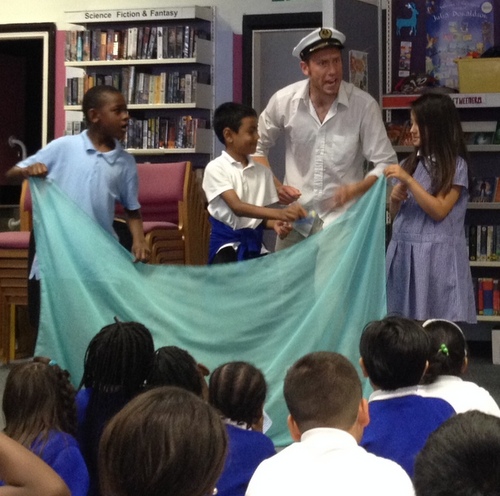
Telling a story in Aisle Four and creating the environment for storytelling.

The Victorian School MasterI graduated from Rose Bruford College in 2002 and that Christmas I took a job with a small scale touring pantomime company.  I was young and fresh and keen to begin building my career.  Well some would say that at 6ft 4ins I wasn’t the most obvious choice for Rumpelstiltskin but I was still very excited to be involved particularly when I learned that we would be doing a public performance in a supermarket.

Well when we arrived at the venue we realised the story wasn’t to be performed in the store but in the staff canteen to the children of the workers.  The other problem (as it turned out) was that store was open and the canteen in operation.  During a 90 minute show we battled deafening tanoy announcements, staff and parents talking over the story and even workers crossing the performance area.  It was at about this point I realised how hard a life in the arts was potentially going to be.

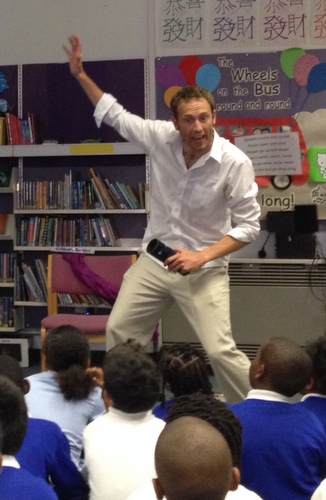
Nearly 12 years on from this experience I am now more than accustomed to inviting family and friends to watch me present stories in strange places.  I have told stories in pub beer gardens, public squares, parks and even a beach hut.  In my view, the same golden rule for success applies whatever the venue: if you aren’t the most interesting thing in the room then you are doomed.

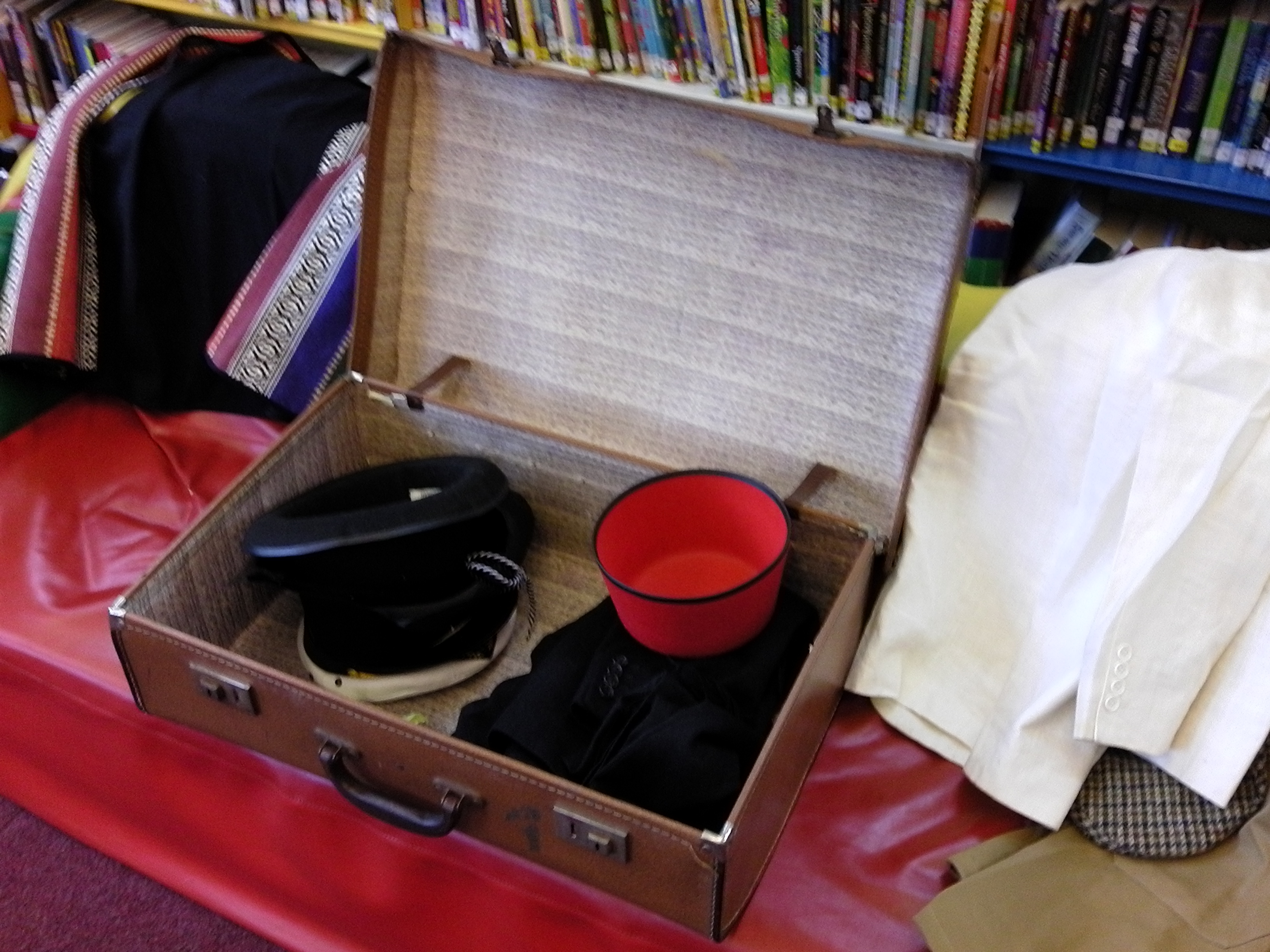
If the environment isn’t right then it won’t matter about the content or delivery, the presentation will not be as effective as it might otherwise have been.  This isn’t always as straightforward as it may seem.  My work is something between pure storytelling and theatricality.  You might think that in suggesting characters using props, hats and wigs even my most wordy stories would be the most interesting thing in any room.  However, I was once telling Private Peaceful in a library when my young audience were completely distracted as a cat crossed the window ledge behind me!

I accept that there are certain things which are beyond the control of the event organiser (unless its your cat) but there are invariably steps that can be taken to ensure that everybody has the best possible opportunity to enjoy the story.

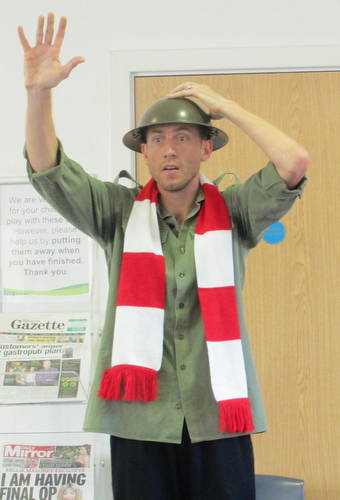
The War GameIs the story suitable and do the group know enough about the subject matter?  Preparing for an event (determining a story’s suitability, talking to a group about the content/background) will maximise engagement and minimise disruptive behaviour.  In telling “The War Game” I have noticed that audience members with some knowledge of The Great War take more from the experience.

Can the group engage comfortably and safely with the presentation?  It’s easy to say “they won’t mind” but in setting up a space the patience of an audience should be considered.  This could mean laying out mats in a public library or ensuring that all the equipment in the school hall is away before we start our session so that there is extra space and no distractions but it can also relate to numbers.  As a performer I don’t mind a large audience but when size compromises or dilutes the quality of the presentation there is a problem.  Sadly, in austere times and as many schools grow to three or even four form entry, I am in regular correspondence with organisations who want to offer experiences to children but are having to make tough decisions based on numbers.

How is the experience going to be valued by those taking part?  Young people with little experience of live presentations will watch adults and how they interact with a presentation.  This means that very young children can sometimes be engrossed by stories because they are taking cues from their parents and elder siblings.  Unfortunately things can also go the other way.  I was once telling Hansel and Gretel to a group.  At the beginning of the session I enlisted a teacher to assist me in handing out sweets and pebbles to the children so that they could help tell the story.  Rather than placing the two items in front of each child the teacher chose to throw them to (or sometimes at) the children.  A higher than usual proportion of that group spent the first few minutes of the story throwing their props because, in my opinion, they hadn’t been shown how to respect that element of the story.    In my experience there is a definite difference in behaviour and attitude when a teacher or parent respects my work and gives a story their full attention (that means not marking books or checking a mobile phone).  Its even better when my stories feeds directly into a project/topic and has a lasting legacy.

Odysseus and Poseidon

How is the experience going to be valued by the rest of the community?  In some environments everybody must take responsibility for the experience.  In school halls, museums and public libraries my stories have been interrupted by all manner of people who failed to recognise that their activity meant they had become the most interesting thing in the room.  In my view (and this is only my view) we all have a responsibility to children and their literacy and whilst disruptions in a public setting are often unavoidable in some settings they are inexcusable.

I’m sure that I’ll have other supermarket experiences over the course of my storytelling life but my first is indelibly etched on my mind.  For now my work is about collaboration.  It is about effectively communicating with organisers what I do and how I do it ahead of the event and then it is about working in partnership to ensure that every session is memorable for the right reasons.

Is it pink for a girl when storytelling?

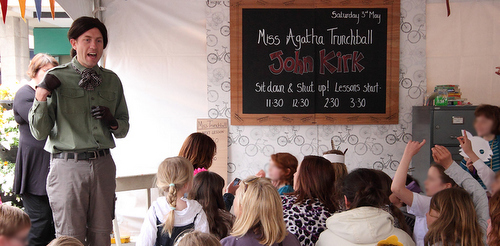
Miss TrunchbullDanielle Gibbons, Libby Stout, Corina Schroder, Ellie Stewart, Gemma Bonner, Lucy Bronze, Rebecca Easton, Nina Pedersen, Martha Harris, Amanda Da Costa, Fara Williams, Katrin Omarsdottir, Louise Fors, Nicole Rolser, Katie Zelem, Gemma Davison, Lucy Staniforth, Natasha Dowie and Kate Longhurst.

You might well ask who these people are.  This is the Liverpool Ladies football team who won the 2014 WSL championship.  A tremendous achievement of which they should all be rightly proud but I doubt many people will be naming their children after any of them just yet.  In my lifetime it would be fair to say that women’s football has always been overshadowed by the men’s game.  Gender stereotypes and ignorance may also be at least in part to blame.

Why am I telling you this?  Well as I present “The War Game” I have been thinking a lot about gender and how audiences respond to my stories.  In “The War Game” I have opted to finish with a moment’s silence to commemorate those who have lost their lives in war.  This is signalled by a whistle and ended with three sharp whistles (like you’d hear at the end of a football match).  On one occasion the silence was broken when a female member of staff quite reasonably encouraged the audience to clap.  I (foolishly) suggested that perhaps girls don’t understand football.  Then, in a question and answer session, when a young man asked why women didn’t fight The Great War.  Rather than tell the young man all the positive things that women did do during the war I simply told him they weren’t allowed to by the British Army.  Twice I staggered over stereotypes and did nothing to dispel them.  Hopefully I can redress this in the remainder of this blog.

Private Peaceful visits WandsworthWomen are an important part of my life.  Without the love and support of my mother and my wife I genuinely hate to think where I’d be.  I’d also be nowhere without the many significant women in my work.  In a recent blog I discussed the attributes of heroes, focussing on Odysseus and Beowulf but in that blog I also talked about Scheherazade who in “1001 Nights” used all her courage and wit to change the heart of Shahryar and in doing so saved the lives of the women of her land.  Heroines do not always trip off the tongue in the way heroes do.  Perhaps this is because in many stories women act quietly support their men who then take the glory (in “Dracula” Mina Harker is as at least as important in the hunt for the vampire as any of the male characters but doesn’t necessarily get the credit).  In the past I have spoken of my admiration for Odysseus’ wife Penelope who waits for her husband to return from Troy for twenty years.  Whilst Odysseus the man could be said to act impulsively, Penelope the woman is steadfast in her loyalty.

It isn’t just in stories that women quietly demonstrate heroism.  Whilst working with Hackney and Waltham Forest museums I learned about the role of women during The Great War.  The war wasn’t easy for anyone and the men who fought were husbands, brothers, fathers to the women they left behind.  Still it was those women who kept Britain going during the war, some of whom contributed directly to the war effort in transport and munitions factories (girls who worked in munitions were known as canaries because the chemicals turned their hair and skin canary yellow!).  This greater responsibility empowered the Suffragette movement and led to further emancipation.

Now ahead of launching “The War Game”, I wasn’t sure that girls would like the story.  That a story which revolves around a football match wouldn’t capture their imaginations.  Sure enough as I tell the story I see hard-to-reach little boy’s eyes light up at the mention of football because football is their thing.  Do the girls switch off?  Well of course not – it was silly of me to think they ever would – they stick with the story to the end.  To understand why allow me to share a generalisation from the question and answer sessions that follow each presentation.

Me:  What is the story about?

Boy’s answer: Football

Girl’s answer: Friendship
Cracking Clues at Chelsea LibraryThe point of telling “The War Game” is to commemorate an event of global significance and make it more accessible to young audiences but in doing so it is interesting to see how we relate to stories.  The above example is of course a gross and controversial generalisation as many girls also say football but then I could just as easily have written a blog considering why boys like fairy tales.  The fact is that many of the stories I tell could be construed as being for boys or for girls but whether they be about footballers or princesses, a story’s themes are what will appeal to us and make them winners.

It is wrong to assume things on the basis of gender.  Liverpool ladies, Scheherazade, Penelope and the women of Britain who contributed so stoically to the war effort are all great examples of how many stereotypes about girls are misplaced.  As for stories, we could talk further about gender differences or we could just accept that part of the joy of stories is subjectivity and where one person is enthralled by the football match another understands the humanity in a simple act.  Today, I’m happy to put the lid back on a can of worms and leave it at that.

PS (31/12/14) follow this link to a TED talk about how gender roles are portrayed in film. https://t.co/DyffkJzrXQ
Everyday should be National Poetry Day!

Last week the UK celebrated National Poetry Day.  Always one to join the band waggon late I thought I would have a lazy blogging week and share some of my older poems.

When I think about it poetry is a big part of my work.  From reciting poems in my storytelling to using epic poetry in drama and storytelling workshops.  For me the charm of verse is it’s form and immediacy.  I can write a 30 minute story or a four stanza poem.  The results can be very satisfying.  When I worked with Guilden Morden Primary School to tell the story of The Great Fire of Guilden Morden the sophistication of the children’s poetry blew me away.

Anyway here is the selection of poems I have chosen – other video can be viewed on my Youtube Channel.

My most popular (I recently passed 500 views) – this poem is a rethinking on Alfred Noyes’ “The Highwayman” from the viewpoint of one of the other characters.  I wrote it for a workshop exploring the poem.


My most furry – again here I am rethinking Julia Donaldson’s “The Gruffalo”.  In my version the Gruffalo makes the argument that he is the victim of the mouse’s lies!


My most anarchic – This is one of Lewis Carroll’s nonsense poem recited by the Mad Hatter.


http://www.youtube.com/watch?v=xSQlAAaRAkQ


My most classical – very few people who watch my version of Homer’s Odyssey would realise that I have remained true to the form of the original epic poem.  Whilst I have tinkered with a lot of the text to make its shorter (necessary when the original is 24 books long!) I have retained most of the introduction.

http://www.youtube.com/watch?v=9_yzOwrev0w


and just for fun… I have a background in parody and pastiche.  Here is my version of “Frankenstein” set to Gloria Gaynor’s “I Will Survive”!!  I have also reworked Dracula and Jekyll and Hyde to the tunes of pop songs and some of the Canterbury Tales (I hope to record a few over the coming weeks).


I Need a Hero!

John Kirk is a storyteller and drama facilitator specialising in drama workshops and theatre for young people.“Where have all the good men gone?” asks Bonnie Tyler in her song, “I Need a Hero”.  Good question Bonnie.  See, the title of her track isn’t just catchy it’s true.  We all need heroes and stories would be poorer without them.  I have written before about fairy tale villains and the modern anti hero’s role in stories but where would they be without a good old fashioned hero to foil them?  The tug of war between good and evil and right and wrong has manifested itself in countless ways through time.  Be it a Knight in shining armour sent to battle a dragon or a humble servant/beggar who’ll save the Kingdom and marry a Princess (the premise of many a pantomime) we need a hero.  What are their qualities and their relationships with their followers and loved ones and what can we learn from their adventures?

The hero.  The warrior, the conqueror, the vanquisher, the heartthrob.  Archetypally the hero is male although not always.  For every Aladdin there is a Scheherazade who demonstrates the qualities of heroism.  The hero is generally young or youthful.  The hero is bold; strong both in body and mind and is respected widely for their strength.    Many heroes represent change and vibrant progressiveness which will shake up a stagnating world.

I have recently been exploring epic poetry and for the purpose of this blog we’ll consider Odysseus, King of Ithaca and the warrior Beowulf.  Both men are legendary figures, first appearing many thousands of years ago with their exploits translated and reinterpreted over time since.  Odysseus the Greek and Beowulf the Scandinavian come from very different traditions but they are both heroes.  Both are bold warriors and leaders of men who have not just defeated mortal armies but monsters too (Odysseus blinding Polyphemus the Cyclops and Beowulf slaying the beast Grendel and his Mother).  They have demonstrated great intelligence and cunning through their various adventures but they are not without falls.  It is Odysseus’ arrogance which leads Poseidon to seek vengeance against his entire crew.  It might be argued that Beowulf dies because he is too proud to ask his younger warriors to fight with him.

John Kirk is a storyteller and drama facilitator specialising in drama workshops and theatre for young people.What of their followers?  Despite gifts and praise, when Beowulf’s followers are faced with a Dragon fear gets the better of them.  At many stages of The Odyssey, Odysseus’ crew verge on mutiny and in finally disobeying his will, they doom themselves.  That I suppose is the point.  The fallibility of their followers is in sharp contrast to the quick wits and mental toughness displayed by the hero.  Our heroes inspire ordinary men to be better than themselves and rise above their weaknesses (in 1001 Nights, the heroine, Scheherazade inspires King Shahryar with her skill as storyteller).

As we remember The Great War I am struck by the relationship between Hero and follower, their relationship with conflict and sacrifice and the parallels with modern conflict and soldiering.  Odysseus is reluctant to go to Troy but his contribution once there is invaluable whilst Beowulf offers his men to aid another Kingdom.  How many brave and loyal men died at Troy, following their leader’s orders, so that King Menelaus could retrieve Helen?  How many brave and loyal men were prepared to lay down their lives because their leader said so, to fight somebody else’s dragon.  Stories and their meanings can be disputed but I think that this is an interesting perspective that shouldn’t be overlooked.

Without meaning to continue the Great War analogy too far, for the hero there is a Home Front.  It is from here that a hero will often find purpose for it is here that they know love.  Odysseus spends time with Circe and Calypso but has a deep and faithful bond with Penelope who steadfastly waits for his return.  After his success, Beowulf is received by Hygelac, King of the Geats and his people with warmth, love and adoration.   It is in the reconciliation of love that we see the hero’s actions have been for a selfless cause.  The hero is rewarded but really everybody’s a winner (Odysseus reclaims his Kingdom and family, Beowulf strengthens the bond with another country and consolidates his position and again, our heroine Scheherazade spares the people of her city any further misery by changing the heart of King Shahryar).  Our hero must understand love and it’s influence on their actions.  A strong moral compass is important to a hero because if they are seen to act out of greed or for individual gain they would be viewed quite differently (Robin Hood is a hero for redistributing his loot not for keeping it!).

It isn’t just love and new found riches that our hero will enjoy.  It isn’t uncommon for them to live long and prosperous lives and sometimes to even achieve further greatness.  Now what do they call that?  Oh yes… “They all lived happily ever after!”

Non-verbal storytellers

John Kirk is a storyteller and drama facilitator specialising in drama workshops and theatre for young people.

As a storyteller it is not unusual to have people in the audience with a limited understanding of English.  When I presented Private Peaceful I devised a hand out to accompany the session so that learners could follow up the story afterwards.  A hand out is all well and good but what if your audience can’t read?  Well, most of my pieces incorporate a strong visual element so that even if the story is too much for the individual there is something for them to engage with.

I recently visited a school for children with learning difficulties.  I presented Dracula and The Unlucky Mummy to the students (I’d chosen the pieces realising that they are perhaps my most visual and silly) before running a short training session with staff from local schools.  We began the session by articulating what we saw as the challenges in our own working environments to imaginative writing.  It was in this forum that staff spoke about the challenge of working with individuals who for one reason or another, are non-verbal.  In the past I have used this blog to reiterate my belief that we are all storytellers and to discuss Stanislavski’s Subtext but in this piece I’d like to share some ideas about enthusing and empowering non verbal groups with storytelling.  Many of these ideas are inspired by people I have met and worked with over the years and from observing other brilliant professionals at work.  I hope that you will find them as useful as I do.

John Kirk is a storyteller and drama facilitator specialising in drama workshops and theatre for young people.

Encouraging Free Choice  If the objective of the session is to get your young people to be imaginative then you may have to empower them with the idea of a free choice first.  I can express my free choice orally when I tell stories but this isn’t possible for everybody.  One idea for encouraging non verbal free choice is through multiple choice activities in which questions and instructions stimulate the young person to narrative decisions.  Examples of possible instructions might be “pick up the object you think is found in the room”, “move to where you think we should set the story” or “point to the name of the character”.  This can be a slow process but through simple instructions and reinforcing the rules of your activity through repetition you will soon empower young people to tell their own stories.

Storyboarding  Another idea for encouraging free choice in storytelling might be for the young person to draw a cartoon strip story.  Using a simple template of boxes or arrows to indicate the direction of the narrative a story can be structured by the young person.  Such storyboards could then be annotated with assistance.

Using Sound and Movement  Perhaps you aren’t looking at the narrative but are exploring the atmosphere and tone of a story.  This could be done through sounds and working in a group as an “orchestra”.  Offering an idea as a starting point such as “the city” or “the seaside” encourage the group to respond through simple sounds or body percussion.  What does volume or pace say about mood?  This is as much a listening exercise as a sound making exercise and will require your group to work with sensitivity toward the contributions of other people.  Continuing on a musical theme you might encourage the group to express their story, mood or a character through movement or dance.

John Kirk is a storyteller and drama facilitator specialising in drama workshops and theatre for young people.

Using Props and Objects  It may be possible for the participants to use objects to tell their story using objects or props (placing items as the story is told and moving and animating them according to narrative).  Whilst this is a structured activity it would be encouraging an almost child like play.

As a drama workshop facilitator I have used these activities with varying degrees of success when working in Primary and SEN environments and when devising in Secondary and Sixth Form environments.  I think that these ideas appeal to young people because they are easy to access and own and they are fun.  These games encourage a group to risk being wrong without the consequence of failure.  In terms of the non verbal storyteller, used correctly they play to particular strengths rather than underlining weaknesses.

The success of these ideas inevitably depends upon the level of ability within a group and will require patience (your group may not get them the first time) and a variety of accessible stimulations (props and objects which appeal to the different senses, music or imagery).  In exploring and nurturing what an individual can do we hopefully create an environment in which they are able to tell more and more sophisticated and interesting stories.


Wave your Flag

John Kirk is a storyteller and drama facilitator specialising in drama workshops and theatre for young people.“Did you see Dolly?”  That is usually the first question I am asked when I admit that I went to the Glastonbury Festival 2014.  My audience is then disappointed to learn that I went to watch Michael Rosen instead of the first lady of Country Music.

What I did see at Glastonbury were flags.  Hundreds of flags.  These flags came in all shapes and sizes, carrying the colours of foreign lands and regional territories, the emblems of sports teams and companies and the messages of the people (“Will you Play at our Wedding Dolly?”).  The flag bearer and their tribe are usually fairly ordinary, muddy people.  You won’t necessarily find a costume or a philosophy at the other end of a flagpole and therefore the flag is not necessarily a symbol of counter culture.  A flag will help you find a tent or a friend.  It might get you on television and will generally serve as a safe way to help you stand out in a crowd of 200,000 people.

John Kirk is a storyteller and drama facilitator specialising in drama workshops and theatre for young people.Another arena where people fall behind flags are sport’s events.  This summer we have had a plethora of international competitions, opening and closing ceremonies, with all their pomp and circumstance.  Integral to these pageants have been the anthems and flags and the manner in which these standards have set the tone.  Who can forget the raw passion of Brazilian fans, bedecked in their bright yellow shirts as they sang their anthem a cappella.  Compare this to in 2008, when Boris Johnson got the Union Flag caught in his belt during the Olympic Closing Ceremony.  What did these moments say about two nations?

The ideas of what a flag might mean in relation to personal and national identity is very interesting particularly in the year that Scotland decides whether to remain part of the union with England.  Of course there are many important considerations but if the Scots voted with heart rather than head then how a person feels might lead Scotland to the Saltire.

John Kirk is a storyteller and drama facilitator specialising in drama workshops and theatre for young people.

In my capacity as a storyteller and drama facilitator I encourage self expression and the discovery of identity.  Through heritage projects (Hackney Museum and the Guilden Morden Fire) I help young people to discover their local history and to consider their legacy whilst promoting tolerance and diversity.  In drama workshops I initiate games and activities in which participants explore ideas and issues and challenge the way in which groups articulate themselves and their opinions through vocal and physical technique.  Many of my successes are defined as soft outcomes but often it won’t feel that way to the individual.  The ability to speak confidently in a group and have your opinion listened to can be life changing for some people.

Like the anthem or the flag much of my work can be linked to pride, confidence and self esteem and expressing identity whilst understanding place within a wider community.  My view is that unlike the Glastonbury crowd or the Commonwealth athletes, most people’s flags will be purely figurative.  You don’t need to march behind a banner to be you but if you’re going to wave a flag at least wave it properly!

The Minstrel and the Firebird

In the Dark Days there lived a Minstrel.  The Minstrel would play for the people of the town to earn enough money for his crust of bread.  In times gone by the Minstrel had entertained the King but now his Flute was battered and he had no money to mend the strings of his Mandolin.  Sometimes it seemed to him that he was completely alone in the world.

One afternoon the Minstrel was sat in the town square with his crust of bread when his attention was drawn to a group of boys.  They had cornered something, some kind of animal, and were daring each other to kill it.  The Minstrel chased the boys away and there cowering in the corner of the square in the filth and dirt was a soot black bird.

The Minstrel could see that the bird was hurt and too weak to fly.  Rather than leave it to die, he gently lifted it up and placed it into the pocket of his tunic.  Returning to his seat in the square he offered the bird his crust of bread.  The bird began to glow; yellows and reds and oranges.  The bird was no ordinary creature; it was a Firebird, that rarest and most beautiful of creatures, said to have been forged at the dawn of time in the very heart of the Sun.  It glowed out of love for the Minstrel.

That evening the Minstrel took the Firebird back to his lodgings where he made it a nest from some old rags.  The nest was very simple but as the Minstrel showed his compassion the Firebird seemed stronger and brighter.

The next day, once the Minstrel had fed the Firebird they went into the square.  The Firebird proved to be very good for business and a crowd gathered to hear the Minstrel play.  That night the Minstrel spent the copper coins he had earned on a great feast which he shared with the Firebird.  The following day the crowd was bigger and that night the Minstrel felt it wise to use some of his copper coins to buy a metal cage, to protect the injured Firebird.

So this went on.  Each day the Minstrel and the Firebird would go to the square where they were met by bigger and bigger crowds and each night they would feast.  The Minstrel bought a new Flute and strings for his Mandolin and it wasn’t long before he was invited to entertain the King.  The Firebird was now strong enough to fly but the Minstrel wasn’t ready to let her go.  The Firebird, that rarest and most beautiful of creatures, sat in her metal cage.  Still she glowed but not as brightly as before.

The night before the royal performance the Minstrel woke to a tapping noise.  He went to where the Firebird’s cage stood by the window.  There was another Firebird.  The two rare and beautiful creatures were dancing silently in the moonlight.  As the Minstrel approached he could see that the caged bird was flaming and glowing more magnificently than ever before.  The dance continued until finally her friend flew away; a shooting star in the night sky.  The Minstrel could see that the Firebird was crying.  The Firebird, that rarest and most beautiful of creatures was sad at her imprisonment.

The Minstrel knew what he had to do.  He threw open the window and lifted the Firebird from the cage.  Although the Firebird was burning brightly she felt cool to the Minstrel’s touch.  The Minstrel let her go.  The Firebird flew out into the sky, chasing her friend, high above the trees and mountains, high up into the air until her brightness brought on the dawn.  As the Firebird flew further and further away, the Minstrel despaired – how could he entertain the King without his friend?

The Minstrel needn’t have worried.  The next morning the Minstrel walked out of the Royal Palace.  The King had heard of the Minstrel’s popularity in the square and had very much enjoyed his music even asking him to return for another performance.  The Minstrel smiled.  He would miss the Firebird but he knew she was happy.  Despite letting the Firebird go the Minstrel was no longer lonely and as he looked up at the warm, morning sun, he was certain that all of his day’s would be that little bit brighter.

April to June: What they said..

John Kirk is a storyteller and drama facilitator specialising in drama workshops and theatre for young people.

This year I have seen the amount of work I do swell.  More than ever before I am being asked to travel across the country to work with young people and adults on all manner of projects.  As the school year ends I thought I would share a few of the comments from the past three months.

In March Private Peaceful was perhaps the largest single project I have ever undertaken and the feedback from it was phenomenal but rather than share what you can see on a dedicated page I have picked out testimonials from other workshops that I offer.

“Children from all ages and classes were engaged and buzzing from their work with you.”

Literacy Coordinator, Watling Lower School, Dunstable (Jack and the Beanstalk Workshop and Storytelling Day, May 2014)

John Kirk is a storyteller and drama facilitator specialising in drama workshops and theatre for young people.“The staff said you were the best story teller they had ever experienced.”

Inclusive Coordinator, Sauncey Wood Primary School, Harpenden (The Unlucky Mummy Myths and Legends Day, May 2014)

and perhaps my favourite…

“‘I really get it now. Shakespeare was my worst thing before but now I understand that it’s meant to be fun and dramatic.'”

Year Eight, Shenfield High School, Shenfield (Shakespeare’s The Tempest Workshop Sessions, May 2014)

John Kirk is a storyteller and drama facilitator specialising in drama workshops and theatre for young people.

I’d be lying if I said that everybody adored my style of working and that there haven’t been difficult days along the way but the comments I choose to share here are my mandate for carrying on working into 2014-15.  They demonstrate my value and the difference my storytelling and workshop sessions make to young people and educational professionals.

I am incredibly lucky to have worked with some fantastic people during the current academic year (City Read London, Shrewsbury Children’s Bookfest, Guilden Morden Primary School and Hackney Museum) and much of my success is because of the wonderful, supportive people who give me such wonderful opportunities.

The Summer Reading Challenge 2014 has already kicked off what’s looking like a very exciting six months.  Who knows?  Maybe I’ll be visiting you.

See also feedback from Jan-March

Gods and Monsters: Approaching Homer’s Odyssey

John Kirk specialises in drama workshops and theatre for young people.A year ago I devised Dracula to coincide with The Summer Reading Challenge (SRC) 2013.  The piece was hugely successful and it has been my pleasure to present it across the rest of the country at schools and events since.  Time waits for no man and a year later I am about to embark upon an even bigger tour with an even bigger challenge: Homer’s Odyssey.

I had originally thought to give SRC 2014 a miss – Private Peaceful was a very demanding and very consuming project and I thought that perhaps I needed some time to reflect.  In February I was booked by Hammersmith and Fulham Libraries for four days of storytelling.  I knew that the obvious choice considering the theme this year is Mythical Mazes, would be Theseus and the Minotaur but I tell this already as part of my traditional storytelling offer to schools.  I briefly considered “The Secret Garden” as an alternative slant on the theme before settling on Homer.

There are many good reasons for children to hear The Odyssey.  It may be 3000 years old but its a really famous and influential story packed with Gods and Monsters.  Be it the Coen Brothers’ Oh Brother!  Where Art Thou? or the test of the Glass Slipper to find true love in Cinderella, shades of The Odyssey are everywhere.  The original is very skilfully written and as the plotlines merge it is clearly much more than an adventure story.  There is a strong message through the narrative about the foolishness of men and the wisdom and fortitude of women.  I have used this blog to talk about the role of strong women in fairy tales before and whilst Odysseus truly is a man of exploits and trials (many of which are brought about by ill judged decisions) loyal Penelope is admirably steadfast and dignified as she waits for his return.

John Kirk is a storyteller and drama facilitator specialising in drama workshops and theatre for young people.In recent months I have been doing more and more work around narrative poems.  I have explored Alfred Noyes’ Highwayman, Tennyson and even used narrative poetry as a device for telling the story of The Great Fire of Guilden Morden.  I have been keen to retain the sense of a narrative poem, its language and imagery, in my reinterpretation.  I say reinterpretation because mine will be an adaptation of Homer.  There is no way I could remember twelve and a half thousand lines of poetry but I hope that I offer a flavour of the journey as we follow Odysseus home in just 40 minutes.  My story must also have a sense of progression and therefore cannot afford to linger.  My other big challenge is making the piece accessible to very young audiences.  I want the experience to be fun but its important that the tone is right and any jokes mustn’t cloud the narrative.

John Kirk is a storyteller and drama facilitator specialising in drama workshops and theatre for young people.The result is a series of short stories which in the future I will be able to tell independently or present as a show following Odysseus from Troy back to Penelope.  I’ll be doing my usual array of voices, physical attitudes and helping the audience to identify Gods from the Monsters with suggestions of costume and some more visual setpieces.  (I have already redecorated my Kitchen with tomato juice in a failed attempt to produce a suitably gory effect for the blinding of Polyphemus).

If the preparation is an indicator of the summer to come then it’s going to be epic!

Dates from 9th July 2014 in London Libraries.  Follow link and check local listings for details of presentations.