Category Archives: Entertainment

Tom Palmer’s “The Last Try” dates

The War GameFollowing the announcement of my project with Tom Palmer and Hull Culture and Leisure Ltd I am delighted to share the dates of the project.

Tom Palmer’s “Last Try”

Dates (times and venues tbc)

9th February 2016 – Hull

10th February 2016 – Hull

22nd February 2016 – Wakefield

23rd February 2016 – Bradford

24th February 2016 – Bradford

25th February 2016 – St Helens

It has taken a lot of coordinating to get this far and I’m grateful to Tom Palmer and the libraries involved for their support.  It’s a very exciting to think that next year I’ll be working in the heartland of Rugby League and I can’t wait to get stuck into the project and bring the story to life.

Today though (October 10th) it’s Grand Final Day and I’m a Wigan fan.  If you’re going to the game enjoy yourselves and I hope to see you in 2016!

Tom Palmer’s “The Last Try”

The War GameI am pleased to be able to announce that prolific author Tom Palmer and Hull Culture & Leisure Ltd have agreed for me to present “The Last Try”.

“The Last Try” is a fictional account of the life of Jack Harrison, the renowned Hull FC rugby player who scored a record 52 tries in the 1914-15 season, and who was awarded the Victoria Cross for his actions during the First World War.

Having previously worked with Terry Deary on “The War Game” this project represents an exciting opportunity to work with another top author and library authorities with strong links to rugby and specifically rugby league.  I hope to be able to offer presentations from armistice day 2015 until the commemoration of The Battle of the Somme next July but the project will also fall at a time when England will host a Rugby Union World Cup and Hull become City of Culture 2017.

The War GameWorking on a project like “The Last Try” will create opportunities to discuss The Great War with school groups and young people whilst hopefully inspiring more children to read.  I am primarily offering the project to libraries with links to rugby league or rugby union in England and Wales but I have also approached the library service in Perpignan (home of Catalan Dragons) and am talking to literature festivals about potential presentations.

As ever, any dates will be posted on my website.  If you know somebody who might be interested in hosting or attending a presentation please share this information.  To find out more about my work and “The Last Try” contact me.

Rave reviews

The Hungry CaterpillarHere are a selection of the rave reviews I have received between January and March 2015 from schools and libraries about my work:

“Absolutely brilliant performance, totally engaging all the children and staff.” Librarian, Swansea, March 2015

“You brought the stories to life and enticed even the most reluctant of readers.” Deputy Head, Primary School, St Albans, March 2015

“You do exactly what you say you’ll do… your standard remains consistently high and polished.”  Shrewsbury Children’s Bookfest, March 2015

“A great day and very inspirational for the children.”  Teacher, Primary School, Lewes, February 2015

Its easy to suggest that I am universally loved.  My way of working isn’t to every taste but having said this I am regularly wowed by the response my stories receive.  Perhaps the best comment I received over the past three months (those of you who reached this blog via my homepage may recognise it) is this one…

“It is always worrying when we invite someone new into school, as you never know which way it will go.  However, you really motivated and inspired the children and it was a joy to welcome you into the school.”  Assistant Head Teacher, Salford, February 2015.

Provided people continue to put their faith in me then I  hope to carry on taking my work around the country motivating, inspiring, enthusing and entertaining for as long as I can.

The Hitchhiker’s Guide to Swansea

Odysseus and PoseidonAnother week another odyssey – this time I went to Swansea via Oxfordshire.

First Oxfordshire for Rudyard Kipling’s “Just So Stories”.  The Just So Stories may not be the most fashionable collection of short stories and are certainly overshadowed by The Jungle Book, but Kipling’s clever solutions to things that occur in nature (How the Camel gets its hump, how the Rhinoceros gets its skin and how the Elephant gets its trunk to name the few I incorporate) are little gems and great to tell.  As a child I thoroughly enjoyed these stories and they offer a wonderful and imaginative Launchpad for further learning.

As I already knew the stories from the collection I wanted to tell and I had an idea of how I wanted to tell them the preparation work was very enjoyable.  As with many of my stories, finding the right props was trickier but in the end my Mum came to the rescue as she made the most wonderful crocodile for the story of The Elephant’s Child.  I would not be exaggerating if I said that when I presented the story in East London, the crocodile’s appearance left two Reception classes speechless – he is brilliant (photos to follow)!

I’m glad to say my version of Kipling’s tales have been very well received.

HUNGRY MEAD1“We had a great time and our little ones were enthralled.” (Parent, Ebb & Flo Bookshop Session, Chorley)

“The day was absolutely fantastic and enjoyed by all! An imaginative and creative way to bring the ‘Just So Stories’ to life for younger children.” (Teacher, Wychwood Primary School, Oxfordshire)

It is always pleasing to be given the challenge of developing new material rather than simply trotting out the old favourites.  It is often good for my practice and my relationship with an organisation (the experience of working together becomes far more personal when the booker has been very specific about the day).  I particularly like to develop stories I feel will have a life beyond the intended audience.  So far my version of the “Just So Stories” has been in front of almost 350 children and I hope it will be a part of my repertoire for some time to come.

So that was Oxfordshire but what about Swansea?

I have been touring Britain for the better part of a decade.  I have been up and down England, into Scotland and even visited the Channel Islands but I had never worked in Wales.  I had heard stories of how wonderful Welsh audiences could be so I was very excited to take “The War Game” a story about football, to Swansea Central Library, situated in the heart of rugby mad Wales.  I had a very memorable day (even if the three schools I worked with all wore blue and had unpronounceable names) and it was all over much too quickly for my liking.

It wasn’t just my day or lime green hotel room that were memorable..

The War Game

Now one of the reasons why I perhaps hadn’t worked in Swansea before is the fact its 42 junctions along the M4 from London.  Don’t get me wrong, I love travel and visiting new places but motorway driving is monotonous.  Wishing I had got the train I set off for home, deciding to stop for fuel at Membury Services (not far from Swindon).  It was here that I picked up Sheffield University students Alex and Dom – my first ever hitchhikers.  It turned out that the boys were spending their Easter break hitchhiking for charity and were en route to Bucharest(!).  They had left Sheffield that morning and were attempting to get to Dover.  What they had been doing in Swindon was a little confusing but I gave them a ride to a service station on the southside of the M25 before turning for home.

As March ends so too does my busiest period of the year.  Over the next couple of weeks I’ll be taking bookings for April thru July and firming up my summer schedule.  Highlights will include another trip to The National Football Museum, visits to libraries in Peterborough and Hull and work on a Heritage Pop Up project in Redbridge but beyond these landmarks who knows where the next few months will take me…
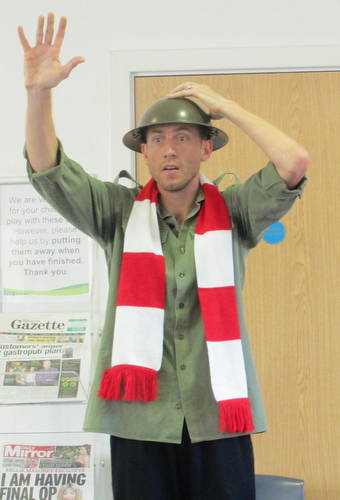
Goodbye (Manchester) Piccadilly! See you again in April…

The War GameOn Friday last I found myself sharing Terry Deary’s “The War Game” at The National Football Museum in central Manchester.

When I had initially contacted the museum I hadn’t thought about the notion of “national”.  Now I work in some pretty big libraries (Wembley, Swiss Cottage and Newcastle for example) but by comparison The National Football Museum is HUGE.  I’ll admit that the enormity of the occasion and a desire for my work to be appreciated almost got the better of me.

Despite my nerves I needn’t have worried.  I had a glorious day out and presented the story three times to three large, receptive audiences.  It was heartening to hear people singing along to war time songs like “Long Way to Tipperary” and to share the story of Clapton Orient (I’ll be sharing it here in April).  The best bit is that I’ll be going back to Manchester during the Easter Holidays*.

I definitely feel that this will put a spring in my step for the next five weeks as I take my repertoire of stories on the road, visiting Kent, Birmingham, Lancashire, Shropshire and for the first time, Wales.  First stop: Miss Trunchbull will be visiting East Sussex on Tuesday.

*I’ll actually be working in Salford, Wigan and Rochdale between now and Easter.

Telling a story in Aisle Four and creating the environment for storytelling.

The Victorian School MasterI graduated from Rose Bruford College in 2002 and that Christmas I took a job with a small scale touring pantomime company.  I was young and fresh and keen to begin building my career.  Well some would say that at 6ft 4ins I wasn’t the most obvious choice for Rumpelstiltskin but I was still very excited to be involved particularly when I learned that we would be doing a public performance in a supermarket.

Well when we arrived at the venue we realised the story wasn’t to be performed in the store but in the staff canteen to the children of the workers.  The other problem (as it turned out) was that store was open and the canteen in operation.  During a 90 minute show we battled deafening tanoy announcements, staff and parents talking over the story and even workers crossing the performance area.  It was at about this point I realised how hard a life in the arts was potentially going to be.

Nearly 12 years on from this experience I am now more than accustomed to inviting family and friends to watch me present stories in strange places.  I have told stories in pub beer gardens, public squares, parks and even a beach hut.  In my view, the same golden rule for success applies whatever the venue: if you aren’t the most interesting thing in the room then you are doomed.

If the environment isn’t right then it won’t matter about the content or delivery, the presentation will not be as effective as it might otherwise have been.  This isn’t always as straightforward as it may seem.  My work is something between pure storytelling and theatricality.  You might think that in suggesting characters using props, hats and wigs even my most wordy stories would be the most interesting thing in any room.  However, I was once telling Private Peaceful in a library when my young audience were completely distracted as a cat crossed the window ledge behind me!

I accept that there are certain things which are beyond the control of the event organiser (unless its your cat) but there are invariably steps that can be taken to ensure that everybody has the best possible opportunity to enjoy the story.

The War GameIs the story suitable and do the group know enough about the subject matter?  Preparing for an event (determining a story’s suitability, talking to a group about the content/background) will maximise engagement and minimise disruptive behaviour.  In telling “The War Game” I have noticed that audience members with some knowledge of The Great War take more from the experience.

Can the group engage comfortably and safely with the presentation?  It’s easy to say “they won’t mind” but in setting up a space the patience of an audience should be considered.  This could mean laying out mats in a public library or ensuring that all the equipment in the school hall is away before we start our session so that there is extra space and no distractions but it can also relate to numbers.  As a performer I don’t mind a large audience but when size compromises or dilutes the quality of the presentation there is a problem.  Sadly, in austere times and as many schools grow to three or even four form entry, I am in regular correspondence with organisations who want to offer experiences to children but are having to make tough decisions based on numbers.

How is the experience going to be valued by those taking part?  Young people with little experience of live presentations will watch adults and how they interact with a presentation.  This means that very young children can sometimes be engrossed by stories because they are taking cues from their parents and elder siblings.  Unfortunately things can also go the other way.  I was once telling Hansel and Gretel to a group.  At the beginning of the session I enlisted a teacher to assist me in handing out sweets and pebbles to the children so that they could help tell the story.  Rather than placing the two items in front of each child the teacher chose to throw them to (or sometimes at) the children.  A higher than usual proportion of that group spent the first few minutes of the story throwing their props because, in my opinion, they hadn’t been shown how to respect that element of the story.    In my experience there is a definite difference in behaviour and attitude when a teacher or parent respects my work and gives a story their full attention (that means not marking books or checking a mobile phone).  Its even better when my stories feeds directly into a project/topic and has a lasting legacy.

Odysseus and Poseidon

How is the experience going to be valued by the rest of the community?  In some environments everybody must take responsibility for the experience.  In school halls, museums and public libraries my stories have been interrupted by all manner of people who failed to recognise that their activity meant they had become the most interesting thing in the room.  In my view (and this is only my view) we all have a responsibility to children and their literacy and whilst disruptions in a public setting are often unavoidable in some settings they are inexcusable.

I’m sure that I’ll have other supermarket experiences over the course of my storytelling life but my first is indelibly etched on my mind.  For now my work is about collaboration.  It is about effectively communicating with organisers what I do and how I do it ahead of the event and then it is about working in partnership to ensure that every session is memorable for the right reasons.

Everyday should be National Poetry Day!

Last week the UK celebrated National Poetry Day.  Always one to join the band waggon late I thought I would have a lazy blogging week and share some of my older poems.

When I think about it poetry is a big part of my work.  From reciting poems in my storytelling to using epic poetry in drama and storytelling workshops.  For me the charm of verse is it’s form and immediacy.  I can write a 30 minute story or a four stanza poem.  The results can be very satisfying.  When I worked with Guilden Morden Primary School to tell the story of The Great Fire of Guilden Morden the sophistication of the children’s poetry blew me away.

Anyway here is the selection of poems I have chosen – other video can be viewed on my Youtube Channel.

My most popular (I recently passed 500 views) – this poem is a rethinking on Alfred Noyes’ “The Highwayman” from the viewpoint of one of the other characters.  I wrote it for a workshop exploring the poem.


My most furry – again here I am rethinking Julia Donaldson’s “The Gruffalo”.  In my version the Gruffalo makes the argument that he is the victim of the mouse’s lies!


My most anarchic – This is one of Lewis Carroll’s nonsense poem recited by the Mad Hatter.


http://www.youtube.com/watch?v=xSQlAAaRAkQ


My most classical – very few people who watch my version of Homer’s Odyssey would realise that I have remained true to the form of the original epic poem.  Whilst I have tinkered with a lot of the text to make its shorter (necessary when the original is 24 books long!) I have retained most of the introduction.

http://www.youtube.com/watch?v=9_yzOwrev0w


and just for fun… I have a background in parody and pastiche.  Here is my version of “Frankenstein” set to Gloria Gaynor’s “I Will Survive”!!  I have also reworked Dracula and Jekyll and Hyde to the tunes of pop songs and some of the Canterbury Tales (I hope to record a few over the coming weeks).


Gods and Monsters: Approaching Homer’s Odyssey

John Kirk specialises in drama workshops and theatre for young people.A year ago I devised Dracula to coincide with The Summer Reading Challenge (SRC) 2013.  The piece was hugely successful and it has been my pleasure to present it across the rest of the country at schools and events since.  Time waits for no man and a year later I am about to embark upon an even bigger tour with an even bigger challenge: Homer’s Odyssey.

I had originally thought to give SRC 2014 a miss – Private Peaceful was a very demanding and very consuming project and I thought that perhaps I needed some time to reflect.  In February I was booked by Hammersmith and Fulham Libraries for four days of storytelling.  I knew that the obvious choice considering the theme this year is Mythical Mazes, would be Theseus and the Minotaur but I tell this already as part of my traditional storytelling offer to schools.  I briefly considered “The Secret Garden” as an alternative slant on the theme before settling on Homer.

There are many good reasons for children to hear The Odyssey.  It may be 3000 years old but its a really famous and influential story packed with Gods and Monsters.  Be it the Coen Brothers’ Oh Brother!  Where Art Thou? or the test of the Glass Slipper to find true love in Cinderella, shades of The Odyssey are everywhere.  The original is very skilfully written and as the plotlines merge it is clearly much more than an adventure story.  There is a strong message through the narrative about the foolishness of men and the wisdom and fortitude of women.  I have used this blog to talk about the role of strong women in fairy tales before and whilst Odysseus truly is a man of exploits and trials (many of which are brought about by ill judged decisions) loyal Penelope is admirably steadfast and dignified as she waits for his return.

John Kirk is a storyteller and drama facilitator specialising in drama workshops and theatre for young people.In recent months I have been doing more and more work around narrative poems.  I have explored Alfred Noyes’ Highwayman, Tennyson and even used narrative poetry as a device for telling the story of The Great Fire of Guilden Morden.  I have been keen to retain the sense of a narrative poem, its language and imagery, in my reinterpretation.  I say reinterpretation because mine will be an adaptation of Homer.  There is no way I could remember twelve and a half thousand lines of poetry but I hope that I offer a flavour of the journey as we follow Odysseus home in just 40 minutes.  My story must also have a sense of progression and therefore cannot afford to linger.  My other big challenge is making the piece accessible to very young audiences.  I want the experience to be fun but its important that the tone is right and any jokes mustn’t cloud the narrative.

John Kirk is a storyteller and drama facilitator specialising in drama workshops and theatre for young people.The result is a series of short stories which in the future I will be able to tell independently or present as a show following Odysseus from Troy back to Penelope.  I’ll be doing my usual array of voices, physical attitudes and helping the audience to identify Gods from the Monsters with suggestions of costume and some more visual setpieces.  (I have already redecorated my Kitchen with tomato juice in a failed attempt to produce a suitably gory effect for the blinding of Polyphemus).

If the preparation is an indicator of the summer to come then it’s going to be epic!

Dates from 9th July 2014 in London Libraries.  Follow link and check local listings for details of presentations.

A Guide to Guidance: how can you be sure a story is suitable?

John Kirk is a storyteller and drama facilitator specialising in drama workshops and theatre for young people.Whenever I take a booking or ask for feedback on my work, suitability is mentioned.  For each of my stories I have suggested the age or level the audience should be at in order to watch it.  You did read that correctly, I said suggested.

Most recently I have been presenting “Private Peaceful” as part of the Cityread 2014.  My brief was to work with young readers in public spaces (lots of libraries!).  Michael Morpurgo’s story is quite rightly, not pitched at younger young readers but I know from experience of working in public spaces to expect very young audiences.  I therefore devised a piece which could be accessible to an audience of young people aged 7 plus.  This was challenging as I did not want to compromise the language or the tone of the original in my work.  In my interpretation I remove elements of the story which are too disturbing for a young audience or too difficult to do justice in a 40 minute presentation (the shooting of Bertha, Molly and the baby).  Similarly, I say that my version of “A Christmas Carol” can be enjoyed by audiences of young people aged 4 plus.  I don’t deviate from Dickens’ story or his language and in places my ghost story can be scary but I include elements of slapstick, pantomime and colourful, comic characters to entertain the very youngest audience members.

John Kirk is a storyteller and drama facilitator specialising in drama workshops and theatre for young people.The truth is that when I say a piece is suitable for a particular age or level I am making a broad statement.  If I am liaising with a school directly it is much easier to advise them on a story to choose for their children.  Here my statement on suitability is definitely “this story is suitable for a person of the stated age or level”.  When I work In public environments I have less control over who will be watching.  I can put a statement of suitability on my literature or speak to the audience briefly before the presentation begins but my statement is more ambiguous, “a person of this age or level can access this story in some way”.

Perhaps it shouldn’t be like this but in the end I don’t know the audience who will watch my work.  When I work in schools, a child who is particularly sensitive will respond to my work differently compared to one who is bomb proof.  During the school holidays a parent will not be able to leave one child in order to monitor their sibling so I often present stories I deem inappropriate to very young children.  Saying this, I have had two year olds howling with laughter at Dracula because of my presentation style and teenagers who have disrupted my stories because they weren’t prepared to engage with my work.

John Kirk is a storyteller and drama facilitator specialising in drama workshops and theatre for young people.There are risks when booking or attending stories for children but many pitfalls can be avoided with insight into the work.  Just because it says its suitable for a seven year old doesn’t mean its not Michael Morpurgo.  Just because it says its suitable for four year olds doesn’t mean that its not Charles Dickens.  A statement of suitability is to say you can rather than you should watch.  It is for adults to exercise their discretion in choosing an appropriate story for their audience.

“Saluting” my CityRead 2014…

Here is the story of my CityRead2014 in pictures.  The saluting came about when the group piled into the photograph at New X Learning.  It became a trend that would be repeated across London.

I started in Lewisham…

John Kirk is a storyteller and drama facilitator specialising in drama workshops and theatre for young people.

and was next in Wandsworth.

John Kirk is a storyteller and drama facilitator specialising in drama workshops and theatre for young people.

April rolled in with presentations in Barking and Dagenham…

John Kirk is a storyteller and drama facilitator specialising in drama workshops and theatre for young people.

and Islington.

John Kirk is a storyteller and drama facilitator specialising in drama workshops and theatre for young people.

As the Easter Holidays began the dates came thick and fast with presentations in The City of London…

John Kirk is a storyteller and drama facilitator specialising in drama workshops and theatre for young people.

Waltham Forest…

John Kirk is a storyteller and drama facilitator specialising in drama workshops and theatre for young people.

and Ealing.

John Kirk is a storyteller and drama facilitator specialising in drama workshops and theatre for young people.

I did nine presentations in Croydon…

John Kirk is a storyteller and drama facilitator specialising in drama workshops and theatre for young people.

eight in Haringey…

John Kirk is a storyteller and drama facilitator specialising in drama workshops and theatre for young people.

with days in Merton…

John Kirk is a storyteller and drama facilitator specialising in drama workshops and theatre for young people.

and Camden too – Phew!

John Kirk is a storyteller and drama facilitator specialising in drama workshops and theatre for young people.

When the schools went back we pressed on with huge crowds in Lambeth…

John Kirk is a storyteller and drama facilitator specialising in drama workshops and theatre for young people.

Redbridge…

John Kirk is a storyteller and drama facilitator specialising in drama workshops and theatre for young people.

and Brent.

John Kirk is a storyteller and drama facilitator specialising in drama workshops and theatre for young people.

Not forgetting Hackney…

John Kirk is a storyteller and drama facilitator specialising in drama workshops and theatre for young people.

Westminster…

John Kirk is a storyteller and drama facilitator specialising in drama workshops and theatre for young people.

Kensington and Chelsea …

John Kirk is a storyteller and drama facilitator specialising in drama workshops and theatre for young people.

and Hammersmith and Fulham.

John Kirk is a storyteller and drama facilitator specialising in drama workshops and theatre for young people.

As April ended I went to Bexley …

John Kirk is a storyteller and drama facilitator specialising in drama workshops and theatre for young people.

and Bromley to work with secondary school groups.

John Kirk is a storyteller and drama facilitator specialising in drama workshops and theatre for young people.

My CityRead 2014 finished with May visits to Richmond Upon Thames…

John Kirk is a storyteller and drama facilitator specialising in drama workshops and theatre for young people.

… and Kingston Upon Thames.

John Kirk is a storyteller and drama facilitator specialising in drama workshops and theatre for young people.

65 presentations in 27 days across 23 different London authorities to 2300 people.

My CityRead 2014 was incredible.