Tag Archives: participation

What the little boy said next blew me away…

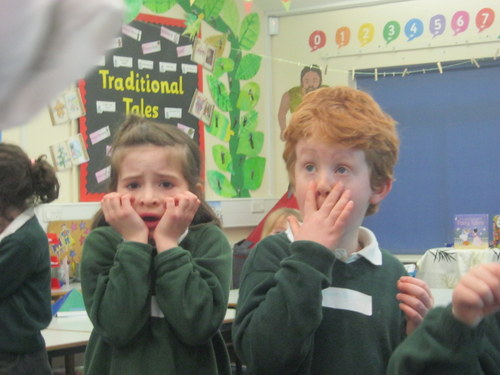
So I was approaching the end of a traditional tales session and about to tell The Billy Goats Gruff a group of Nursery and Reception children.  Now I have many props and hats that I use in my storytelling sessions but even though I’ve been telling it for years I don’t have any goat horns.  Instead I have a set of black devil horns (don’t ask).  I therefore like to play a guessing game as to the title of the story.  It’s not easy particularly when my horns are definitely more vamp than goat.

Me (to the children):  What group of three have horns that we could tell a story about?  Three Bears?  Three Pigs?  Three Blind Mice?

The children have a go even if they have no idea, making all kinds of suggestions but then a little boy puts his hand up and his answer blew me away.

Little boy: Cars.

I almost gave him a standing ovation.  It was another brilliant example of why I love telling stories to young people.  He’s clearly had the same experiences of buses as me!


You wait for ages and three come at once!

Read this and I’ll buy you some chocolate…

Recently a mother brought her child to one of my storytelling sessions.  When her boy got up and volunteered she jeered at him.  When he was embarrassed and didn’t want to do it anymore she said “I’ll buy you some sweets if you do it”.  I stopped her saying that volunteering should always be the individual’s choice but what she had done (other than mortifying him and putting everybody else off helping me) was to say to her child and the rest of the audience “sweets are better than this”.  Thanks.

This particular lady thought she was doing the right thing; she had attended the library to listen to a story – big tick.  Unfortunately though, it doesn’t follow that a love of books, reading and stories will rub off by simply turning up in a library.  When I deliver stories it’s very common for children to look around at how other people are receiving the story and judge their own response accordingly; are Mum and Dad watching? are Mum and Dad enjoying this?  You can’t hand a book to a child and say “read this and I’ll buy you some chocolate” because a carrot and stick approach is simply not appropriate when trying to nurture a child’s interest.  Libraries are undoubtedly the right place to encourage a love of reading and books but more often than not a child’s library experiences need to be positively reinforced by an adult.

It’s the same in schools.  We live in an age when many children see reading, writing and arithmetic as purely for tests and exams so, thankfully for me, schools are always looking for ways of inspiring their children.  A good author visit or storytelling day should have quite obvious and immediate short term benefits but authors and storytellers may not have the long term solutions a school is searching for.  The long term legacy of such experiences depend upon them being properly valued at the time and adequately followed up by teachers in the classroom.

I am keen for schools and the public to get the most out of what I do.  I try to encourage discussion of my visits and I try to build opportunities for further writing exercises into my session structures.  In public sessions I try to work with libraries to ensure stories are available to be borrowed and also encourage adults to engage with me on social media so that they are aware of my events in the future.  More often than not my work is about enjoyment and entertainment but by trying to inspire the adult as well as the child I hope that for some children a story becomes more than 30 minutes of fun.  A well-executed storytelling can become a doorway to a whole world of stories or a topic or who knows, a career.

We all have bad habits we can easily shake off.  It can be as simple as singing the songs at toddler rhyme time rather than using the time to check text messages or being seen to borrow and read books or just putting the book marking off and engaging with the class’s storytelling visit.  If we don’t do these things what messages are being shared?  Your learning is somebody else’s problem.  Reading is something you have to do.  I’m too busy for stories.  If we want to encourage and inspire our children we all have to raise our game.

A Jekyll and Hyde storyteller

Something is happening to me.  It’s not happened overnight but over a period of years.  I’m having a professional identity crisis; I am a Jekyll and Hyde storyteller.

Let me introduce my aliases to you.  Jekyll is subdued.  He sits on a chair and tells stories using simple props, hats and the odd sound effect.  Jekyll is the one who presents trios of stories to reception classes and spooky stories at public events.  Jekyll looks and behaves like a stereotypical storyteller (if such a thing even exists).  Hyde on the other hand is manic.  He loves a crowd and is instinctively theatrical.  Hyde likes knockabout fun with volunteers and chucks buckets of water for any given reason.  Don’t get me wrong my Jekyll and Hyde’s are both great but the conundrum increasingly is that if people turn up to see one and get the other will they be disappointed by the presentation they get?

I feel that I’m at my best when I get material which allows me to use all of my abilities.  For me it’s about striking a balance between knockabout routines and visual humour and using words to paint pictures for an audience so that they can close their eyes and just imagine it.  I’m the Toyota Yaris of storytelling; neither wholly one thing nor the other.  I sit on a stylistic fence and that can be a real drag.  For years I have struggled to describe my own work when pushed by friends and family.  These days I often need people to sell my work in order to generate audiences and defying categorisation is tricky.

In the end though, being a bit different is mostly brilliant.  You see children enjoy my different.  My different exposes them to stories and encourages listening and positive participation.  My different is fun and creates lasting memories (I meet children who remind me who they were in a story or that I squirted them with water two years ago).  Storytellers might call me an actor, actors might call me a children’s entertainer and teachers might call me Mr Kirk but I hope the children I meet remember that in the end I’m just John.

To everybody else out there who finds that they are a bit of a Jekyll and Hyde, have a happy Halloween!

I’m pretty busy this October half term..

I’m pretty busy this half term.  Come and see me in action.
Friday

My #librariesweek

Its National Libraries Week in the United Kingdom, a celebration of everything that’s great and glorious about public libraries and what they offer.  There have been countless events, talks and activities being hosted the length and breadth of the country and library authorities seem to have gone all out to demonstrate their value within the communities they serve.

I have got involved too as the #100mphdog has become the 100 mile dog with visits to Stoke on Trent, Bolton and Nottinghamshire as well as spending some time as a visitor to Telford Libraries ahead of my appearance at the Wellington Arts Festival 2017 (one of the largest free literary festivals in Britain).

As I type this its just gone 7am on Saturday morning and I’m en route to Bolton.  Tomorrow my day will be taken up with getting to and from Mansfield.  This morning the train is pretty busy and I’ve got a carton of orange juice, my lap top and a load of football fans for company.  I may be working all weekend away from Lauren and Verity but it’ll be worth it; Bolton are one of my favourite authorities to work with and the library team in Nottinghamshire are a lot of fun.  This weekend we’re not only celebrating #librariesweek but the Summer Reading Challenge as children and their families collect their certificates at ceremonies laid on by the library and I provide the entertainment.  I did a celebration event a few weeks back in Bromley and was struck by how much meeting the mayor meant to the children and their families.

I have probably said it in this blog before but its a real privilege to share stories in wonderful library spaces.  In recent weeks we have begun taking Verity along to rhyme time sessions and borrowing books with her.  She enjoys being in the library and literally eats books.  This year I celebrated 5 years of work with libraries.  What started with a handful of London’s libraries has expanded beyond my wildest expectations but I still love visiting new libraries and communities.  Whenever I work with a library they give me a platform to tell a story; it might entertain, inspire or challenge a young person and that’s brilliant on so many levels.  There’s a lot of satisfaction in knowing that the library believe in you and these days its affirming to see familiar faces in library audiences.  In Stoke on Trent we did two presentations; at Hanley and Stoke libraries.  I have been telling Jeremy Strong’s “The Hundred Mile an Hour Dog” since June; sometimes its the 5mph dog but so far this week its been the 110mph Dog.  One teacher even remarked that it had been worth filling in the risk assessment to see it!

Next week it won’t be libraries week and all the verve and vibrancy that has crammed my social media timelines will subside but library life will continue and it won’t be long before there’s another big event and libraries will pull out all the stops again.  As for myself I will be working hard to ensure that I can work with libraries in the very near future and that the events I offer continue to be of a standard and quality that these fine institutions deserve.


2017:the summer that zipped by at 100mph

So the six week holidays are coming to an end and another Summer Reading Challenge is drawing to its conclusion.  Once again thousands of young people have participated as readers and volunteers in libraries across Britain and once again I have played my small part in launching, enhancing and celebrating the challenge through storytelling.

This year my major project was Jeremy Strong’s “The Hundred Mile an Hour Dog”, a silly story about one boy’s efforts to train his chaotic pet.  I first presented the story in libraries in June and by the end of the summer between myself and Dan McGarry will have presented it over 80 times to just over 2500 people.  I have also been presenting Rudyard Kipling’s Just So Stories.

I have had a very good summer and a lot of people have said a lot of very nice things about my work (I’ve met lots of lovely people, worked in a couple of new areas and for the first time I have been receiving reviews on Facebook).  This has been very flattering but I feel it’s really me that needs to thank people for their contributions to what must be classed as a successful project.

Lauren and Verity – I love you both and I’m looking forward to a family holiday; you deserve it.

Jeremy Strong and David Higham Associates – the author of this fantastically silly story and his agents has been a very active supporters of the project and their encouragement and flexibility has been important.

Dan McGarry – I can’t take credit for all the presentations.  In Northamptonshire sessions were delivered at all but two libraries and Dan brought his unique twist to the presentation of the story.

Joseph Attenborough – this is the fourth project where Joey supplied an original soundtrack for me to work with.  Whilst some would say music is unnecessary I say the music is a vital contribution, setting the tone of the story and the atmosphere at key moments.

Dan White – another valued contributor, Dan’s image of Streaker at full speed has appeared in libraries across the country (at one stage it dominated my twitter timeline almostly entirely!) and has really helped to attract an audience to the project.

The Libraries – we can have the best project ever but without library staff support nobody would come.  This year more than any other it has become clear just how crucial good library staff and their relationship with service users is in building a suitable audience for events.  I have discussed advertising in this blog before and once again word of mouth proved the best way of drawing a crowd.

The service users – my style of storytelling relies upon interaction and participation (if you come to my event I’m going to spray you with water and stick a silly wig on your head).  It has been brilliant to see young people at my events up and down the country willing to get involved in my madness with good humour.  It has also been great to see so many people who I met in 2016 whilst doing Roald Dahl’s “The Twits” returning to hear about Streaker.  As one storyteller said to me, this is the ultimate compliment.

One of the privileges and pleasures of this year’s Reading Challenge for me has been talking to people about stories and books and recommending new and old stories to children.  It is quite easy to become consumed by the logistics of delivering events at multiple venues (believe me, it’s a mammoth task) and lose sight of what it’s all about; the pleasure of reading.

I’m not going to lie, there have been mornings when my body has told me that I’m no longer in my twenties and there have been late nights when I have felt desperately guilty for leaving Lauren literally holding the baby but I have enjoyed it and have already started work on next year’s challenge.

For now though I’m preparing for the new school year.  I do have some more reading challenge dates into the autumn and then some more public appearances into the winter including a couple of small festivals.  Keep an eye on my website and I’ll look forward to continuing to share my work and any developments with you here soon.   For now though, Streaker and I are off to pick out a sun lounger on a Spanish beach!

Mammoths to Medals (Revisited)

John Kirk specialises in drama workshops and theatre for young people.In 2013 I moved from the London borough of Hackney to the London Borough of Waltham Forest.  I may have only moved seven short miles but after six happy years in one of the most vibrant boroughs in Britain it was a massive wrench.  Whilst living in Hackney I had some of the most creatively fulfilling years of my life as I built strong working relationships with organisations including The Hackney Museum.  Hackney Museum, based in Hackney Central Library is an amazing community resource staffed by knowledgeable and creative people with a passion for sharing local history.  I may be biased but I think its one of the best museums in the country.

Working in heritage environments is something I really enjoy.  My earliest solo storytelling pieces were based around British history (including a Victorian Classroom session for The Bruce Castle Museum) and this summer I will be helping to lead a creative exploration of the Guilden Morden fire.

Anyway, as I sat watching Lizzy Yarnold, Jade Etherington and Team GB at the Sochi Winter and Paralympic Games I couldn’t help but think back to my time working with Hackney Museum.  It was in the build up to Summer Olympic and Paralympics (London 2012) that I collaborated with Hackney Museum on Mammoths to Medals,a presentation which sought to tell the incredible story of Hackney’s history as part of the Museum’s Mapping the Change project.  In just 30 minutes we explored 200,000 years of Hackney’s history highlighting the contributions of those people who have called Hackney their home; Anglo Saxon Farmers, Tudor Society, Victorian Industrialists and migrants from across the globe.

In the life of the project I have presented the piece on many occasions at Hackney Museum and in Hackney Primary Schools.  Incorporating games and learning activities into a chronological narrative the piece offer facts about Hackney and but also it questions how we will be remembered.

John Kirk is a storyteller and drama facilitator specialising in drama workshops and theatre for young people.A lot has changed in the two years since we made the piece was documented at Kingsmead Primary School.  Hackney’s demographic and landscape have been slowly morphing for 200,000 years but concerns about how communities will withstand the gentrification of East London mean our legacy is once again scrutinised.

When we look at Hackney’s story it shows us that change doesn’t have to be a bad thing.  It points to how different traditions, cultures and values have shaped an area into a place people want to live and work.   I am incredibly proud of being a part of Hackney’s history and of this piece.  I hope that through watching Mammoths to Medals young people recognise how they can shape their community.

Thankfully I haven’t lost touch with Hackney Museum and hope to be back to run sessions as the country prepares to commemorate The Great War.  For the moment though I am very settled in Waltham Forest and I’m looking forward to the future.

What’s your Story? A Simple Storytelling Game

John Kirk is a storyteller and drama facilitator specialising in drama workshops and theatre for young people.As human beings have evolved we have developed an introspective (thoughtful) nature.  The ways in which we try to answer the bigger questions in our world is fascinating.  We have turned our minds to the sophistication of technology, we seek truth in theology and spiritual enlightenment but we also tell stories (what are fables and parables if they are not attempts to better understand our own nature and environment?).  Whether you are conscious of it or not, you fill your lives with stories and the ability to exchange stories is a big part of being human.  We fill our lives with narrative and take our turn at playing orator and audience.  Some stories we will tell are significant and some less so but I believe that storytelling is about more than art and communication, storytelling helps to define us.

When I work with a group I do so understanding that even the youngest participant has some notion of a story.  I doubt there is anybody in the world who doesn’t have a story to tell or cannot tell a story.  The work that I do concerns articulating that story better and helping participants to understand the mechanics of their narrative.

To demonstrate this I’d like you, the reader to play a game.  This will hopefully show you that a) everybody has a story to tell and b) everybody can tell a story.  Depending where you are reading this you may want to think about it for a little while, write your answer down or even share your answers over a dinner with friends and family.  My exercise is essentially a parlour game that I often use in workshops with young people and adults as an icebreaker but in this context we are using it to encourage open, honest introspective thinking about identity.  Please read the exercise and rather than saying “I have no idea” say “that’s tricky, let me think about that”.  I hope that you feel able to participate in the game and remember: we’re doing this on the internet – nobody is judging you.

John Kirk specialises in drama workshops and theatre for young people.“Think of one thing that most people know about you and one thing that less people know about you.”

Nobody is saying that telling a story is easy but these stories are about you.  You only share as much as is comfortable.  Don’t worry if the answer you have given seems more like a statement at the moment.  If I were in the room with you and you had given me a very short answer I would probe you with further questions.  Let’s pretend I’ve done that and tell me your stories.

Examples:

One thing most people know about me…

Short answer: I am a football nut.

Story:  I was raised on Manchester United before rejecting them for Wimbledon Football Club.  I was there for the sit ins at Selhurst Park when Wimbledon Football Club became Milton Keynes Dons.  Between 2002 and 2006 I visited the 92 football clubs that make up the football league.  Having moved to North London these days I will only turn Match of the Day on if either Arsenal or Manchester United have played.

One thing less people know about me…

Short answer: I have Burmese heritage.

John Kirk specialises in drama workshops and theatre for young people.Story: My Grandmother was born in Kalaw in the 1920s.  During the Second World War she met my Grandfather and once the war was over she left Burma and moved to the North West of England.  Opposition to the ruling military junta meant that until quite recently visitng Burma was out of the question.  In 2013 my Father, Uncle, Brother and I with our respective partners visited Kalaw and the Convent where my Grandmother was educated.

Storytelling is as much about listening and responding as it is about telling a story.  In each of my stories there are points of intrigue and potential common experiences which might draw further stories from the orator (doing the 92, a trip to Burma) or even draw stories from the audience (a love of sport, migration, family holidays etc).  If that’s the case with you don’t deny your audience a good story or a great conversation.

I hope you enjoy this little game and I hope it proves that we all have a story to tell – happy storytelling!

http://youtu.be/Wk_n2ustc4U

A Story? Really? A blog about managing innocence in storytelling

John Kirk is a storyteller and drama facilitator specialising in drama workshops and theatre for young people.As a storyteller I rely upon two presentation models: narrating events and being the character.  My relationship with the audience will change depending how I present the story.  If I am narrating events I inform the audience of our relationship.  I allow them to understand that the story and its events are a fiction and that they are watching a presentation.  I do this by introducing myself, talking about the story and clearly demonstrating different characters.  When I become a character my audience must do much more of the work themselves.

“So what?”, I hear you cry.  Well, when I present a session as a Victorian School Teacher the participants are briefly starring in a drama devised to expose them to the way education might have been in the 19th Century.  If the participants don’t respect the threat of caning then the session is less effective.  Equally, when I present a Detective investigating a crime the participants must be convinced that the scenario is credible.  A lack of investment in the world of the story can be a session’s undoing.

John Kirk specialises in drama workshops and theatre for young people.Cynicism can bedevil creativity as we grow up and the examples above relate to characters and sessions devised for pre-teens but what about when we are very young?  What are the dangers of investing too heavily in stories?  Can there be any harm in believing that you just met the Gruffalo?  I suppose that very much depends on the experience.  For a young child, meeting a creature with terrible tusks, terrible claws and terrible teeth in terrible jaws etc. will either be the best or worst day of their life.

Clearly telling a very young participant that what is happening (or about to happen) isn’t real can impact their experience.  You could go as far as to say that intentionally breaking the illusion robs them of an innocent experience.  There is unquestionable security in the truth and I think it is the storyteller’s responsibility to offer that security through the narrative by ensuring audiences see that the wicked get there just desserts.  If the participant absolutely believes is this more memorable or just confusing?  Is Miss Trunchbull scary if you know its an act or is the Mad Hatter as wonderful if you know its in some way false?  How a situation is managed will hinge on lots of factors including the sensitivity of the participant and the circumstances and legacy of the meeting.

From my point of view it isn’t easy to maintain the reality of being a character rather than a person for an extended period of time.  It can involve a lot of planning with a school or organisation ahead of the day.  Trying to think like a character at all times and allowing everybody to believe you are a character can be exhausting (once I spent an entire day in a Headteacher’s study in role pretending to work at her desk!).  I have however found that the legacy of this approach is huge and the feedback on such sessions is generally very positive.

John Kirk specialises in drama workshops and theatre for young people.“When you came in to work with the children during world book week, they were completely gripped!  The story narrative you came up with to engage the children was phenomenal, the children completely believed the 3 Little Pigs had been eaten!  You stayed in role all day and as a result the children played along too, the quality of writing and language we got from them was fantastic.   I have no doubt in my mind that we would use you again… as we are still talking about it a year later!!” (Teacher, St Wulstans and St Edmunds Primary School, Fleetwood)

I suppose that to some extent the purpose of the story will determine whether the participants are allowed to believe in the character.  After presenting the Victorian Classroom I will appear to participants as myself and discuss their experiences.  This is partly to assure groups that the monstrous school master is imaginary but also so that the group can articulate how my lesson and their lessons compare.

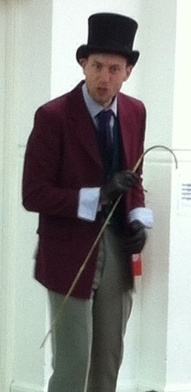
John Kirk is a storyteller and drama facilitator specialising in drama workshops and theatre for young people.The real world can be a hard place and sometimes we grow up too fast.  Its a sad day when a child becomes inhibited by doubt.  I was recently at a school and a little girl took me to one side and asked whether I really was Willy Wonka.  I told her that in life we can choose to believe or we can choose not to believe but that decision was ultimately hers.  She skipped away satisfied with my answer, having just chatted with the world’s greatest chocolate maker!

There are times when I wish I was a little more innocent.  As an adult and a storyteller I have an important role to play in maintaining the innocence of my youngest audiences for as long as possible.

The Merits of a Narrative Poem

John Kirk specialises in drama workshops and theatre for young people.When I was younger I didn’t think that I liked poetry.  Outside Shakespeare I rarely read verse for pleasure.  Last year though, I was introduced to Alfred Noyes’ “The Highwayman” and it changed my view of poetry completely.  Since then I have been reading other narrative poems including the “The Ballad of the Fleet” (Tennyson) and “The Walrus and the Carpenter” (Carroll) and incorporating them into my work.

A narrative poem tells us a story but it is set out in stanzas with the rhythms and rhyming patterns familiar in other types of poem.  It will contain a skilfully woven story packed with wonderful imagery and metaphors which compels its audience.

In my opinion the narrative poem offers so much that I have even used them in pieces for Birthday Parties!  Here are what I see as the merits of working with narrative poetry.

The narrative poem is perhaps one of the most ancient form of storytelling (The Iliad and Beowulf are both story poems).  As a Drama Facilitator I believe they are a fantastic way of introducing complex text to young audiences which demonstrates the breadth and depth of our literary heritage beyond Shakespeare.

It offers a whole story.  A chapter of a book or a scene from a play wouldn’t offer the beginning middle and end in this way.  If I want to guarantee that a group have heard the material a narrative poem is a concise way of quickly offering an entire story.

The narrative poem will capture the imaginations of boys and girls as it often recalls and romanticises some kind of adventure.

John Kirk is a storyteller and drama facilitator specialising in drama workshops and theatre for young people.Investigating narrative poetry through drama is a lot of fun and once a group has a story they are better positioned to explore the author’s imagery and language choices.  The poems I am talking about were mostly written in the 19th and 20th Century and whilst the language is certainly complex it is not impenetrable.  Accessing it allows young  participants to make their own judgements about themes, events and characters (perhaps physically characterising or hot seating characters about their decisions in the story or making up scenes based upon their deductions).

I have also found that exploring a narrative poem can become a catalyst for exploring rhythm, rhyme and meter and getting groups to write in poetry.

_ _ _ _

“The wind was a rushing train, dodging every tree

The moon was a shiny banana ripe and ready for me.

The road was a lonely wanderer, under an ongoing spell

and Mr Highwayman came riding, riding, riding

Josh Highwayman came riding, up to the Grand Hotel.”

_ _ _ _

“The snow was a breeze of coldness coating the leafy bush,

The sun was a ball of fire, gleaming upon rushing waves

The field was a soft green carpet, over the earthy road

And the Highwayman came skating, skating, skating

The Highwayman came skating up to the big mansion’s door.”

_ _ _ _

As well as getting excited about narrative poetry I have discovered narrative songs.  My taste in story song is eclectic ranging from Benny Hill (The Fastest Milkman in the West) to Charles Daniels (The Devil Went Down to Georgia) and Chris Wood (Hollow Point).  You could easily laugh some narrative songs off as being novelties but constructing an effective narrative within a poem or a song is a great skill.  Tennyson and Noyes might not be matched for their poetry’s beautiful imagery  but Hollow Point particularly is (in my view) a powerful piece of modern verse based storytelling.

Up to now narrative poems have formed the basis of workshops or featured within other work that I have presented but this summer to coincide with The Summer Reading Challenge 2014 I am taking my new found love of the narrative poem to a whole new level as I reinterpret Homer’s “Odyssey” for a young audience.

My final reinterpretation is unlikely to be a narrative poem but one thing is certain – it’s going to be epic!

Special thanks to the children of South Malling Primary School for sharing their “modern” takes on “The Highwayman”.