Tag Archives: primary school

Do Mr and Mrs Twit love each other?

After telling children Roald Dahl’s “The Twits” I enjoy posing the following question about the story:

Do Mr and Mrs Twit love each other?

The children are never in doubt; Mr and Mrs Twit do not love each other.  If you push them on this opinion they say things like “because they are nasty to each other” and “because they play tricks on each other”.  I understand the basis of this argument but happen to believe the Twits actually love each other.  Let me explain why..

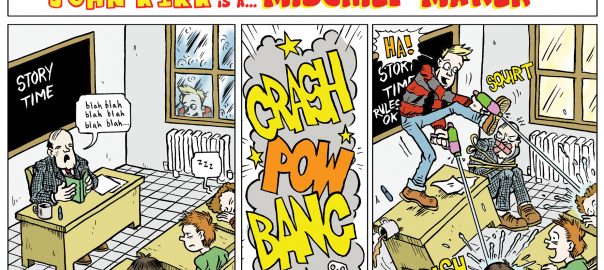
In many of my most popular storytelling sessions (Roald Dahl’s The Twits, Jeremy Strong’s The Hundred Mile an Hour Dog and Nigel Auchterlounie’s  Dennis and the Chamber of Mischief) I use water pistols to spray the audience.  I don’t mean that I use them to gently flutter a few droplets of water in the vague direction of the audience I mean I use water pistols to quite literally drench the audience.  When outraged children ask me why I do this I point out (and they agree) that they enjoyed getting wet.  You see it’s all about the context of the soaking; if I walked up to a stranger in the street and threw a bucket of water over their head they’d be justifiably irked.  My audiences are rarely upset at getting wet.  This is partly because I’ll have forewarned them that water will be a part of the presentation but mostly because the soaking I dish out makes some degree of sense in the context of the story.

What’s this got to do with Mr and Mrs Twit?

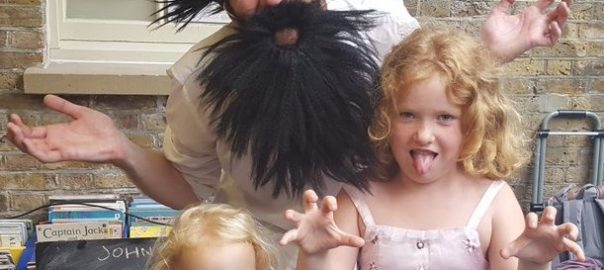
Mr and Mrs Twit are vile, disgusting, revolting people.  Mr Twit has a filthy beard, Mrs Twit has a glass eye and they both have a wicked sense of humour.  In the first part of the story we learn how Mrs Twit put a glass eyeball in Mr Twit’s drink and worms and his spaghetti and that in return Mr Twit put a frog in Mrs Twit’s bed and made his wife believe that she was shrinking.  You could say that these cruel tricks demonstrate that they detest each other.  I say it shows why they are compatible.  Yes, the jokes are extreme but rather than causing the victim to run away they provoke a sort of brinksmanship as Mr and Mrs Twit try to better the previous plot.  You might say that this to do with a desire for revenge or that the Twits are trying to kill each other but I’m not convinced.  Their treatment of the monkeys and the birds show that Mr and Mrs Twit are capable of much darker, much more devious deeds and that if they wanted to kill they’d have done it already as murder is clearly within their power.  Then there’s the fact that despite their revolting trickery they are willing to work together with a common awful purpose at the drop of a hat.  Like my audiences who enjoy getting squirted with a water pistol in the context of a storytelling session I believe the Twits thoroughly enjoying playing tricks on each other.  It may seem bizarre but Mr and Mrs Twit seem prepared to be the butt of the other’s cruelty in the context of their own private game so much so that it’s difficult to say when the mark is overstepped (does Mr Twit go too far when he has his second nasty idea?).  In my view the reason the Twits keep coming back for more is that they don’t just love each other they depend on each other.  I therefore wonder if Mr and Mrs Twit find some perverse satisfaction in the fact they share the same grizzly fate?

When I approached the story I wanted to make the complexity of Mr and Mrs Twit’s twisted relationship as clear as possible.  As well as revelling in the Twit’s tricks, in my retelling composer Joseph Attenborough reflects  their shared joy of being utterly horrible by devising a series of snatches of laughter; Mr Twit, Mrs Twit and finally both the Twits laughing.  It’s the briefest of acknowledgements but it is there and now you know to look out for it hopefully you’ll hear it the next time I tell the tale.

My licence to tell Roald Dahl’s “The Twits” in primary schools, libraries and at events was recently reviewed and extended.  To find out more about this and other projects contact me.
 

The genius of Justin’s House

Since Verity was born what appears on our television has changed dramatically.  Where in the old days we might have found time to watch a drama series these days we watch Cbeebies.

Verity may only be 17 months old but she has her favourite programmes.  Her absolute favourite is In the Night Garden.  From the moment it goes on she is captivated.  She’ll talk to the characters and dance along with Upsy Daisy and Maka Paka.  We recently took her to the stage show and I’ll admit to having wept with pure joy at seeing how much she enjoyed herself.  After the show she got to meet her hero, Iggle Piggle.  She was enraptured.

She is also into Justin’s House.  Justin’s House, for those of you who aren’t seasoned watchers of children’s television is stars Justin Fletcher (aka Mr Tumble).  It’s set in a house in Justin Town where he and his friends, Robert the Robot and the Little Monster, enjoy singing and dancing and have all kinds of fun.

The two shows I have mentioned share a number of features.  Firstly they are uber colourful.  Then there’s the fact the episodes are structured so that if you watched the series you’d become familiar with the routine.  Both programmes have very catchy music with songs being used to introduce characters, deepening the sense of familiarity.  Finally episode plots tend to be very gentle, warm and simple.  They talk about feelings, friendship and fun.  They are definitely not the stuff of Albert Square!

Where Justin’s House is different to In the Night Garden is that Justin Fletcher has devised a slapstick stage show.  Slapstick is visual, physical comedy relying on well-rehearsed routines and sequences for laughs.  It’s easy to dismiss slapstick as an easy or base art form but children really enjoy watching people fall over, bump into each other or getting a pie in the face.  My earliest storytelling sessions were far more theatrical in their nature and my versions of The Unlucky Mummy and Dracula were crammed with slapstick gags which were always very popular with audiences.  Even now I use a lot of water pistols in my work because, in the end, who doesn’t think it’s a little bit funny to see someone get squirted in the ear?

The slapstick in Justin’s House is very slick and perfectly pitched but for me the genius of the show is to put it in front of a live audience.  The audience act like a character, joining in with songs, answering questions and responding to the unfolding story.  The audience’s role is recognised by the director who regularly cuts to the audience so the viewer can see facial expressions.  Justin also acknowledges the audience.  In the song Justin’s House, he sings about the audience saying “you’re funny and sunny, put a smile on my face, you’re brilliant, you really are great!”.  He’s right to be grateful because without the audience the whole programme would have a very different rhythm and feel quite flat or awkward.

So what can a storyteller learn from Justin Fletcher?

Be colourful – when selecting props and visual aids make sure they are bright and colourful.  I use a lot of wigs, hats and props in my storytellings and use voices and physical motifs to enhance my stories.

Have a structure – children find security in familiarity whether it be a daily routine or a storytelling.  If you are running regular sessions a format will help your group become more comfortable and more willing participants.  When I run a session as a one off I’ll explain the rules of the session before I start in order to hype them up and manage expectations; so sometimes when I do global tale sessions the children get to vote on the stories they’ll hear or if I want volunteers they’ll understand how they are going to be selected.

Use music and song – consider enhancing your set with sound.  If you can, find ways of getting the children involved in creating the sound (maybe a sing-a-long).  I don’t play any instrument to a particular standard but will incorporate recorded music, live sound effects and singing where it’s appropriate.  Sometimes creating a sound effect can be just as intriguing for an audience the story!

Consider your content – I do a lot of work for 6+ year olds.  Stories like Dennis and the Chamber of Mischief or The Hundred Mile an Hour Dog invariably include a lot of participation and a water pistol (see above).  My sessions for under-fives are much more gentle.

Get on with and enrapture your audience – in every storytelling session rapport and communion with the audience is crucial.  If you can create a lively positive environment then hopefully everybody will have a good time!  It’s easier to work with a crowd than against them.

Undoubtedly Justin Fletcher is an excellent professional who has developed very strong formats and material and clearly understands how to entertain children.  You can argue the rights and wrongs of watching television but it’d be an error to write children’s television off for it’s content and delivery – these are well made, clever productions that anybody who might like to work with children can learn from watching.  Besides if Iggle Piggle and Justin Fletcher offer Verity some light hearted fun and it makes her happy then that makes me happy too.

A “Twit” update

Just a quick update.

A couple of months ago I posted this – A storyteller in search of a story in which I explained that I had lost the right to tell The Twits and that October would see Mr Twit’s last outing.  Well that’s no longer true.  You see Mr Twit has been reprieved by the Roald Dahl Estate and I am taking bookings for the next academic year.  This is quite obviously fantastic and quite unexpected news.  Over the coming months I will still be shaking up my repertoire and if you are a published author, writer’s agent or international publishing house I am still very much in the market for my next challenge but for now the urgency to do so isn’t quite so great.  Thanks to everybody who sent messages of support, they were all read and appreciated.

Now back to Dennis and the Chamber of Mischief…

The heat is on: storytelling and the British weather

Britain is a country that sometimes experiences all four seasons in one day.  You’d think that the weather is something which happens outdoors and as we’re basically an indoor nation for all but a few weeks of the year it couldn’t possibly be that big a factor on storytellers.  Well that’s true unless you happen to be doing an outdoor event or the majority of your work is in old public buildings like schools, museums and libraries.  A Carnegie Library may look beautiful but they can be quite drafty, a school hall of the 1960s or 70s may seat a lot of children but I’ve known them to be like greenhouses have the radiators blasting out in July and whilst it’s fun to tell stories in museums and stately homes curators can be curiously aquaphobic!

During the cold snap of all cold snaps back in March 2018 the weather posed me a range of problems.  First there was getting to the jobs.  Driving conditions were treacherous and in recent months British railways have been, shall we say “unpredictable,” so when the snow arrived for a while it was Russian roulette as to whether you would complete a journey.  Then there are the audiences; I get quite warm when I work so a chill in the air doesn’t bother me too much but if you have to sit on the floor for up to an hour, sometimes in wet clothes because you had a snowball fight at break or you walked through the snow to the venue, a draft can test the concentration of anybody.  During March’s extreme weather conditions some schools closed whilst I was on site.  I started one session with 45 children and finished up with just 8 children as the weather in the area around the school I was working in worsened.

It’s now July.  “The Beast from the East” is a distant memory and Britain is experiencing a heat wave.  The trains are still “unpredictable” but their reliability is no longer my only gripe.  Good weather can mean some trains, particularly the London Underground, become stiflingly hot and disgustingly uncomfortable.  As for my audiences well if cold weather wasn’t good for concentration heat is no better.  My audiences are a sweltering sea of shuffling, sweaty children.  Luckily for them I always incorporate a water pistol somewhere in my summer storytellings (although I’m  sure how a hose pipe ban would affect this – fingers crossed it doesn’t).

Whatever the weather the show must go on and I must look after myself.  In winter this means wrapping up and taking steps to avoid illness (ie being sure to eat enough fruit and vegetables and getting enough rest).  Dressing appropriately and living well is just as important in the summer time but as the temperatures rise it’s more important than ever that I drink water.

I understand my body better than when I first started working; I know that in the autumn I’ll have a cold and in the spring I’ll have hay fever both of which affect the quality of my voice.  I know that whilst March and then June-September when I am in demand I have to manage my workload, December will be a time to recover.  Last March I developed tonsillitis.  Whether this was down to work I’ll never truly know but undoubtedly it was a factor.

This blog may seem like I’m complaining about all forms of weather as only the British know how and I suppose I am but actually there’s a lot to be said for British weather too.  Each new season has its own identity and festivities which demand a different set of stories.  Then of course there are countless stories which are inspired by the weather and the seasons which I could not do without.  I can’t say that I ever miss the winter months.  It’s nice to watch the sunrise from a railway carriage but it’s even to be out and about in the early morning gloaming when it seems you have the world to yourself and the summer is stretching out in front of you.  So whether I’m dragging my suitcase through snow drifts, getting soaked to the skin in torrential rain or frazzled in 30 plus degree heat if there’s a story to be told I’m glad to be the one to be telling it.

The visual language of storytelling

In another life it was my luck to be able to work in schools in Italy and Spain as an actor and English coach.  This was an opportunity to see cities I had never visited like Granada and Venice but it also lead to an alternative way of working with an audience.  You see for most of the people we performed to English wasn’t their native tongue which was a huge disadvantage in terms of following the story.  To be understood the cast had to learn a sort of visual language.  It felt very strange to a young actor only a few years out of college to be virtually signalling the audience but it seemed to work.  As I’m writing this I remember some of the ridiculous conversations in the rehearsals about classical acting; in the breaks actors would talk about subtext and character objectives then go back to waving their lines!  I knew then as well as I know now that what we were engaged in would have Stanislavski doing backflips in his grave but we were there to serve our audience and that was all that really mattered.

Flash forward to today and my experiences on these European tours have been very useful in my storytelling work at home.  Every week I meet lots of young people for whom English is a second language and for some, they are quite new to learning it.  English is pretty complicated and we have lots of ways to say similar things that can be quite baffling.  Imagine you are not only unfamiliar with the language but the content too and one of my sessions is starting to look very alien.  If I don’t offer more clues to aid my audiences understanding a story could be overwhelming.

As I devise my flagship stories (The Twits, The Hundred Mile an Hour Dog, Dennis and the Chamber of Secrets) I consider a series of physical phrases which can be easily repeated to go with certain words and images.  Makaton or British Sign Language it isn’t but, like in Italy and Spain all those years ago, a visual language is necessary to act as a framework for my audience or all of my words and imagery will be for nothing.  An advantage of working in this way is that it’s a lot easier for me to remember a word or phrase if it’s linked to a gesture than it would be otherwise.  Sometimes when I am in the groove it can be like remembering a dance as much as a narrative.  It’s a very active way of working and popular with primary schools thanks to a scheme devised by Pie Corbett called “Talk for Writing” which encourages learners to use pictures and actions to recall and create stories.  This means that for many schools my delivery of stories seems to consolidate their literacy work.

I don’t just rely on hand gestures.  Most of my stories include lots of volunteers, participation, games, props, costumes, music and silliness.  In a Shakespeare session where even native English speakers would struggle I approach the stories in a fun and easily accessible way.  If I’m delivering traditional tales for pre-school and foundation age children I’ll use a lot of repeated language and actions, as well as rhythm and rhyme to encourage vocabulary.  When I tell more complex stories to older audiences the quality of my voice, my use of pace, pausing and power communicates almost as much as my actual words.  Big and visual works for children at home and abroad (the UAE loved The Mad Hatter’s Tea Party! because it was colourful and chaotic) and working overseas and with language schools in the UK is certainly something I’d like to do more of in the future.

There are those that would say that what I do isn’t storytelling and that telling a story should be a sedentary activity.  I would say that I serve my young audiences, offering fun, inspiring and most of all accessible sessions.  I like to think I’m taking an aural experience and making it into something visual.  If it sounds different then maybe you should come and have watch/listen.

For a list of forthcoming events please visit my calendar or if you’d like to make a further enquiry contact me.

A storyteller in search of a story

—

Aspects of this blog are superseded by A Twit Update and My adventure with Dennis continues!

—

So this week it has been confirmed that I can no longer offer Roald Dahl’s “The Twits”.  It’s a sad day but not totally unexpected.  Over the last two years I have presented this marvellous tale on almost 200 occasions across England and then in Wales, Scotland, the Channel Islands, Germany and the United Arab Emirates.  It been the most wonderful period and I’ll always be thankful for the opportunities my brief association with the Roald Dahl Estate created.  I will miss sharing what I consider to be a terrific story.

Knowing when to archive a story is as much a part of the creative process as developing the project in the first place.  Telling stories is a lot of fun but the bottom line is that a storyteller is a small business and once a client has seen your entire repertoire the opportunity for a future booking is greatly reduced.  Changing up material helps a storyteller’s repertoire remain fresh and the teller themselves remain energised but it can mean making some tough decisions about old or “well loved” material.

Over the years I have mothballed many projects for many different reasons.  Some decisions were forced upon me because of licencing issues (Private Peaceful and The Twits).  Some stories were very enjoyable to deliver but I found that my style had evolved in a different direction (The Mad Hatters Tea Party!, Dracula and the Unlucky Mummy).  Some stories were shelved because of a lack of demand or, in very rare cases, because what I did with them wasn’t very good.  In some cases when it hasn’t worked or I have been sick to the back teeth of a story I’ve managed to salvage something by finding it a new lease of life.  I don’t mind admitting that I didn’t like Anansi the Spider and the Stories of the World until I significantly altered the way I was telling it so that I was more comfortable with the material and it now sits amongst my favourite projects.  Generally though, if no one’s laughing anymore and the applause is polite rather than enthusiastic it’s probably time to let a story go.  After almost 200 presentations, as much as I love telling The Twits, I think the project has reached and exceeded its end point.

So what next?

My current project Dennis and the Chamber of Mischief will occupy me into the autumn but I am already aware that Beano Studios have another party interested in the book so I have no plans to make it available for schools presentations.  Instead I have been working up two new projects; Band of Brothers: the story of three Lions, which explores The Great War through the stories of three young men who fought it and It’s all Greek to Me!, in which I delve into some of the stories of Greek Mythology’s heroes.  I’m also toying with the idea of bringing Beowulf Sleeps back into my repertoire.  This was a project I did for a school three years ago.  I didn’t take it further at the time because it was at odds with the way I was then telling stories.  This autumn, as I move in a more traditional storytelling direction, I feel that it would sit nicely within my revamped repertoire.  I will of course continue to offer my usual array of folk and fairy tales, myths, legends and Shakespeare but beyond that I am really looking for the next challenge.  What that will be is a mystery right now but I hope that a famous author or publisher will have taken notice of what I do and offer me a title I simply can’t refuse but I’m not holding my breath!  In the meantime I can look forward to Mr Twit’s farewell party to be hosted on Saturday the 20th October 2018 as I take part in one final reading festival in Grantham being hosted by The National Trust.  When one door closes…

Bring on the mischief #dennis2018

Its been a crazy week in which Dennis and the Chamber of Mischief has moved on a bit.  As discussed, months of sitting on a laptop, thinking a story is now transistioning into presenting said story in libraries and that process has not been plain sailing.

My first stop was in Northampton where I worked through the material with Dan McGarry.  We did this last year with The Hundred Mile an Hour Dog but this year we’ve both been so busy the get together is happening in the same week as the test event.  While last year I had told the story at home prior to seeing Dan, this was more or less the first time through Dennis in front of anybody else.  It feels clunky and clumsy and it lacks the dynamism I crave but that I know will come in time.  It is full of stops and starts but we get through the whole thing.  Dan has a few pointers and then has a go himself.  Watching him go through the story lets me think about how I would do it if I were asked to the story.

The second hurdle of the week is the test audience.  I head to Woolwich Library to tell the story to a proper audience and at the end they offer their feedback.  This criticism is generally invaluable and will help me to shape the piece.  Yesterday’s rehearsal was ropey but I am not worried.  Storytelling is about finding a balance between an agreed structure and instinctively responding to the live scenario.  Besides previous test audiences have been very positive about my projects.  What can possibly go wrong?  Well, the Woolwich test audience don’t hate the story but they don’t love it either.  They make valid points about the clarity of the delivery, the opportunity to participate and the music.  As awkward as it maybe for me to hear this I must take on board very quickly because I have presentations the following day.

24 hours later.

The day after the underwhelming test event I am scheduled to do two presentations in Islington.  After the first one I asked the audience their thoughts on the story and half the audience love it.  Phew, what a turnaround.  So what’s changed in 24 hours?  Well, on the advice of the test audience I have made further edits to simplify the story.  I have tinkered with the soundtrack, built in more audience participation and I have pared back the use of props and hats.  The truth is that many of the things the test audience said I thought already I just needed to hear them.  Another useful by-product of doing two presentations on the same day is that I am getting to grips with the material and starting to search for the pace of the story (ie finding a way through the telling that doesn’t slow me down or tie me in knots).  The clunkiness of two days ago is already giving way to a more edgy, creativeness which in time will make way for the slick fluidity of practice and confidence.

My week ends in Hull at the Big Malarkey Festival 2018.  The Big Malarkey is a colourful mix of music and stories and circus and joyful innocence.  The sun is out and the people of Hull have smiles on their faces.  I have done a few festivals this summer already and although this is a fleeting visit it’s obviously a belter.  The positive atmosphere coupled with seeing familiar faces from Hull’s library service inspires me to give a very energetic delivery of the story.  There’s laughter and it’s playful.  When I finish I want to do it again because it was fun.

As I leave The Big Malarkey and head south again a very important week in the life of the project is over.  By October these early bumps in the road will be a footnote in the project’s history.  From the pilot I gained the necessary perspective to move things forward constructively and then the handful of presentations I have already done have allowed me to begin a process of consolidation.  This is an exciting time and I am looking forward to the summer.

Preparing for mischief #dennis2018

This week sees me pilot (put in front of a test audience) Nigel Auchterlounie’s Dennis and the Chamber of Mischief.  I thought I’d use my blog to reflect on the process of how I prepare to tell stories (ie how I get from nothing to the first presentation).  Sometimes storytelling is about stepping in front of a crowd and telling tales from memory and the heart but when I’m presenting a living author’s work I have a duty to represent their book.  This means having to prepare what I will say in order to guarantee coherence and quality.  Its this process that oral storytellers would point to as the reason why I’m a turn rather than a teller.  It’s unglamorous but essential work that I hope will interest would-be storytellers.  Please be warned that this blog may contain some plot spoilers.

To begin at the beginning I first contacted Beano Studios 12 months ago about the viability of a summer project for 2018.  After a lot of correspondence between myself, Beano Studios, Templar Books and The Reading Agency a project was eventually agreed.  This moment is always a moment of great relief because it means that I’ll be working over the next summer and that my work has legitimacy.  There is however one small problem; after 6 months of discussion I find out that Nigel hasn’t actually finished writing the book I’m supposed to be telling.  it’s a frustrating revelation because I like to do my preparation in the winter when work is quiet.  Instead I enjoy a relaxed Christmas and a trip to the Caribbean with no source material to read or begin working with.

To my great relief the manuscript arrives at the end of February and tonsillitis gives me the opportunity to read it in the second week of March.  Nigel Auchterlounie is a regular contributor to The Beano and as I read I can’t help thinking of a cartoon strip.  You see, whilst Dennis and the Chamber of Mischief is a basically a classic quest/adventure it’s packed with huge ideas which appear and disappear in the turn of a page.  There are lots of characters and the action takes place across time and space.  My first thoughts are that it will be a challenge to turn the book into a storytelling for a library.

When I edit I always work backwards through a book.   In 2014 editing Private Peaceful into a 40 minute storytelling was relatively straightforward because Morpurgo has a habit of describing everything 2 or 3 times.  I would pick one and ditch the others.  The Hundred Mile an Hour Dog was trickier because it’s a situation comedy and each episode has to be fully described for the audience to understand why what’s happening might be funny.  Dennis and the Chamber of Mischief is a whopper of a tale weighing in at almost 250 pages.  It’s comfortably the longest source story I have ever attempted to adapt.

Deep breath.

Working on and off between other commitments my edit lasts three weeks and sees the story reduced from 31500 words to 3500 words.  It’s savage but necessary.  Authors have the luxury of time in their presentation of a tale that I don’t.  Saying this, my editing process doesn’t end when I finally step away from the lap top.  I’ll continue to edit during the life of the project and over time I will naturally adapt and adjust phrasing.  I’ll also reinstate material once it’s clear how long my delivery is going to be.

SPOILER ALERT: In my retelling I have decided to centre on Dennis’ pursuit of the Golden Pea Shooter of Everlasting Fun into the Chamber of Mischief and out again.  Into this I have to set up unfamiliar concepts for the audience including the character of Dennis, Beanotown, the Chamber of Mischief, and the various magical objects the story hangs around.  In order for an audience to understand how we reach the end of the story I have to make my narrative arc as clear as possible.  This means that a lot of clever sub plots are excluded (rather than Dennis tackling 9 challenges in the Chamber of Mischief, my version contains just four).  Whenever I prepare a story I must bear in mind that whilst a book might be aimed at child aged 6+ there will be children aged 4+ and possibly younger who come to watch and listen to me and they don’t have very long concentration spans.  In short: I have to serve my audience and they are different to the audience of the book.

The next major task is thinking about the props, hats and wigs I’ll need in my presentation.  My style of storytelling is to narrate and when a character speaks become the character by wearing something or changing my voice or physicality.  It means what I am doing is incredibly clear to the audience.  Working on Roald Dahl’s The Twits was a gift as it suited my style to a tee because there are very few characters.  A story like A Christmas Carol in which I introduce a multitude of characters in a short period and we don’t ever get to know them is harder for everybody.  Dennis and the Chamber of Mischief has a lot of characters but not just people; SPOILER ALERT: there are dogs (obviously), giant squid, talking paintings and medieval knights.  I used to source my props in London’s numerous costume shops but these days I do it all online.  Trying to find one prop, voice, hat or wig to define a character really gets you thinking about and helps to consolidate the story.

By now it’s Easter.  The diary is almost full and my June deadline is looming.  I have about 6 weeks to learn the whole thing.  My savage editing serves for two purposes; it reduces the text but it also helps me to remember it.  These days this is crucial.  I have loads of dormant words floating around my head from almost a decade of storytelling and with a very young child in the house and other work commitments finding time to cram more in is sometimes terrifies me.  As I say though, the words I took from the book and the words I use in the storytelling will evolve in time but this is about having a framework at the beginning.  This year, with two other storytellers involved in delivering the project a solid framework has never been more important.

All that remains now is for me to tell the story.  There’s just enough days in the week to go through it with Dan McGarry.  I’ll then put it up in front of an audience and as the fun starts the hard work begins.  Dennis and the Chamber of Mischief is set to be presented 86 times and I guarantee that what we start with and finish with will be poles apart.

To this point the process has been very insular; sitting with a lap top in front of the TV, on a train or in hotel rooms.  For the 30-50 minute delivery hours have been spent pouring over the words to the point I think I sometimes dream about Dennis’ adventures.  The next stage will be far more instinctive and far more to do with my communion with a live audience.  Will the story have the momentum I need to take everybody on this wacky adventure?  Time will tell but if it does then all the preparation I’ve done to this point will be time well spent.

My work with EYFS (Early Years and Foundation Stage)

Telling stories to under fives is so very very important.  If we can convince a child early on that stories are magical then perhaps we make them a reader and maybe we change their future.  That isn’t to say it’s easy.  After I quit my day job and decided that I was going to tell stories for a living I was prepared to do pretty much any job that came my way and when local nursery school invited me to do 30 minutes with them every fortnight I jumped at the opportunity.  Now, I have worked with all kinds of different challenging behaviours, children with profound complex needs and even teenagers but these sessions with 0-3 year olds were some of the toughest I have EVER run.  Having been a father to Verity for almost 16 months I laugh about it now but back then I dreaded these sessions because I felt out of my depth and simply didn’t know what to do.  Spin forward to today and working with under fives is my bread and butter.  I work fairly regularly in EYFS (Early Years and Foundation Stage) settings and have even run staff training with nursery workers and sessions with new parents around telling stories.  I have developed a really solid set of traditional folk tales which go down really well in schools and I am making tentative steps into running under fives drop in sessions for libraries too.

So what’s changed in 10 years?  Well, being a Daddy probably helps- fatherhood has taught me many things including patience, understanding and being more adaptable– but mainly its about recognising the different ways that children learn and play.  When doing drop in sessions and nursery sessions I have a set format for delivery so if I am doing a regular set the audience know what to expect.  I will vary the pace of a session by incorporating different activities, games, songs and rhymes as well as stories.  I pack my storytelling with movement and the opportunities for the children to participate through repetition and instead of just using words I’ll use sounds, songs and rhymes to make the narrative more accessible and fun.  My acting career is a distant memory but I still sometimes deliver in role to enhance the experience and bring a different dimension to the sessions.

“Younger children’s attention span is not the same as older children. John knew exactly how to engage very young audience whilst telling the story and most children enjoyed being involved in the story. What impressed me most during story telling was that one baby about 7 months old was so mesmerised by John’s storytelling and her eyes were glued to him the whole time!” (Librarian, Northamptonshire, June 2018)

Once upon a time I was terrified by the thought of telling a story to a room of babies.  My confidence has grown because I have gained experience from working in the environment and learning from talented early years professionals and the children themselves.  There’s one word that sums up telling stories to Early Years and Foundations Stage children: joyful.

Postcard from the Wee Write! Festival 2018

I love Scotland.  I don’t really know why.  Perhaps it’s because we went there a lot on our family holidays or because of the happy times spent at Edinburgh Festivals in the early noughties.  Maybe it’s the accent or simply because I don’t have to spell out my surname to Scottish people but I have always had a soft spot for the place.  Anyway, the last time I worked in Scotland was on a schools tour almost fifteen years ago.  I have been trying to find a way of working there again ever since.  Earlier in 2018 I thought I’d cracked it; I booked dates for the summer in Moray, Angus, Fife and Dumfries and Galloway but the plan was scuppered because of my family commitments.  Then came The Beast from the East hit Britain.  It caused chaos and lead to the postponement of the Wee Write! Festival.  Determined to do something for young Glaswegians the organisers managed to pull together a wonderful programme of activity in just a few weeks.  I hadn’t been originally invited to participate but when I was contacted I didn’t think twice – I was Ton my way to Scotland!

“You take the high road and I’ll take every form of transport known to man, and I’ll be in Scotland before yee (maybe)!”

The thing about living in London and working in Glasgow is it’s a very long way and travelling on a Sunday is not easy.  So my day begins at 3.45am (you haven’t misread that) as my alarm goes and I hop in the shower having spent the night sleeping on Verity’s play mat in the living room.  I creep out of the house, terrified of waking her particularly as we’ve been camping this week and her sleep is all over the place from spending the night in our van.  By 4.10am I’m at the tube station.  I have used the night tube once before but never in the very depths of the night.  As a train geek this is brilliant fun and I’m excited to see that a service runs every 10 minutes through the night.  When the tube arrives it’s pretty empty but it soon fills up with people heading home from their nights out or, like me, to the airport.  When I reach Victoria I stroll along Buckingham Palace Road arriving just before 5am.  I try to talk my way onto an earlier bus but I’ve got no chance – all the buses from Victoria Coach Station have been fully booked from 3am because there’s no other way of reaching Luton at this time in the morning.  No worries, I wander back to Greggs for a sausage roll (yes, Greggs is open before 5am in Victoria Coach Station!).

At this stage I am not worried at all.  I have selected a bus which will get me to Luton in good time for my flight.  I had foolishly bought a rail ticket only to discover that I’d miss check in by a minute if I used it so as the bus gets underway I’m feeling pretty smug.  I read my book in the dawn light as we loll through the empty London streets.  Looking out the window the dew in Hyde Park gives the grass a very eerie appearance.  Everything is going fine until the bus suddenly stops.  The driver informs us that a joy rider has crashed a car and abandoned it in the middle of the road.  There is nothing on the road and the bus is still stuck.  The minutes are now ebbing away as the Police arrive and inspect the vehicle.  I know that they are working as fast as they can but as they check the vehicle over I am wishing they’d just find the hand brake and clear the road.  The bus finally gets through and we arrive at Luton Airport ten minutes late.  I have just enough time to check my bag before jogging through security and onto the the plane.  An hour later I am reunited with my bag and am queuing for a transfer into the city of Glasgow.

I have only been to Glasgow a couple of times but the central area has never struck me as being that big (it is however very hilly particularly if you misread the google map and go up the same hill twice!).  I finally find the Mitchell Library.  The Mitchell Library is one of the largest libraries I have ever been in and it has a beautiful early 20th century exterior.  Today its grandness is somewhat overshadowed by the fairly busy dual carriageway it sits next to but as I go inside and see the gathering crowds it is clear that the Mitchell Library is a much loved community asset.  Having said my hellos I make myself scarce for a while.  I take a turn along Bath Street and Sauciehall Street toward Buchanan Street stopping off to see the Duke of Wellington’s traffic cone hat before heading out onto the river Clyde and meandering via BBC Scotland back to the library.  It still pretty early and the city has a very relaxed feel about it; the city is awash with colour with everybody wearing either Celtic green or Race for Life Pink.  When I get back to the library the place is buzzing and there’s a very friendly atmosphere; there’s cartoonists leading master classes, toddler story times, a science workshop and people hanging out in the cafe space.  The children seem to be having a high old time.  In the foyer as I listen to the Seussical Musical it’s easy to forget that I am here to work.

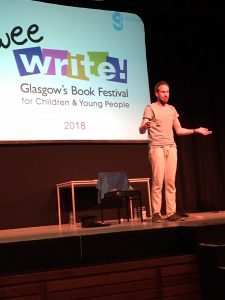
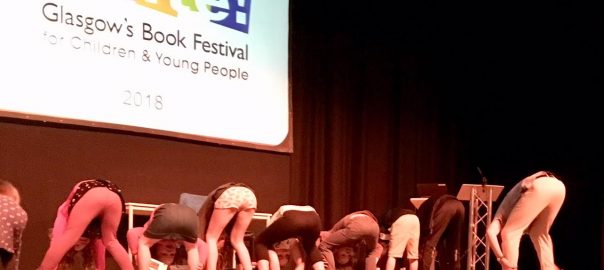
Finally my moment arrives and I’m ushered into in the 400 seat Mitchell Theatre.  This venue has seen some seriously big names play on it.  I am doing a demanding double bill of “The Twits” and “The Hundred Mile an Hour Dog”.  The presentations go down well.  The audience seem to enjoy “The Twits” but it’s trickier to tell with Streaker.  It’s quite quiet in the auditorium for both stories as the crowd give very little away.  I worry that my brand of chaos seems to be getting lost in the vast auditorium and that I’m not getting up my usual momentum but there are still queues at the end of each session for photographs and lots of positive feedback.

Then as quickly as it all began my participation in the festival is over.  By 4.30pm I’m back on the street and after another couple of hours in Glasgow city centre its back to the bus stop and off to the airport only to find my flight has been delayed (it’s now nearly midnight and I’m still not quite home).  There are signs all over the city reminding its inhabitants that “People make Glasgow” well I will certainly remember the people who made my Wee Write! Festival so memorable and I am very grateful to the organisers for their hospitality and the audiences for supporting my work.  Its been a crazy day but it was a pleasure to have been part of a very special event in a very special city.