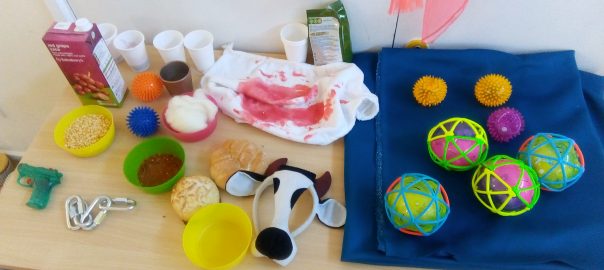
This is the makings of a sensory story. Using the things you see I told the story of the Prophet Yusuf (some may know it as the story of Joseph) in a 20 minute Religious Education session. In each session I offered a simple narrative, stopping periodically to share these items through touch, sight, hearing, smell and taste and hopefully enhance the participants experience of the story. Let me talk you around the table.
1. Spices (green bowl) – at the beginning of the session I placed the story and set the scene by playing some Arabic music and encouraging the participants to smell some Arabian spices to get a sense of a Middle Eastern market.
2. Wool (pink bowl) – Yacub and his sons are shepherds. I was keen for the participants to have the opportunity to touch sheep’s wool.
3. Stretchy sheet and plastic flashing balls – Yusuf has a dream in which the sun, the moon and eleven stars all bowed down to him. I got some stretchy sparkly material (the sky) and encouraged the participants to gently bounce the flashing balls (the sun, moon and stars) on the cloth.
4. Water pistol – Yusuf’s brothers throw home into a well – it was enough of an excuse to spray the participants with water!
5. Cloth – the brothers then return home with Yusuf’s bloodied shirt and tell their father his favourite son is dead. In reality this is an old towel with red paint on it. It looks and feels pretty disgusting and got some great reactions from the participants.
6. Chunky chain – In time Yusuf is thrown into prison. The chunky chain is heavy, cold and makes a great noise when you rattle it.
7. Grape juice – in prison the cupholder dreams of giving Pharoah wine. As this session was in a school we offered the participants grape juice.
8. Bread – in prison the baker dreams that birds steal bread from his basket. These loaves had a wonderful aroma and contrasting textures.
9. Cow mask – Pharoah dreams of 7 fats cows being eaten by 7 thin ones. This mask has a sound effect embedded in the nose.
10. Split peas (yellow bowl) – Yusuf’s brothers come to Egypt to ask for food. The participants could run their fingers through the split peas (grain).
I hoped that this range of objects offered a real range of sensory experiences. Touch and sight are the easiest to fulfill with taste and smell in my opinion the hardest. I’m a little bit nervous about allergies and if I was leading the session alone the logistics of offering a taste of grape juice would bring the story to a grinding halt.
Sensory storytelling is perhaps my biggest challenge. They require a completely different discipline to my regular repertoire. I am definitely on learning curve and although I’m becoming more confident sadly I get very few opportunities to lead these sessions. This is a shame because the inclusive and accessible nature of sensory storytelling would mean they could work with anybody. I devised this story with a mixed group of young people in mind; some with visual impairment, some with hearing loss, some with physical and learning needs and I was really encouraged by the way they responded to the sessions. I hope that they begin to appear more regularly in my schedule in museums, libraries and primary schools.
 I’d like to start this postcard by apologising for its tardiness; I’ve been meaning to write this down for a while but
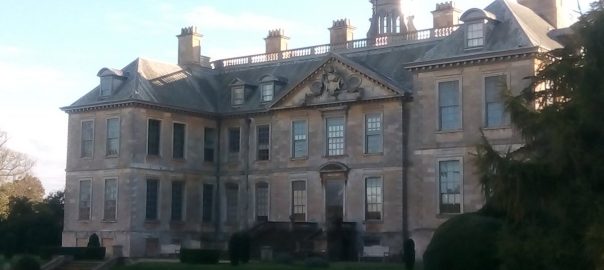
 Earlier this year I was contacted by Ann again. Now living in Lincolnshire, Ann was working with the Federation of Children’s Book Groups in Lincolnshire, helping to set up a literature festival in Grantham at the National Trust’s Belton House and she’d got in touch to see if I’d like to be involved. Well I don’t mind admitting that this was an extremely exciting invitation. Not just because it would be a chance to catch up with Ann again but because 10 years ago my father had suggested I do something at a National Trust property; a conversation which asi remember it has become a catalyst for telling my first and all subsequent stories. A decade on this would be a chance to fulfill a long held ambition.
 The day was brilliant. Belton House in the early autumn sunshine is a spectacular setting and it was lovely to catch up with Ann and Chris Routh (chair of the FCBG who I worked with in West Berks). I had really good turnouts for
 The next day I was back in the Midlands to be a part of Loogabarooga 2018 (apparently that’s how Loughborough is pronounced in Australia!). Engineering work meant that it was quicker and cheaper to get a bus. Unfortunately the bus stop was outside the university leaving me a fair hike into town admittedly in glorious sunshine. Loughborough is the home of Ladybird Books and the festival celebrates all things illustration and cartoons so Dennis and the Chamber of Mischief was a natural fit for presentation in their Festival Den although this turned out to be a rather an intimate marquee for my rather powerful water pistols!
 The wonderful thing about festivals is that you meet all kinds of people. At Belton I chatted all things babies and houses with illustrator Frank Preston Gannon and at Loogabarooga I was scheduled between Beano cartoonist Laura Howell and author Claire Elsom. It’s very easy to feel inspired when get to rub shoulders with heavyweight talent.



 In March 1951 Dennis the Menace and his dog Gnasher made their first appearance in The Beano. Dennis, the trouble making school boy who terrorised his arch enemy Walter, proved popular with readers and soon became the Beano’s most famous character and their longest running comic strip. As the world has changed so too has Dennis and as he approaches 70 years old Dennis, with his trademark black spiky hair and red and black striped jumper, is now more than a comic book hero, he’s a British institution.