Tag Archives: storytelling

Guiding my own fate through diversification

Hackney MuseumDo you have any phobias or superstitions?  I don’t like unprotected heights, the thought of planes crashing with me on them or pigeons flying at my head.  I enjoy stories about the supernatural as much as anybody and I also believe in fate.

Fate is an odd concept.  In Homer’s Odyssey, Tiresias makes a prophecy about Odysseus’ fate, saying how his life will turn out.  Odysseus tries to fight his fate but in the end it comes true.  I am no Greek hero but when I was at school I took comfort from the fact that however stressful the homework seemed I’d get it done.  Since leaving education I have left some key decisions to fate and however stressful things have got, happily (so far), something has always come along.  Immediately I hear you screaming at your screen that this isn’t truly fate or fortune but like Odysseus me fighting fate to make my own luck.  The homework was done because I did it, the work flows because I make it.  Some readers may find this admission reckless or even arrogant.  I don’t know but what I suppose it does show is that I believe I am fated to be successful.

That is a positive statement – I believe I am fated to be successful.  I think that a lot of people who take risks and make sacrifices to pursue what others would see as living precariously, deep down, would share this thought.  The problem with my statement is it comes with a caveat: I believe I am fated to be successful at something.  Whether that is the thing I am currently pursuing is a bigger more difficult question.  I have often thought that I am one of the best in the country at what I do because for many people (including myself at times) what I do is difficult to pin down.

The story so far: as a child bullying leads to a chronic lack of self confidence and a drama club.  In drama I find an identity.  At college I make like minded contacts and we put on plays together.  I am disillusioned by education but encouraged to audition for drama school.  Three years later I graduate without agent representation and for the next five years a career as an actor blossoms.  Five years on I have an agent but am disillusioned again and fall into office work.  A year later I am encouraged to write a one man show which begins to snowball into other presentations.  Four years later the label of a storyteller sticks and a world of museums, libraries and schools opens up.  Four years later I write a blog about fate and diversification.
The Elephants ChildYou see there are elements of my story where I fall into things (in my view fate) but when I read it back its clear that being proactive and willing to diversify has kept me relevant.  From enthusiastic amateur who put on his own shows, to professional actor with a string of credits, to workshop facilitator and storyteller carving a reputation, my work has moved forward; a metamorphosis brought on by needs and circumstances.  By developing my skill set and taking side steps when the path forward was blocked means that 24 years after I first encountered drama, creative arts is still central to who I am, what I believe and what I do.

This week the seeds of the next chapter of my journey through life have been sown with a TEFL (teaching English as a foreign language) qualification which I hope to be able to use in the UK within storytelling to enhance children’s learning of English.  How and where I’ll do that is a question for another day.

Stevie Wonder sang about superstition saying that the writing was on the wall.  Maybe he’s right and all this is just episode of my life.  I will always be my biggest critic because I qualify success as perfection and respect and perhaps diversifying means I am less niche and more “yes” man but my niche is also carved from determination and resilience.  Maybe I am fated to sit in an office, no one can truly say what the future holds for us.  For now, Stevie Wonder’s graffiti artist can keep his spray cans in his bag and stay away my house.

1000 up for Time the Ostler (and counting)!

I also offer a “Highwayman” workshop!!

A year ago I made a video inspired by “The Highwayman” in which Tim the Ostler confesses what he did to betray Bess and The Highwayman.  Twelve months on its just had its thousandth viewing.  Yah!

I’m thrilled that so many people have watched it (admittedly it’s not millions of bods but I’m not a pop star or a puppy/baby doing anything cute).  As with most things though the devil is in the detail – How many people watched the video because they were looking for it?  How is this short clip being used?  Do people like it?  I wish I could tell you but the truth is I have no idea.  For all the views, my video has received very little feedback.

It’d be lovely to know that this little film is being used as a study tool rather than just accidentally clicked on.  So do me a favour, if you’ve watch and enjoy any of my Youtube videos don’t forget to leave a comment or click “like”.

I also offer a “Highwayman” workshop!!

Telling a story in Aisle Four and creating the environment for storytelling.

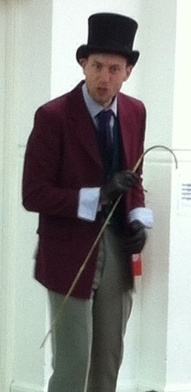
The Victorian School MasterI graduated from Rose Bruford College in 2002 and that Christmas I took a job with a small scale touring pantomime company.  I was young and fresh and keen to begin building my career.  Well some would say that at 6ft 4ins I wasn’t the most obvious choice for Rumpelstiltskin but I was still very excited to be involved particularly when I learned that we would be doing a public performance in a supermarket.

Well when we arrived at the venue we realised the story wasn’t to be performed in the store but in the staff canteen to the children of the workers.  The other problem (as it turned out) was that store was open and the canteen in operation.  During a 90 minute show we battled deafening tanoy announcements, staff and parents talking over the story and even workers crossing the performance area.  It was at about this point I realised how hard a life in the arts was potentially going to be.

Nearly 12 years on from this experience I am now more than accustomed to inviting family and friends to watch me present stories in strange places.  I have told stories in pub beer gardens, public squares, parks and even a beach hut.  In my view, the same golden rule for success applies whatever the venue: if you aren’t the most interesting thing in the room then you are doomed.

If the environment isn’t right then it won’t matter about the content or delivery, the presentation will not be as effective as it might otherwise have been.  This isn’t always as straightforward as it may seem.  My work is something between pure storytelling and theatricality.  You might think that in suggesting characters using props, hats and wigs even my most wordy stories would be the most interesting thing in any room.  However, I was once telling Private Peaceful in a library when my young audience were completely distracted as a cat crossed the window ledge behind me!

I accept that there are certain things which are beyond the control of the event organiser (unless its your cat) but there are invariably steps that can be taken to ensure that everybody has the best possible opportunity to enjoy the story.

The War GameIs the story suitable and do the group know enough about the subject matter?  Preparing for an event (determining a story’s suitability, talking to a group about the content/background) will maximise engagement and minimise disruptive behaviour.  In telling “The War Game” I have noticed that audience members with some knowledge of The Great War take more from the experience.

Can the group engage comfortably and safely with the presentation?  It’s easy to say “they won’t mind” but in setting up a space the patience of an audience should be considered.  This could mean laying out mats in a public library or ensuring that all the equipment in the school hall is away before we start our session so that there is extra space and no distractions but it can also relate to numbers.  As a performer I don’t mind a large audience but when size compromises or dilutes the quality of the presentation there is a problem.  Sadly, in austere times and as many schools grow to three or even four form entry, I am in regular correspondence with organisations who want to offer experiences to children but are having to make tough decisions based on numbers.

How is the experience going to be valued by those taking part?  Young people with little experience of live presentations will watch adults and how they interact with a presentation.  This means that very young children can sometimes be engrossed by stories because they are taking cues from their parents and elder siblings.  Unfortunately things can also go the other way.  I was once telling Hansel and Gretel to a group.  At the beginning of the session I enlisted a teacher to assist me in handing out sweets and pebbles to the children so that they could help tell the story.  Rather than placing the two items in front of each child the teacher chose to throw them to (or sometimes at) the children.  A higher than usual proportion of that group spent the first few minutes of the story throwing their props because, in my opinion, they hadn’t been shown how to respect that element of the story.    In my experience there is a definite difference in behaviour and attitude when a teacher or parent respects my work and gives a story their full attention (that means not marking books or checking a mobile phone).  Its even better when my stories feeds directly into a project/topic and has a lasting legacy.

Odysseus and Poseidon

How is the experience going to be valued by the rest of the community?  In some environments everybody must take responsibility for the experience.  In school halls, museums and public libraries my stories have been interrupted by all manner of people who failed to recognise that their activity meant they had become the most interesting thing in the room.  In my view (and this is only my view) we all have a responsibility to children and their literacy and whilst disruptions in a public setting are often unavoidable in some settings they are inexcusable.

I’m sure that I’ll have other supermarket experiences over the course of my storytelling life but my first is indelibly etched on my mind.  For now my work is about collaboration.  It is about effectively communicating with organisers what I do and how I do it ahead of the event and then it is about working in partnership to ensure that every session is memorable for the right reasons.

Is it pink for a girl when storytelling?

Miss TrunchbullDanielle Gibbons, Libby Stout, Corina Schroder, Ellie Stewart, Gemma Bonner, Lucy Bronze, Rebecca Easton, Nina Pedersen, Martha Harris, Amanda Da Costa, Fara Williams, Katrin Omarsdottir, Louise Fors, Nicole Rolser, Katie Zelem, Gemma Davison, Lucy Staniforth, Natasha Dowie and Kate Longhurst.

You might well ask who these people are.  This is the Liverpool Ladies football team who won the 2014 WSL championship.  A tremendous achievement of which they should all be rightly proud but I doubt many people will be naming their children after any of them just yet.  In my lifetime it would be fair to say that women’s football has always been overshadowed by the men’s game.  Gender stereotypes and ignorance may also be at least in part to blame.

Why am I telling you this?  Well as I present “The War Game” I have been thinking a lot about gender and how audiences respond to my stories.  In “The War Game” I have opted to finish with a moment’s silence to commemorate those who have lost their lives in war.  This is signalled by a whistle and ended with three sharp whistles (like you’d hear at the end of a football match).  On one occasion the silence was broken when a female member of staff quite reasonably encouraged the audience to clap.  I (foolishly) suggested that perhaps girls don’t understand football.  Then, in a question and answer session, when a young man asked why women didn’t fight The Great War.  Rather than tell the young man all the positive things that women did do during the war I simply told him they weren’t allowed to by the British Army.  Twice I staggered over stereotypes and did nothing to dispel them.  Hopefully I can redress this in the remainder of this blog.

Private Peaceful visits WandsworthWomen are an important part of my life.  Without the love and support of my mother and my wife I genuinely hate to think where I’d be.  I’d also be nowhere without the many significant women in my work.  In a recent blog I discussed the attributes of heroes, focussing on Odysseus and Beowulf but in that blog I also talked about Scheherazade who in “1001 Nights” used all her courage and wit to change the heart of Shahryar and in doing so saved the lives of the women of her land.  Heroines do not always trip off the tongue in the way heroes do.  Perhaps this is because in many stories women act quietly support their men who then take the glory (in “Dracula” Mina Harker is as at least as important in the hunt for the vampire as any of the male characters but doesn’t necessarily get the credit).  In the past I have spoken of my admiration for Odysseus’ wife Penelope who waits for her husband to return from Troy for twenty years.  Whilst Odysseus the man could be said to act impulsively, Penelope the woman is steadfast in her loyalty.

It isn’t just in stories that women quietly demonstrate heroism.  Whilst working with Hackney and Waltham Forest museums I learned about the role of women during The Great War.  The war wasn’t easy for anyone and the men who fought were husbands, brothers, fathers to the women they left behind.  Still it was those women who kept Britain going during the war, some of whom contributed directly to the war effort in transport and munitions factories (girls who worked in munitions were known as canaries because the chemicals turned their hair and skin canary yellow!).  This greater responsibility empowered the Suffragette movement and led to further emancipation.

Now ahead of launching “The War Game”, I wasn’t sure that girls would like the story.  That a story which revolves around a football match wouldn’t capture their imaginations.  Sure enough as I tell the story I see hard-to-reach little boy’s eyes light up at the mention of football because football is their thing.  Do the girls switch off?  Well of course not – it was silly of me to think they ever would – they stick with the story to the end.  To understand why allow me to share a generalisation from the question and answer sessions that follow each presentation.

Me:  What is the story about?

Boy’s answer: Football

Girl’s answer: Friendship

Cracking Clues at Chelsea LibraryThe point of telling “The War Game” is to commemorate an event of global significance and make it more accessible to young audiences but in doing so it is interesting to see how we relate to stories.  The above example is of course a gross and controversial generalisation as many girls also say football but then I could just as easily have written a blog considering why boys like fairy tales.  The fact is that many of the stories I tell could be construed as being for boys or for girls but whether they be about footballers or princesses, a story’s themes are what will appeal to us and make them winners.

It is wrong to assume things on the basis of gender.  Liverpool ladies, Scheherazade, Penelope and the women of Britain who contributed so stoically to the war effort are all great examples of how many stereotypes about girls are misplaced.  As for stories, we could talk further about gender differences or we could just accept that part of the joy of stories is subjectivity and where one person is enthralled by the football match another understands the humanity in a simple act.  Today, I’m happy to put the lid back on a can of worms and leave it at that.

PS (31/12/14) follow this link to a TED talk about how gender roles are portrayed in film. https://t.co/DyffkJzrXQ

Non-verbal storytellers

John Kirk is a storyteller and drama facilitator specialising in drama workshops and theatre for young people.

As a storyteller it is not unusual to have people in the audience with a limited understanding of English.  When I presented Private Peaceful I devised a hand out to accompany the session so that learners could follow up the story afterwards.  A hand out is all well and good but what if your audience can’t read?  Well, most of my pieces incorporate a strong visual element so that even if the story is too much for the individual there is something for them to engage with.

I recently visited a school for children with learning difficulties.  I presented Dracula and The Unlucky Mummy to the students (I’d chosen the pieces realising that they are perhaps my most visual and silly) before running a short training session with staff from local schools.  We began the session by articulating what we saw as the challenges in our own working environments to imaginative writing.  It was in this forum that staff spoke about the challenge of working with individuals who for one reason or another, are non-verbal.  In the past I have used this blog to reiterate my belief that we are all storytellers and to discuss Stanislavski’s Subtext but in this piece I’d like to share some ideas about enthusing and empowering non verbal groups with storytelling.  Many of these ideas are inspired by people I have met and worked with over the years and from observing other brilliant professionals at work.  I hope that you will find them as useful as I do.

John Kirk is a storyteller and drama facilitator specialising in drama workshops and theatre for young people.

Encouraging Free Choice  If the objective of the session is to get your young people to be imaginative then you may have to empower them with the idea of a free choice first.  I can express my free choice orally when I tell stories but this isn’t possible for everybody.  One idea for encouraging non verbal free choice is through multiple choice activities in which questions and instructions stimulate the young person to narrative decisions.  Examples of possible instructions might be “pick up the object you think is found in the room”, “move to where you think we should set the story” or “point to the name of the character”.  This can be a slow process but through simple instructions and reinforcing the rules of your activity through repetition you will soon empower young people to tell their own stories.

Storyboarding  Another idea for encouraging free choice in storytelling might be for the young person to draw a cartoon strip story.  Using a simple template of boxes or arrows to indicate the direction of the narrative a story can be structured by the young person.  Such storyboards could then be annotated with assistance.

Using Sound and Movement  Perhaps you aren’t looking at the narrative but are exploring the atmosphere and tone of a story.  This could be done through sounds and working in a group as an “orchestra”.  Offering an idea as a starting point such as “the city” or “the seaside” encourage the group to respond through simple sounds or body percussion.  What does volume or pace say about mood?  This is as much a listening exercise as a sound making exercise and will require your group to work with sensitivity toward the contributions of other people.  Continuing on a musical theme you might encourage the group to express their story, mood or a character through movement or dance.

John Kirk is a storyteller and drama facilitator specialising in drama workshops and theatre for young people.

Using Props and Objects  It may be possible for the participants to use objects to tell their story using objects or props (placing items as the story is told and moving and animating them according to narrative).  Whilst this is a structured activity it would be encouraging an almost child like play.

As a drama workshop facilitator I have used these activities with varying degrees of success when working in Primary and SEN environments and when devising in Secondary and Sixth Form environments.  I think that these ideas appeal to young people because they are easy to access and own and they are fun.  These games encourage a group to risk being wrong without the consequence of failure.  In terms of the non verbal storyteller, used correctly they play to particular strengths rather than underlining weaknesses.

The success of these ideas inevitably depends upon the level of ability within a group and will require patience (your group may not get them the first time) and a variety of accessible stimulations (props and objects which appeal to the different senses, music or imagery).  In exploring and nurturing what an individual can do we hopefully create an environment in which they are able to tell more and more sophisticated and interesting stories.


April to June: What they said..

John Kirk is a storyteller and drama facilitator specialising in drama workshops and theatre for young people.

This year I have seen the amount of work I do swell.  More than ever before I am being asked to travel across the country to work with young people and adults on all manner of projects.  As the school year ends I thought I would share a few of the comments from the past three months.

In March Private Peaceful was perhaps the largest single project I have ever undertaken and the feedback from it was phenomenal but rather than share what you can see on a dedicated page I have picked out testimonials from other workshops that I offer.

“Children from all ages and classes were engaged and buzzing from their work with you.”

Literacy Coordinator, Watling Lower School, Dunstable (Jack and the Beanstalk Workshop and Storytelling Day, May 2014)

John Kirk is a storyteller and drama facilitator specialising in drama workshops and theatre for young people.“The staff said you were the best story teller they had ever experienced.”

Inclusive Coordinator, Sauncey Wood Primary School, Harpenden (The Unlucky Mummy Myths and Legends Day, May 2014)

and perhaps my favourite…

“‘I really get it now. Shakespeare was my worst thing before but now I understand that it’s meant to be fun and dramatic.'”

Year Eight, Shenfield High School, Shenfield (Shakespeare’s The Tempest Workshop Sessions, May 2014)

John Kirk is a storyteller and drama facilitator specialising in drama workshops and theatre for young people.

I’d be lying if I said that everybody adored my style of working and that there haven’t been difficult days along the way but the comments I choose to share here are my mandate for carrying on working into 2014-15.  They demonstrate my value and the difference my storytelling and workshop sessions make to young people and educational professionals.

I am incredibly lucky to have worked with some fantastic people during the current academic year (City Read London, Shrewsbury Children’s Bookfest, Guilden Morden Primary School and Hackney Museum) and much of my success is because of the wonderful, supportive people who give me such wonderful opportunities.

The Summer Reading Challenge 2014 has already kicked off what’s looking like a very exciting six months.  Who knows?  Maybe I’ll be visiting you.

See also feedback from Jan-March

A Guide to Guidance: how can you be sure a story is suitable?

John Kirk is a storyteller and drama facilitator specialising in drama workshops and theatre for young people.Whenever I take a booking or ask for feedback on my work, suitability is mentioned.  For each of my stories I have suggested the age or level the audience should be at in order to watch it.  You did read that correctly, I said suggested.

Most recently I have been presenting “Private Peaceful” as part of the Cityread 2014.  My brief was to work with young readers in public spaces (lots of libraries!).  Michael Morpurgo’s story is quite rightly, not pitched at younger young readers but I know from experience of working in public spaces to expect very young audiences.  I therefore devised a piece which could be accessible to an audience of young people aged 7 plus.  This was challenging as I did not want to compromise the language or the tone of the original in my work.  In my interpretation I remove elements of the story which are too disturbing for a young audience or too difficult to do justice in a 40 minute presentation (the shooting of Bertha, Molly and the baby).  Similarly, I say that my version of “A Christmas Carol” can be enjoyed by audiences of young people aged 4 plus.  I don’t deviate from Dickens’ story or his language and in places my ghost story can be scary but I include elements of slapstick, pantomime and colourful, comic characters to entertain the very youngest audience members.

John Kirk is a storyteller and drama facilitator specialising in drama workshops and theatre for young people.The truth is that when I say a piece is suitable for a particular age or level I am making a broad statement.  If I am liaising with a school directly it is much easier to advise them on a story to choose for their children.  Here my statement on suitability is definitely “this story is suitable for a person of the stated age or level”.  When I work In public environments I have less control over who will be watching.  I can put a statement of suitability on my literature or speak to the audience briefly before the presentation begins but my statement is more ambiguous, “a person of this age or level can access this story in some way”.

Perhaps it shouldn’t be like this but in the end I don’t know the audience who will watch my work.  When I work in schools, a child who is particularly sensitive will respond to my work differently compared to one who is bomb proof.  During the school holidays a parent will not be able to leave one child in order to monitor their sibling so I often present stories I deem inappropriate to very young children.  Saying this, I have had two year olds howling with laughter at Dracula because of my presentation style and teenagers who have disrupted my stories because they weren’t prepared to engage with my work.

John Kirk is a storyteller and drama facilitator specialising in drama workshops and theatre for young people.There are risks when booking or attending stories for children but many pitfalls can be avoided with insight into the work.  Just because it says its suitable for a seven year old doesn’t mean its not Michael Morpurgo.  Just because it says its suitable for four year olds doesn’t mean that its not Charles Dickens.  A statement of suitability is to say you can rather than you should watch.  It is for adults to exercise their discretion in choosing an appropriate story for their audience.

Mammoths to Medals (Revisited)

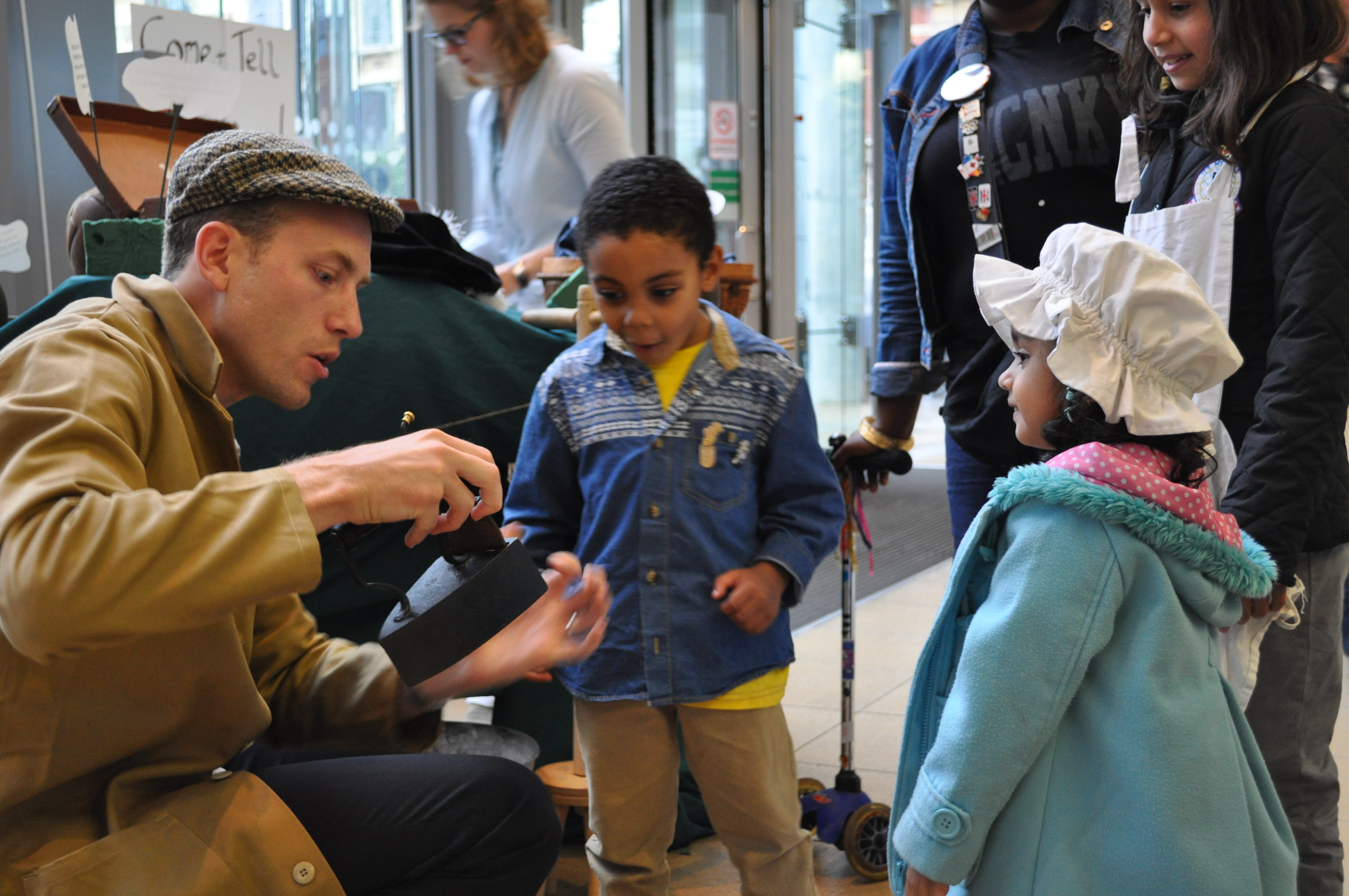
John Kirk specialises in drama workshops and theatre for young people.In 2013 I moved from the London borough of Hackney to the London Borough of Waltham Forest.  I may have only moved seven short miles but after six happy years in one of the most vibrant boroughs in Britain it was a massive wrench.  Whilst living in Hackney I had some of the most creatively fulfilling years of my life as I built strong working relationships with organisations including The Hackney Museum.  Hackney Museum, based in Hackney Central Library is an amazing community resource staffed by knowledgeable and creative people with a passion for sharing local history.  I may be biased but I think its one of the best museums in the country.

Working in heritage environments is something I really enjoy.  My earliest solo storytelling pieces were based around British history (including a Victorian Classroom session for The Bruce Castle Museum) and this summer I will be helping to lead a creative exploration of the Guilden Morden fire.

Anyway, as I sat watching Lizzy Yarnold, Jade Etherington and Team GB at the Sochi Winter and Paralympic Games I couldn’t help but think back to my time working with Hackney Museum.  It was in the build up to Summer Olympic and Paralympics (London 2012) that I collaborated with Hackney Museum on Mammoths to Medals,a presentation which sought to tell the incredible story of Hackney’s history as part of the Museum’s Mapping the Change project.  In just 30 minutes we explored 200,000 years of Hackney’s history highlighting the contributions of those people who have called Hackney their home; Anglo Saxon Farmers, Tudor Society, Victorian Industrialists and migrants from across the globe.

In the life of the project I have presented the piece on many occasions at Hackney Museum and in Hackney Primary Schools.  Incorporating games and learning activities into a chronological narrative the piece offer facts about Hackney and but also it questions how we will be remembered.

John Kirk is a storyteller and drama facilitator specialising in drama workshops and theatre for young people.A lot has changed in the two years since we made the piece was documented at Kingsmead Primary School.  Hackney’s demographic and landscape have been slowly morphing for 200,000 years but concerns about how communities will withstand the gentrification of East London mean our legacy is once again scrutinised.

When we look at Hackney’s story it shows us that change doesn’t have to be a bad thing.  It points to how different traditions, cultures and values have shaped an area into a place people want to live and work.   I am incredibly proud of being a part of Hackney’s history and of this piece.  I hope that through watching Mammoths to Medals young people recognise how they can shape their community.

Thankfully I haven’t lost touch with Hackney Museum and hope to be back to run sessions as the country prepares to commemorate The Great War.  For the moment though I am very settled in Waltham Forest and I’m looking forward to the future.

What’s your Story? A Simple Storytelling Game

John Kirk is a storyteller and drama facilitator specialising in drama workshops and theatre for young people.As human beings have evolved we have developed an introspective (thoughtful) nature.  The ways in which we try to answer the bigger questions in our world is fascinating.  We have turned our minds to the sophistication of technology, we seek truth in theology and spiritual enlightenment but we also tell stories (what are fables and parables if they are not attempts to better understand our own nature and environment?).  Whether you are conscious of it or not, you fill your lives with stories and the ability to exchange stories is a big part of being human.  We fill our lives with narrative and take our turn at playing orator and audience.  Some stories we will tell are significant and some less so but I believe that storytelling is about more than art and communication, storytelling helps to define us.

When I work with a group I do so understanding that even the youngest participant has some notion of a story.  I doubt there is anybody in the world who doesn’t have a story to tell or cannot tell a story.  The work that I do concerns articulating that story better and helping participants to understand the mechanics of their narrative.

To demonstrate this I’d like you, the reader to play a game.  This will hopefully show you that a) everybody has a story to tell and b) everybody can tell a story.  Depending where you are reading this you may want to think about it for a little while, write your answer down or even share your answers over a dinner with friends and family.  My exercise is essentially a parlour game that I often use in workshops with young people and adults as an icebreaker but in this context we are using it to encourage open, honest introspective thinking about identity.  Please read the exercise and rather than saying “I have no idea” say “that’s tricky, let me think about that”.  I hope that you feel able to participate in the game and remember: we’re doing this on the internet – nobody is judging you.

John Kirk specialises in drama workshops and theatre for young people.“Think of one thing that most people know about you and one thing that less people know about you.”

Nobody is saying that telling a story is easy but these stories are about you.  You only share as much as is comfortable.  Don’t worry if the answer you have given seems more like a statement at the moment.  If I were in the room with you and you had given me a very short answer I would probe you with further questions.  Let’s pretend I’ve done that and tell me your stories.

Examples:

One thing most people know about me…

Short answer: I am a football nut.

Story:  I was raised on Manchester United before rejecting them for Wimbledon Football Club.  I was there for the sit ins at Selhurst Park when Wimbledon Football Club became Milton Keynes Dons.  Between 2002 and 2006 I visited the 92 football clubs that make up the football league.  Having moved to North London these days I will only turn Match of the Day on if either Arsenal or Manchester United have played.

One thing less people know about me…

Short answer: I have Burmese heritage.

John Kirk specialises in drama workshops and theatre for young people.Story: My Grandmother was born in Kalaw in the 1920s.  During the Second World War she met my Grandfather and once the war was over she left Burma and moved to the North West of England.  Opposition to the ruling military junta meant that until quite recently visitng Burma was out of the question.  In 2013 my Father, Uncle, Brother and I with our respective partners visited Kalaw and the Convent where my Grandmother was educated.

Storytelling is as much about listening and responding as it is about telling a story.  In each of my stories there are points of intrigue and potential common experiences which might draw further stories from the orator (doing the 92, a trip to Burma) or even draw stories from the audience (a love of sport, migration, family holidays etc).  If that’s the case with you don’t deny your audience a good story or a great conversation.

I hope you enjoy this little game and I hope it proves that we all have a story to tell – happy storytelling!

http://youtu.be/Wk_n2ustc4U

A Story? Really? A blog about managing innocence in storytelling

John Kirk is a storyteller and drama facilitator specialising in drama workshops and theatre for young people.As a storyteller I rely upon two presentation models: narrating events and being the character.  My relationship with the audience will change depending how I present the story.  If I am narrating events I inform the audience of our relationship.  I allow them to understand that the story and its events are a fiction and that they are watching a presentation.  I do this by introducing myself, talking about the story and clearly demonstrating different characters.  When I become a character my audience must do much more of the work themselves.

“So what?”, I hear you cry.  Well, when I present a session as a Victorian School Teacher the participants are briefly starring in a drama devised to expose them to the way education might have been in the 19th Century.  If the participants don’t respect the threat of caning then the session is less effective.  Equally, when I present a Detective investigating a crime the participants must be convinced that the scenario is credible.  A lack of investment in the world of the story can be a session’s undoing.

John Kirk specialises in drama workshops and theatre for young people.Cynicism can bedevil creativity as we grow up and the examples above relate to characters and sessions devised for pre-teens but what about when we are very young?  What are the dangers of investing too heavily in stories?  Can there be any harm in believing that you just met the Gruffalo?  I suppose that very much depends on the experience.  For a young child, meeting a creature with terrible tusks, terrible claws and terrible teeth in terrible jaws etc. will either be the best or worst day of their life.

Clearly telling a very young participant that what is happening (or about to happen) isn’t real can impact their experience.  You could go as far as to say that intentionally breaking the illusion robs them of an innocent experience.  There is unquestionable security in the truth and I think it is the storyteller’s responsibility to offer that security through the narrative by ensuring audiences see that the wicked get there just desserts.  If the participant absolutely believes is this more memorable or just confusing?  Is Miss Trunchbull scary if you know its an act or is the Mad Hatter as wonderful if you know its in some way false?  How a situation is managed will hinge on lots of factors including the sensitivity of the participant and the circumstances and legacy of the meeting.

From my point of view it isn’t easy to maintain the reality of being a character rather than a person for an extended period of time.  It can involve a lot of planning with a school or organisation ahead of the day.  Trying to think like a character at all times and allowing everybody to believe you are a character can be exhausting (once I spent an entire day in a Headteacher’s study in role pretending to work at her desk!).  I have however found that the legacy of this approach is huge and the feedback on such sessions is generally very positive.

John Kirk specialises in drama workshops and theatre for young people.“When you came in to work with the children during world book week, they were completely gripped!  The story narrative you came up with to engage the children was phenomenal, the children completely believed the 3 Little Pigs had been eaten!  You stayed in role all day and as a result the children played along too, the quality of writing and language we got from them was fantastic.   I have no doubt in my mind that we would use you again… as we are still talking about it a year later!!” (Teacher, St Wulstans and St Edmunds Primary School, Fleetwood)

I suppose that to some extent the purpose of the story will determine whether the participants are allowed to believe in the character.  After presenting the Victorian Classroom I will appear to participants as myself and discuss their experiences.  This is partly to assure groups that the monstrous school master is imaginary but also so that the group can articulate how my lesson and their lessons compare.

John Kirk is a storyteller and drama facilitator specialising in drama workshops and theatre for young people.The real world can be a hard place and sometimes we grow up too fast.  Its a sad day when a child becomes inhibited by doubt.  I was recently at a school and a little girl took me to one side and asked whether I really was Willy Wonka.  I told her that in life we can choose to believe or we can choose not to believe but that decision was ultimately hers.  She skipped away satisfied with my answer, having just chatted with the world’s greatest chocolate maker!

There are times when I wish I was a little more innocent.  As an adult and a storyteller I have an important role to play in maintaining the innocence of my youngest audiences for as long as possible.